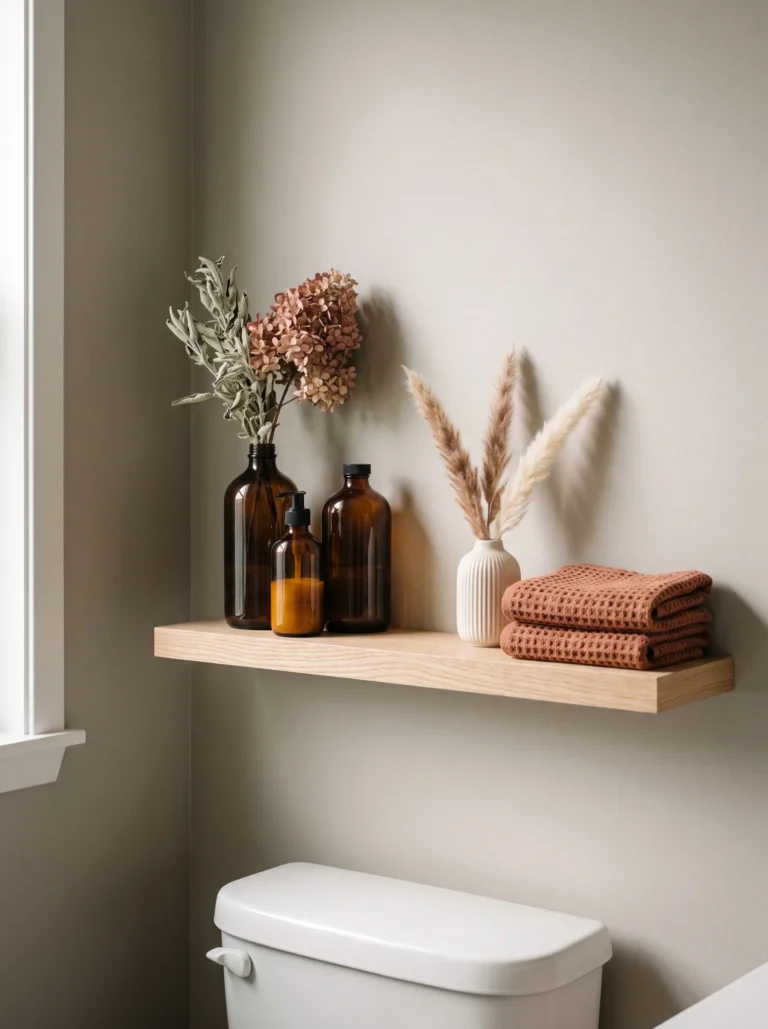

16 Easy Bathroom Closet Organization Ideas for Calm Mornings
Sort by category first, then buy containers. Group everything into five or six groups your household actually thinks in, give each group one shelf or one bin, and label the shelf rather than the box. Containers bought before sorting are the reason most bathroom closets fail twice. The caveat: measure the shelf depth before ordering anything, because a bin two inches too deep is a bin you can’t reach past.
Bathroom closets go wrong in a specific way. Nothing is really lost, it’s just layered, and every search means lifting three things off a fourth to check underneath. The bathroom closet organization ideas below fix that layering problem rather than adding more storage. They’re ordered from free to a small spend, and most take an evening rather than a weekend.
You’ll find options here for deep linen closets, shallow cupboards, under-sink cabinets with plumbing in the way, and rentals where you can’t drill anything.
This post contains affiliate links. If you buy through them, I may earn a small commission at no extra cost to you.
Give every shelf exactly one job

One category per shelf is the rule that makes a closet stay tidy without effort. Mixed shelves force a decision every time you put something away, and decisions are what people skip when they’re late.
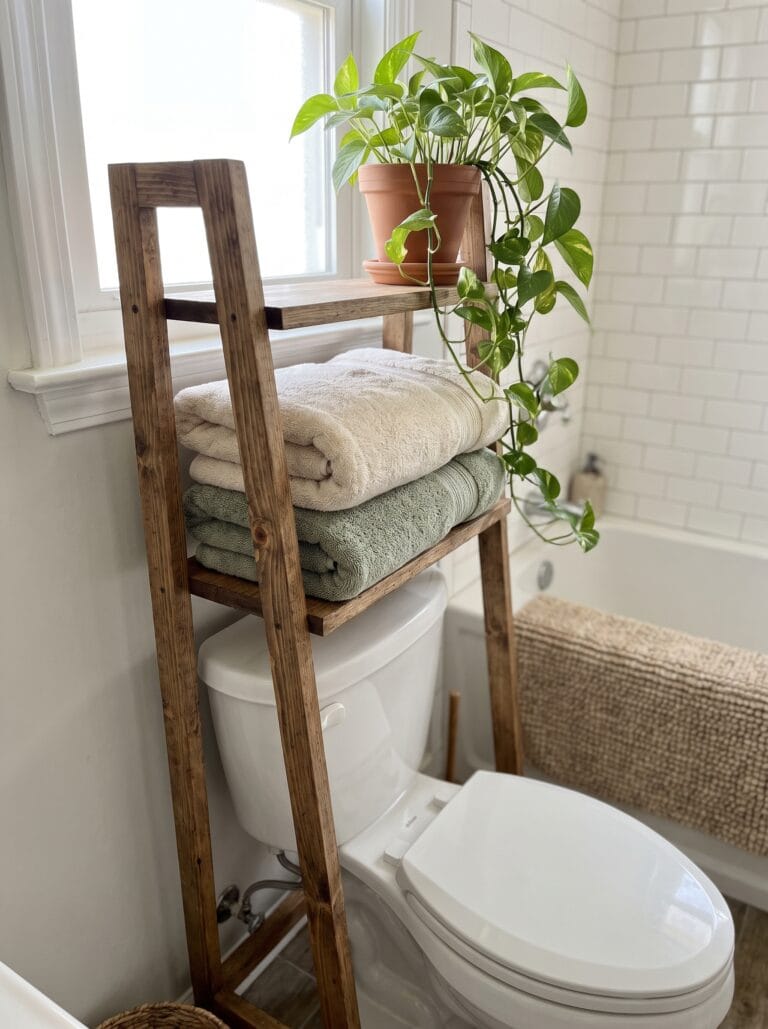
Height should follow frequency, not size. Everyday towels belong between shoulder and hip, where you can reach without looking, and spares go to the shelf you need to stretch for.
Fold everything in a category to one depth so stacks sit square to the shelf edge. Uneven folding is why a neat shelf looks messy within a week even when nothing is actually out of place.
Leave the bottom shelf for anything heavy or bulky. Lifting a full basket down from head height is how closets get abandoned.
Sort by category before you buy a single container

Containers feel like the solution and they’re the last step. Buying bins before sorting means buying the wrong sizes, which is how people end up organizing the same closet twice in a year.
Pull everything out and make groups first: skincare, hair care, dental, first aid, travel sizes, bath and body. Those groups come from your own habits rather than from a catalogue, which is why they survive contact with a real morning.
Clear bathroom closet organizers earn their place over opaque ones here. Seeing the level in a bin is what stops you buying a fourth bottle of something you already have three of. Buy bins with cut-out handles if the shelf is above eye level. Reaching blind into a smooth-sided box is the small friction that makes the system fail.
Roll towels when the shelf is deeper than it is tall

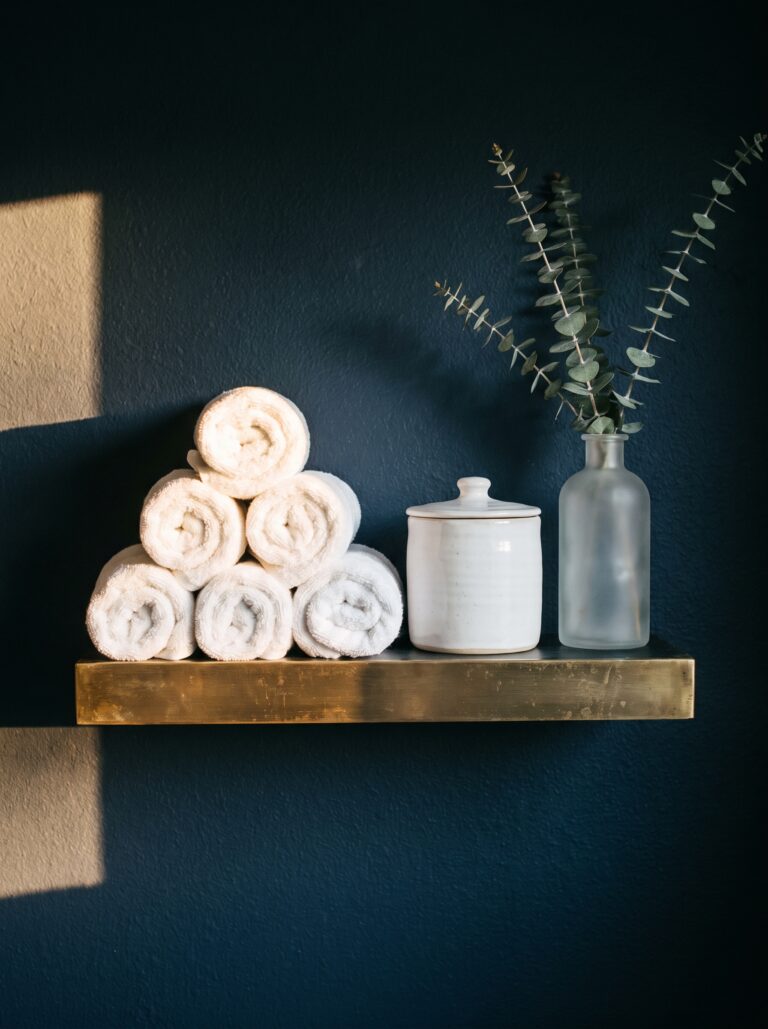
Roll rather than fold whenever a shelf is deep. Folded stacks hide everything behind the front item, while rolls stand in rows you can read at a glance and pull from without disturbing the rest.
Rolling also gets more into the same space. A deep shelf that holds two folded stacks will usually take three rows of rolls, which matters in linen closet organization where depth is the thing you have and height is the thing you don’t.
Add a divider between roll groups so the rows don’t collapse sideways. A single upright board is enough, and it’s the difference between a pyramid that holds and one that slumps by Thursday. Keep one scented thing on the shelf. Dried lavender or a cedar block stops stored linen smelling like the cupboard rather than like laundry.
Use the back of the door for what shelves handle badly

Hair dryers, straighteners, and curling wands defeat shelves. They’re heavy, awkwardly shaped, trail cords, and never stack, so they end up in a tangled pile that takes up a whole shelf for four items.
Vertical pockets solve all four problems at once. An over the door organizer holds each tool separately, lets cords hang rather than knot, and uses a surface that was doing nothing. Check the door clears the frame before ordering. Over-door hooks add about an inch and a half, and on a closet door with a tight rebate that’s enough to stop it closing.
Let tools cool before they go in a pocket. Straighteners hold heat far longer than people expect, and a fabric organizer is the wrong place to find that out.
Shop it on Amazon: madesmart Over-Door Hair Tools Organizer
Put anything deep on a turntable
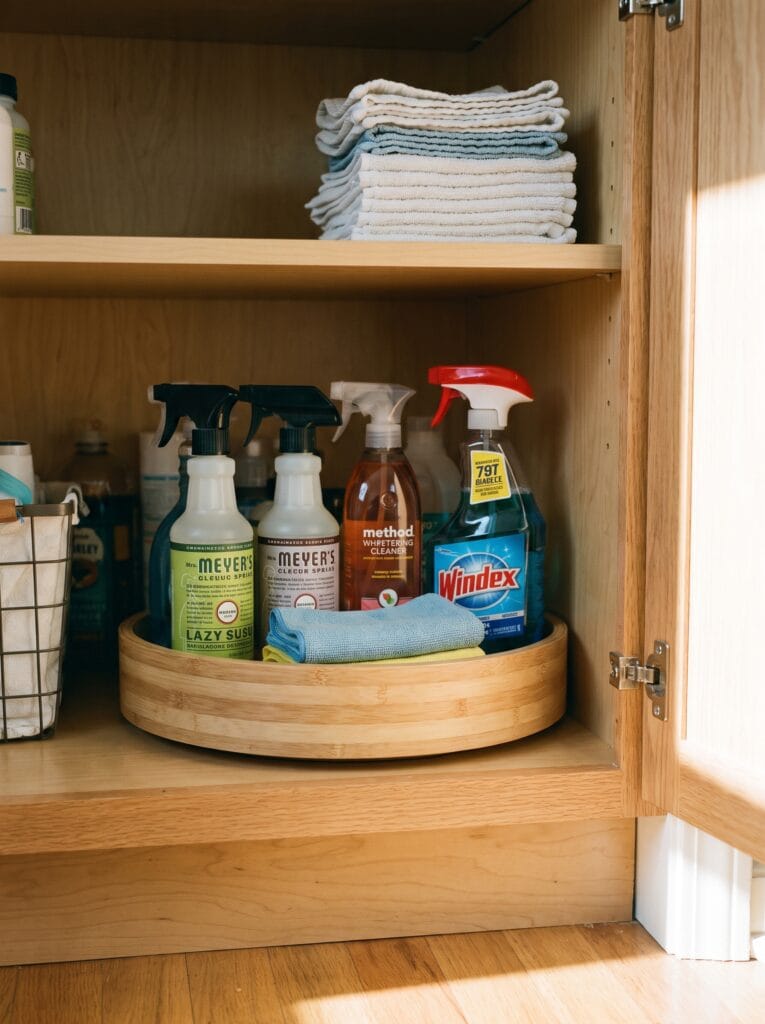
Deep shelves and corner cabinets swallow whatever goes to the back. Anything past your forearm’s reach stops existing, which is why half-empty bottles accumulate in the dark at the back of a cupboard.
A turntable converts depth into rotation. Spinning the shelf brings the back row forward, so bathroom cabinet organization stops depending on how far you can stretch.
Match the diameter to the shelf rather than buying the biggest one. A turntable that catches the cabinet frame as it spins gets used twice and then ignored. Choose one with a raised rim for anything that can tip. Spray bottles are top-heavy, and a flat tray turns one fast spin into a spill.
Build around the plumbing instead of over it

Under-sink cabinets waste more space than any other storage in a house, because a flat shelf can’t cross the trap and most people give up and stack things on the floor of the cupboard.
L-shaped and split-level organizers are designed around that obstacle. One tier sits beside the pipework and one above it, which recovers the vertical space the trap was blocking.
Measure three things before buying: the internal width, the depth from door to back wall, and the height from cabinet floor to the underside of the basin. That last one is the measurement people skip and the one that causes returns. Line the cabinet floor before anything goes in. Slow leaks announce themselves on a liner long before they reach the cabinet base.
Shop it on Amazon: REALINN L-Shaped 2 Tier Under Sink Pull Out Organizer
Label the shelf, not the box

Labels on containers travel with the container, which defeats the point. A label fixed to the shelf edge assigns a permanent address to a category, so the space stays organized even when the box is in the bathroom being refilled.
Shelf labels also work for people who didn’t build the system. Anyone else in the house can put something away correctly without asking, and that’s what keeps a closet tidy past the first fortnight.
Write categories the way your household speaks. “Paper goods” beats “consumables”, and a label nobody understands gets ignored. Hang tags on twine rather than sticking them down if the shelves are painted. Adhesive labels lift paint when the categories eventually change.
Hang spray bottles from a tension rod

Cleaning sprays are the wrong shape for shelves and the right shape for hanging. Their triggers form a natural hook, so a rod turns the empty upper half of an under-sink cabinet into storage without any fixings.
The floor underneath is the real win. Clearing the cabinet base leaves room for a bin or a bucket, which is usually the thing with nowhere to live. Fit the rod at the height of your tallest bottle plus an inch. Set too high it wastes the space above, and too low the bottles foul whatever sits below.
Tension rods need a smooth, solid facing on both sides. Cabinet interiors with a thin back panel will let one end slip under load, so test it with weight before trusting it.
Match the baskets when they’re on show
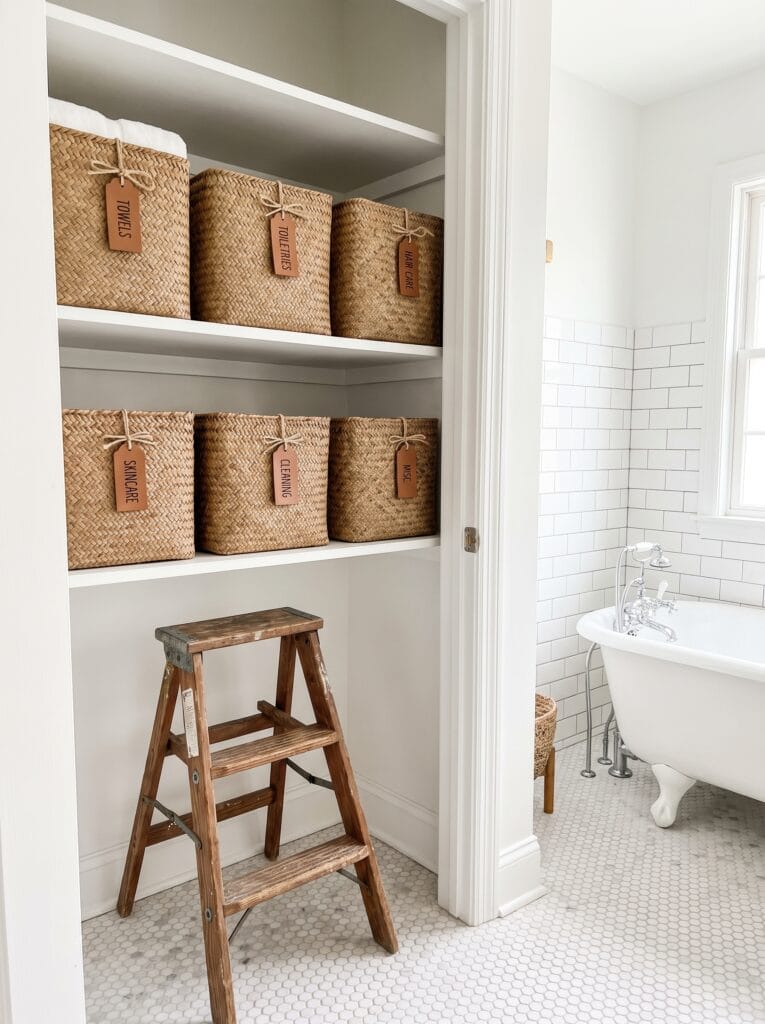
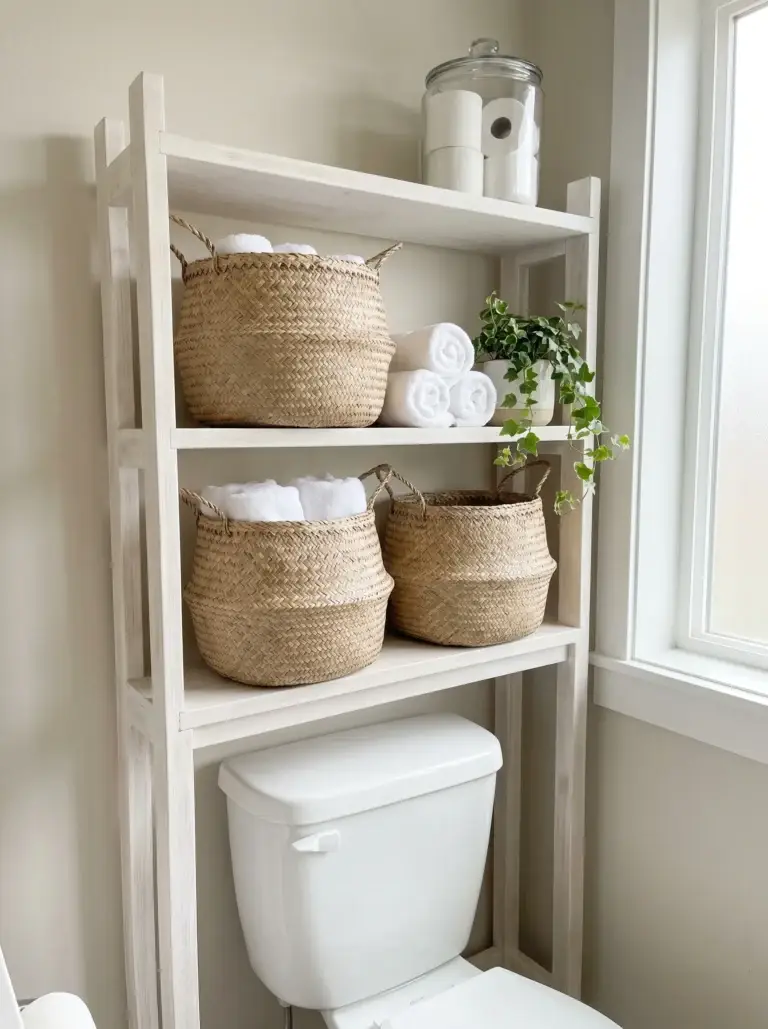
Open shelving turns storage into decoration whether you meant it or not. Six mismatched containers read as clutter, while six identical ones read as a system, and the contents are exactly the same either way.
Natural woven baskets suit bathrooms for a practical reason as well as a visual one. Seagrass and water hyacinth breathe, so slightly damp towels don’t sour the way they do in sealed plastic. Tags on a basket need to be readable from below. High shelves are viewed at an angle, and a label on the top edge disappears from every position you’d actually stand in.
Keep a step stool nearby if you use the highest shelf. Storage you need to fetch a chair for is storage you stop using by February.
Shop it on Amazon: Seagrass Storage Baskets with Labels, Set of 3
Divide drawers by item size, not by category

Drawers fail differently from shelves. Everything slides to the back on opening, small items migrate under big ones, and within a month the drawer is a single mixed layer again.
Compartments sized to the object stop the migration. Hair ties need a deep square, clips need a shallow wide tray, and tubes need a long narrow channel, so dividing by dimension works better than dividing by category. Fill each compartment no more than two thirds. A full compartment spills into its neighbour the first time the drawer is closed hard.
Expandable bamboo dividers suit odd drawer widths better than moulded plastic inserts, which only fit the dimensions they were made for. There’s more on this in our bathroom drawer organization ideas.
Claim the narrow gap beside the vanity

Most bathrooms have a dead strip six to ten inches wide somewhere, beside a vanity, behind a door, or between the bath and the wall. It’s usually treated as too narrow to use.
A slim rolling cart fits exactly that width and rolls out when you need the back of it. Wheels are what make a narrow space usable, because reaching into a deep narrow gap is impossible from the front.
Load it with the things you use in sequence. Everything for one routine on one cart beats the same items spread across three shelves. Check the castors before buying for a tiled floor. Hard plastic wheels catch on grout lines, while rubber ones roll over them.
Step small bottles up so the back row shows

Small bottles are the hardest thing to store, because they’re short enough to vanish behind anything and numerous enough that you never remember what you own.
A tiered riser fixes visibility by lifting each row above the one in front. Every label stays readable from standing height, which means you buy what you’re out of rather than what you think you’re out of.
Risers work better than deep bins for anything you use daily. A bin means lifting and searching, while a riser means looking and reaching. Keep oils and anything light-sensitive off the top tier if the closet gets daylight. Amber glass helps, and shade helps more.
Keep a caddy that leaves the closet

Cleaning supplies are used everywhere except where they’re stored. Anything you have to carry in an armful gets left out on the side afterwards, which is how bathroom surfaces fill up.
A handled caddy makes the whole kit portable in one trip. Everything travels together, gets used, and goes back as a unit rather than as six separate decisions. Decanting into matching bottles is worth the ten minutes. Uniform bottles fit the caddy properly, and a plain label in your own words beats reading brand packaging at arm’s length.
Store gloves and a brush in the same caddy rather than elsewhere. Missing one small item is enough to postpone the job.
Add a rail for anything that shouldn’t be folded
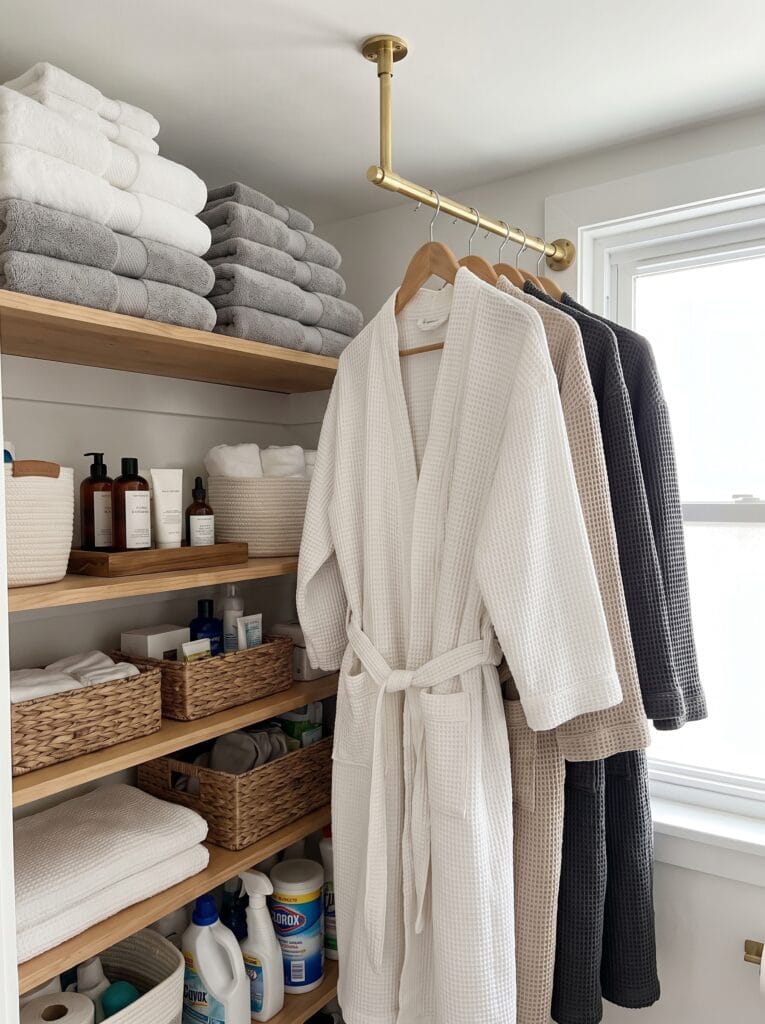
Robes are too bulky to fold and too creased to look right when they are. Hanging them solves both problems and frees the shelf they were eating.
Vertical hanging space usually exists already. The gap under the lowest shelf or above a run of baskets is often 30 or 40 inches of unused height, which is enough for a short rail.
Ceiling-mounted rails work where wall studs don’t cooperate. Fixing into the shelf structure or the ceiling joist is often easier than finding a stud in a shallow closet wall. Allow proper clearance in front. A rail set too close to a shelf edge means fighting the door every time, and robes on hangers need about 20 inches of depth.
Hang adhesive hooks where you can’t drill

Renters get told to use baskets and left there. Hooks are the genuinely useful renter solution, because they create hanging storage on doors and walls without a single hole.
Hang by the cord loop rather than the tool. A hairdryer hung by its handle swings and pulls at the adhesive, while the cord takes the weight straight down. Mesh bags on hooks hold everything that has no natural shape: bath toys, spare sponges, travel bottles. They also drain, which matters for anything that goes in wet.
Press each hook for thirty seconds and then leave it an hour before loading. Almost every adhesive hook failure is a hook that got used too soon. More approaches like this are in our rental-friendly bathroom organization ideas.
Box up anything you touch twice a year

Seasonal and rarely-used items don’t deserve prime shelf space, and leaving them in the open is what pushes daily items to awkward heights.
Lidded boxes protect as well as contain. Spare linens, guest towels, and off-season items collect dust and bathroom humidity over months, and a closed box keeps both off. Put boxes at the extremes, high or low. The middle shelves belong to whatever you reach for without thinking.
Label the front face rather than the lid. Once boxes are stacked, the lid is invisible and the front is the only surface you can read.
Buy in this order, and the closet stays fixed
Most bathroom closets get reorganized twice because the shopping happened before the sorting. Work through the sequence below in order, and you’ll buy fewer things and keep them longer.
- Empty it completely and put everything on the floor. You cannot judge what you own while half of it is stacked behind something else. This step takes twenty minutes and saves the most money.
- Bin what’s expired, dried out, or duplicated. Sunscreen, medication, and anything opened over a year ago goes. Most people lose a third of the volume here, which changes every decision that follows.
- Group what’s left into five or six categories. Use your own words. The number matters more than the names, because more than six groups is a system nobody maintains.
- Measure the shelves, then measure again at the back. Older closets taper, and shelf depth at the front often differs from the back by an inch. Note height between shelves too.
- Assign each category a shelf and write it down before ordering anything. This is the step that tells you what to buy, and it costs nothing to change at this stage.
- Now buy containers, sized to the shelves and the groups. Clear where you need stock visibility, woven where it’s on show, lidded for the twice-a-year things.
- Label the shelves last, once everything has lived there a week. A fortnight of use always moves two categories, and labels applied on day one get peeled off on day fourteen.
The order matters because each step narrows the next. Reverse it, and you’re buying storage for a problem you haven’t defined yet.
Start with the shelf you open every morning
Pick the shelf you reach for before work and fix only that one this week. Empty it, cut what’s dead, and give it a single category.
Momentum comes from a shelf that stays right for a fortnight, not from a closet you emptied onto the floor on a Saturday and half rebuilt by Sunday night. One shelf holding its shape is the proof the system works on your household rather than on a stock photo.
Work outward from there as you have evenings. More storage thinking, from cabinets to over-toilet space, sits in our bathroom decor and storage guides.
Save this pin to keep these bathroom closet organization ideas handy when you’re ready to start.