How to Choose a Bathroom Exhaust Fan: Foolproof CFM Sizing
Size a bathroom exhaust fan at one CFM per square foot of floor, with 50 CFM as the floor for any bathroom. Then pick the quietest bathroom exhaust fan in that range, because anything above 2 sones tends to get switched off and left off. This works for standard eight-foot ceilings. Rooms over 100 square feet, and any bathroom with a jetted tub, need the fixture-count math instead.
Most people buy whichever bathroom exhaust fan has the biggest number on the box. Then the mirror still fogs. Paint above the shower still peels, and the fan roars loudly enough that nobody in the house ever turns it on. That number was never really the problem.
Rated airflow gets measured in a lab, on a short run of smooth, straight duct. Your fan is probably connected to four feet of crushed flexible hose with two tight bends in it. That gap between the lab and your ceiling is where most of the missing air goes, and almost no buying guide bothers to mention it.
Below, you’ll size a fan for your actual room, translate sone ratings into something you can picture, and check the one thing that quietly caps your airflow before you spend a cent.
This post contains affiliate links. If you buy through them, I may earn a small commission at no extra cost to you.
Measure your bathroom before you shop for anything

Multiply length by width. That single number decides almost everything else about the bathroom exhaust fan you need, so measure before you shop.
The Home Ventilating Institute guideline is one CFM for every square foot of floor area. CFM (cubic feet per minute) is simply how much air the fan moves, and it’s the first number to settle when you’re choosing a bathroom exhaust fan. A bathroom measuring 8 by 10 feet is 80 square feet, so it needs at least 80 CFM. Round up to the next model size rather than down.
Never go below 50 CFM, even in a tiny powder room. A 30 square foot half bath still holds steam and odor, and 50 CFM is the practical minimum any manufacturer builds.
Ceilings taller than eight feet change the math, because you’re clearing a bigger volume of air. Multiply square footage by ceiling height, then divide by 7.5 to get the CFM you actually need. A 60 square foot room with a ten foot ceiling works out to 80 CFM, not 60.
The fixture rule takes over past 100 square feet
Large bathrooms don’t scale on floor area, and sizing a bathroom exhaust fan for one means counting differently. Once you pass 100 square feet, count fixtures instead and add them up.
Assign 50 CFM to each toilet, 50 to each shower, 50 to each standard bathtub, and 100 to a jetted tub. A primary bathroom with a toilet, a walk-in shower, and a soaking tub lands at 150 CFM. Add a second toilet in a water closet and you’re at 200.
Jetted tubs earn that bigger number honestly. Moving water throws far more vapor into the room than a still tub does.
Consider two smaller fans rather than one large one in a bathroom with a separate water closet or a closed-off shower. Steam doesn’t travel well around corners or through doorways, so a single powerful unit in the main room leaves the enclosed spaces damp long after you’ve left.
What a sone rating actually sounds like
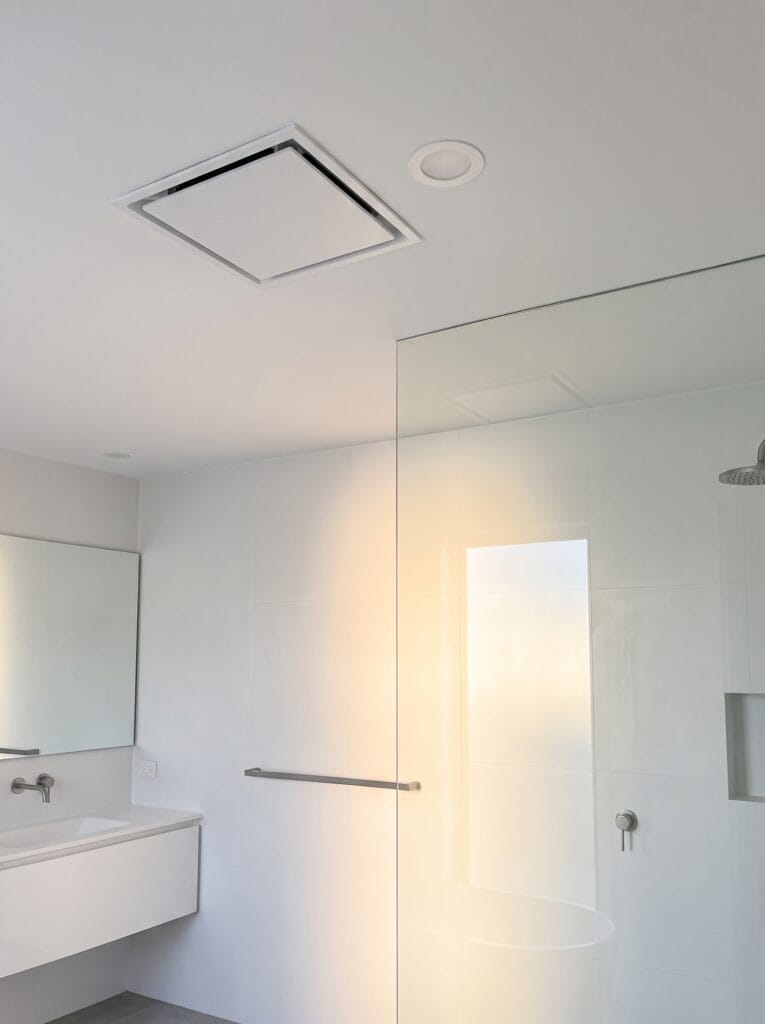
Sones measure loudness the way your ear hears it, not the way a meter does. One sone is roughly a quiet refrigerator humming in the next room.
Here’s the scale that matters. Builder-grade fans run 3 to 4 sones, which is clearly audible and mildly annoying. Quality fans sit between 0.3 and 1.5 sones. Premium units drop to 0.3, quiet enough that people genuinely forget the fan is running.
Below 1.0 sone is the right target for most homes. The reason is behavioral rather than technical: a noisy fan is a fan nobody runs, and a fan nobody runs moves zero air no matter how good its CFM rating looks on paper.
Noise and airflow aren’t opposites either, which surprises people. A larger, slower impeller moves more air at a lower sone rating than a small one spinning hard, so the quiet models are often the higher performers rather than the weaker ones.
Sones don’t scale like decibels either. Two sones is twice as loud as one sone, which makes the number unusually easy to reason about once you know the anchor. The Panasonic WhisperCeiling DC is the reference point most contractors use here, because a single unit covers 50, 80, or 110 CFM through a switch on the housing and still runs at 0.3 sones.
Shop it on Amazon: Panasonic FV-0511VQ1 WhisperCeiling DC Ventilation Fan
Your duct decides how much air the fan really moves
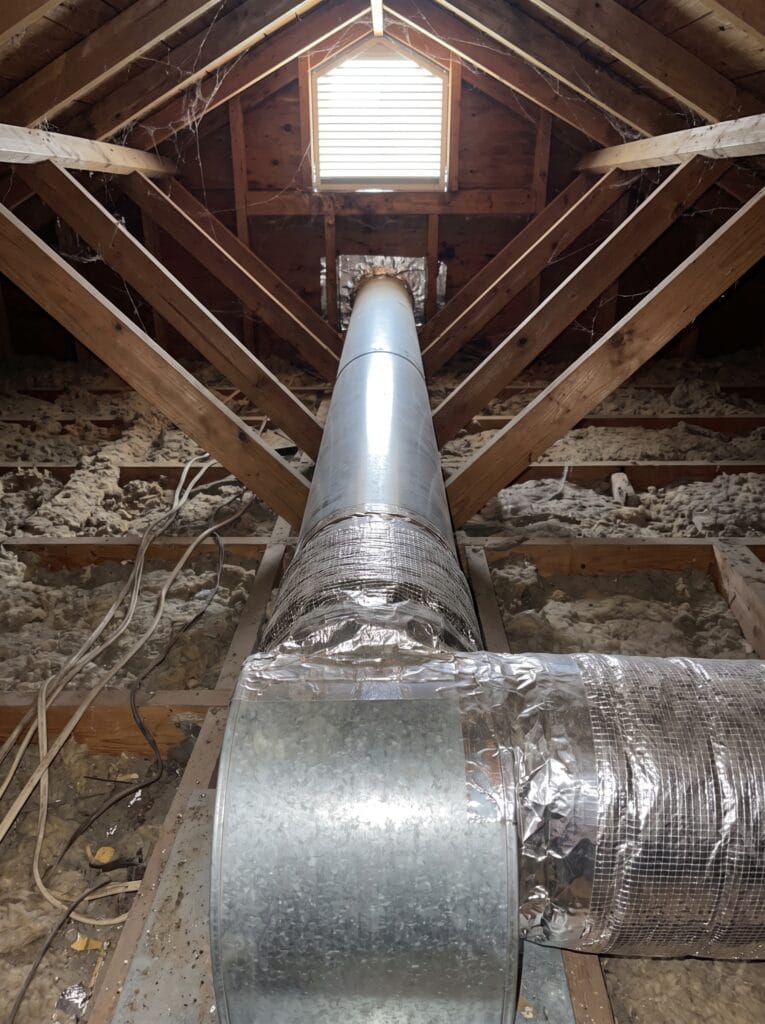
Duct size is the step nearly every bathroom exhaust fan buying guide skips, and it undoes more bathroom ventilation projects than any other single mistake.
Rated CFM is measured at 0.1 inches of water gauge static pressure, on a short straight duct. Real installations rarely look like that. Every elbow, every foot of ribbed flexible duct, and every undersized connection adds resistance, and resistance eats airflow before it ever reaches the roof.
Match the duct to the port on the fan. A 110 CFM unit built for 4 inch duct that gets connected to an existing 3 inch line can lose roughly 40 percent of its rated airflow, which turns your carefully sized 110 CFM fan into a 65 CFM fan. Rigid metal duct beats flexible every time. Where flex is the only option, pull it taut instead of leaving it slack, because compressed ribbing behaves like a series of small obstacles.
Keep the run short and the bends few. Under eight feet with one elbow is ideal, and each additional elbow costs you roughly the equivalent of several more feet of straight duct.
Look for HVI certification on the box. That label means an independent lab verified the airflow claim, while an uncertified number is whatever the manufacturer decided to print.
Where the air has to end up
Vent outdoors. Never into an attic, a soffit, or the space between floors, and this is building code in most of the United States rather than a preference.
Warm wet air dumped into an attic condenses on the cold underside of the roof deck. Over a winter that produces mold, darkened sheathing, and insulation that mats down and stops insulating. It’s an expensive mistake that stays hidden for years. Terminate at a roof cap or a wall cap with a damper that closes. Cheap caps have flaps that stick open and let cold air and insects back in.
Insulate any duct that runs through unconditioned space. Otherwise moist air cools inside the duct itself, condenses, and drips back down through the fan housing into your bathroom. If the room has no window at all, our bathroom lighting ideas for rooms with no window covers the fittings that pair with it.
Basic fan, light combo, heater, or humidity sensor
Four bathroom exhaust fan types cover almost every situation. They differ in what they solve, so match the type to your actual problem rather than buying the longest feature list.
A plain exhaust fan moves air and nothing else. Best for a bathroom that already has good lighting and a comfortable temperature. Cheapest to buy and simplest to replace, with the fewest parts that can fail.
A fan and light combination replaces both fixtures in one ceiling opening. Best for small bathrooms and half baths where ceiling space is limited. The limitation is that a failed light usually means pulling the whole unit.
A fan with a heater takes the chill off a cold room fast. Best for bathrooms over garages, on exterior walls, or in older houses with weak heating. These draw serious current and almost always need their own dedicated circuit, which is a real cost if you don’t have one.
A fan with a humidity sensor starts itself when moisture climbs and shuts off once the room dries. Best for kids’ bathrooms, rentals, and anyone who forgets the switch. The WhisperSense dual sensor model reads both humidity and motion, so it handles the two reasons the fan should be running without anyone thinking about it.
Shop it on Amazon: Panasonic FV-0511VQC1 WhisperSense DC Fan with Dual Sensor
If you’re weighing this against opening a window, our guide on how to ventilate a bathroom with no window covers the cases where a fan is doing all the work by itself.
How long the fan needs to run after a shower

Twenty minutes after you leave is how long the exhaust fan should keep running. That’s the number, and it surprises most people.
Steam doesn’t vanish when the water stops. Moisture has already soaked into towels, drywall, grout, and the back of the door, and it keeps releasing into the room for a long stretch afterward. Switching the fan off as you walk out leaves most of that water behind. A simple countdown timer switch solves this for about twenty dollars. Set it and forget it on the way out.
Humidity-sensing models handle the same job automatically, and they’re the better answer in any bathroom where the person using it won’t reliably flip a switch. Teenagers, guests, and tenants fall into that category reliably.
Replacing an old fan without attic access
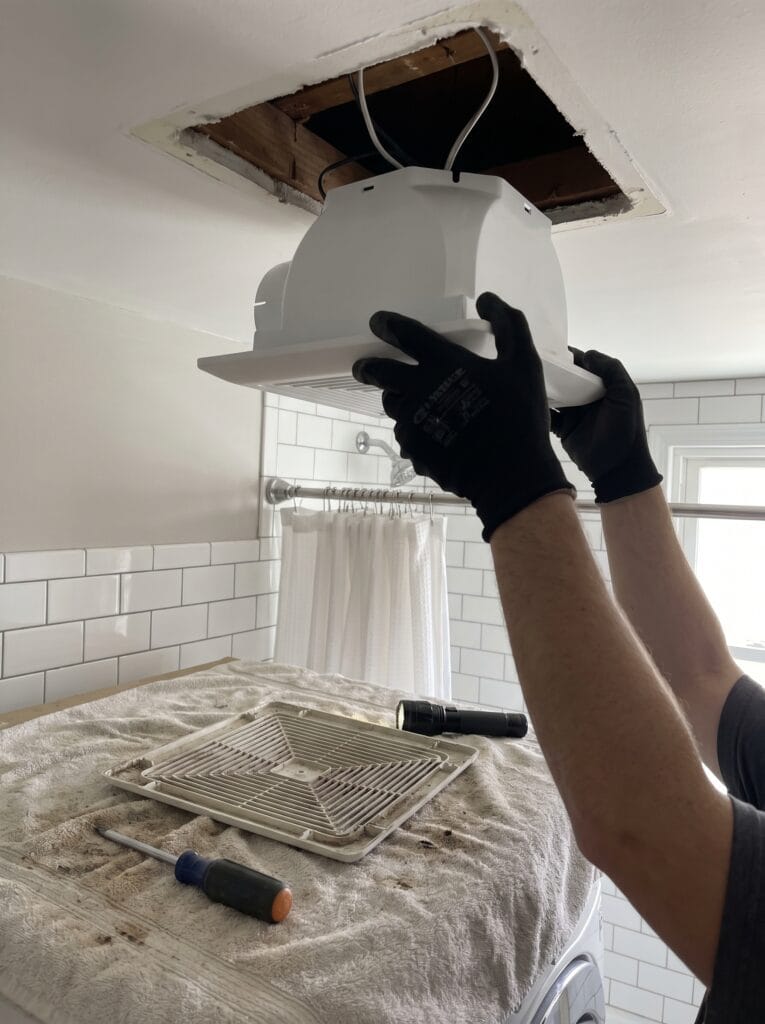
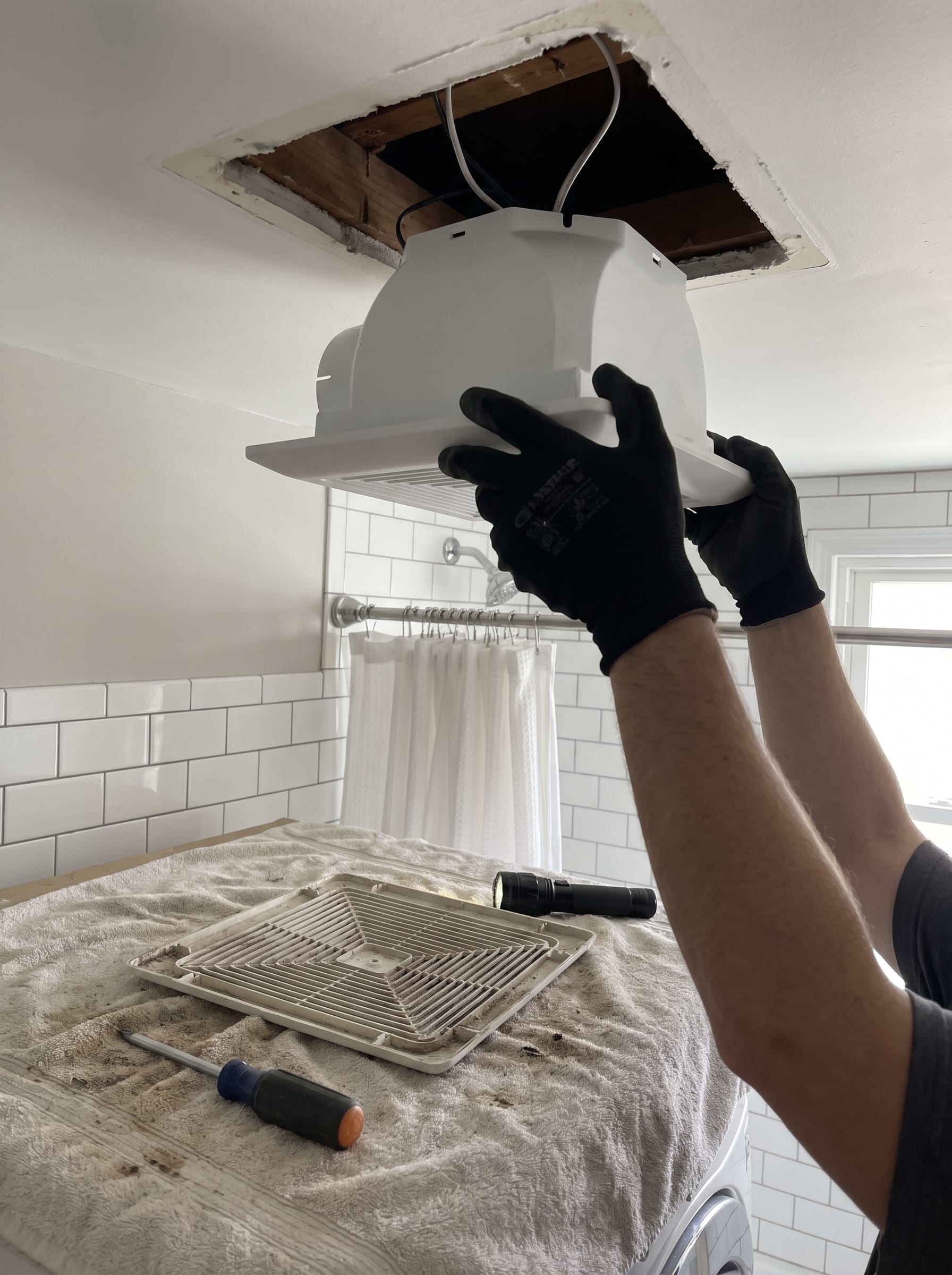
Most bathroom exhaust fan retrofits never require entering the attic. Modern housings are designed to install and service entirely from inside the room, which matters enormously in a single-story house with a low roof or in any second-floor bathroom.
Check the existing duct size and the ceiling opening before ordering. Then look for a unit that adapts to the opening you already have, because enlarging a hole in drywall above your head is a genuinely unpleasant afternoon.
Turn off the breaker before touching the old unit, and confirm it’s dead with a tester rather than trusting the label on the panel.
What an undersized fan quietly costs you
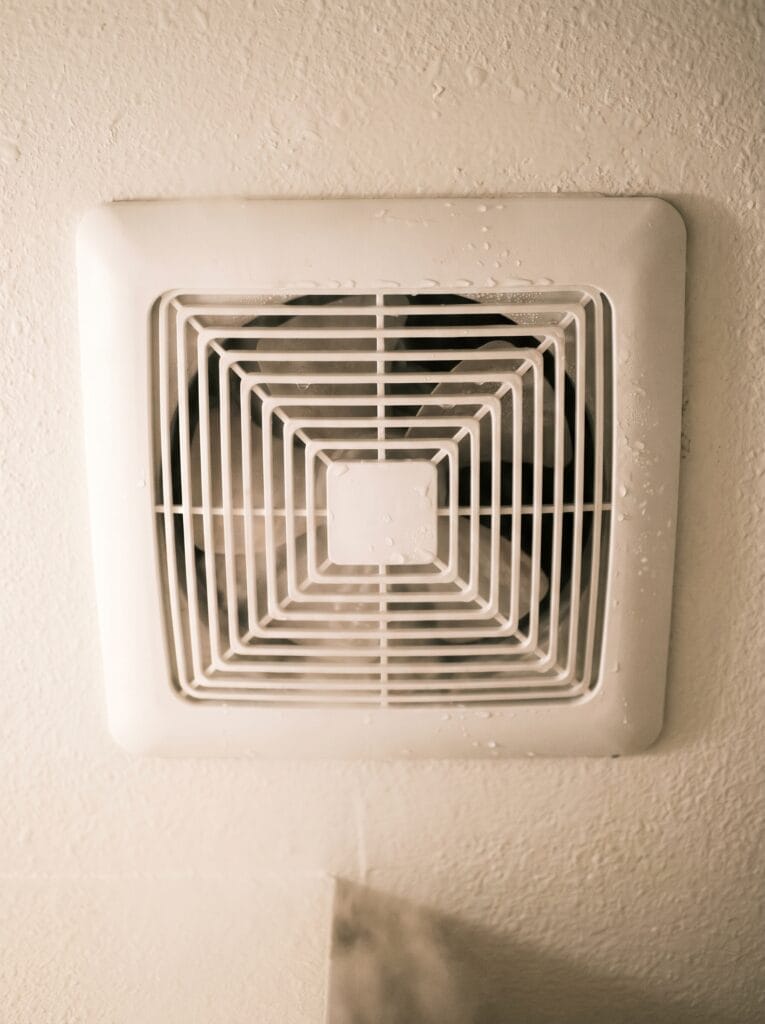
Mildew along the grout line is the first sign, and it shows up months before anyone connects it to ventilation. Undersized fans don’t fail loudly. They just never quite finish the job.
Damp air that lingers soaks into the porous surfaces around it. Grout darkens, caulk at the tub edge goes spotty, and mildew takes hold in the corners where air moves least. Paint on the ceiling starts to release, usually in a ring right above the shower.
Costs climb from there. Repainting a bathroom ceiling runs a couple of hundred dollars, regrouting a shower runs more, and replacing softened drywall behind a tub surround runs into the thousands.
Performance drops over time too, even on a correctly sized unit. Dust loads the impeller and the grille, and a fan choked with lint can lose a noticeable share of its rated airflow. Pull the cover and vacuum it twice a year to reduce that loss.
Compare that against the price gap between a builder-grade fan and a good one. Spending an extra eighty dollars once, on the right bathroom exhaust fan for the room, is cheaper than any of the repairs above.
Putting your own numbers together
Measure your room tonight. Work out the CFM, decide whether you’ll tolerate anything above one sone, then go look at what’s already in your ceiling before you order a bathroom exhaust fan that your existing duct can’t feed. If you are planning other upgrades at the same time, our bathroom materials, fixtures and layout guides cover how these pieces fit together.
That last check is the one that separates a fan that clears the mirror in four minutes from one that runs for twenty and barely moves the steam.