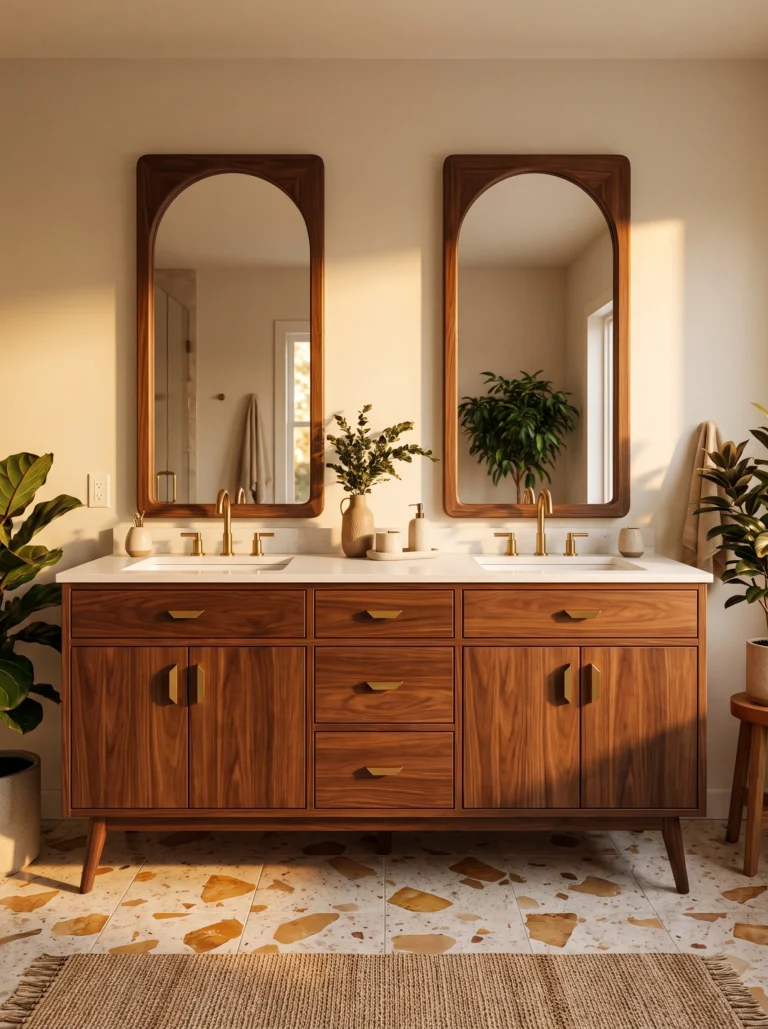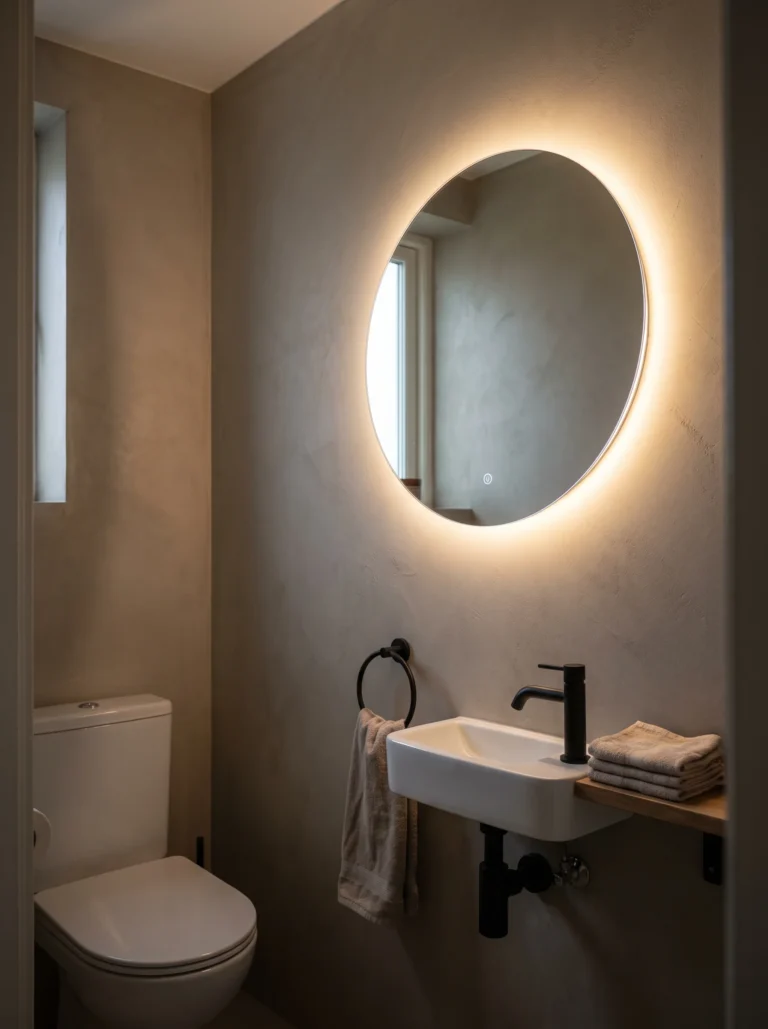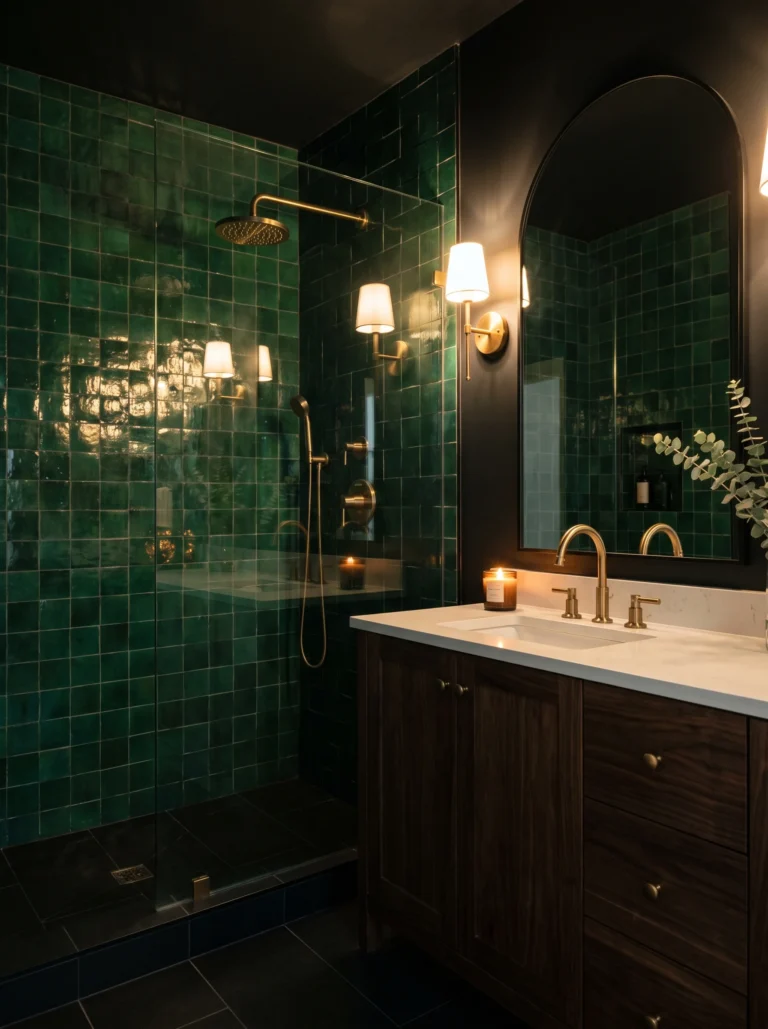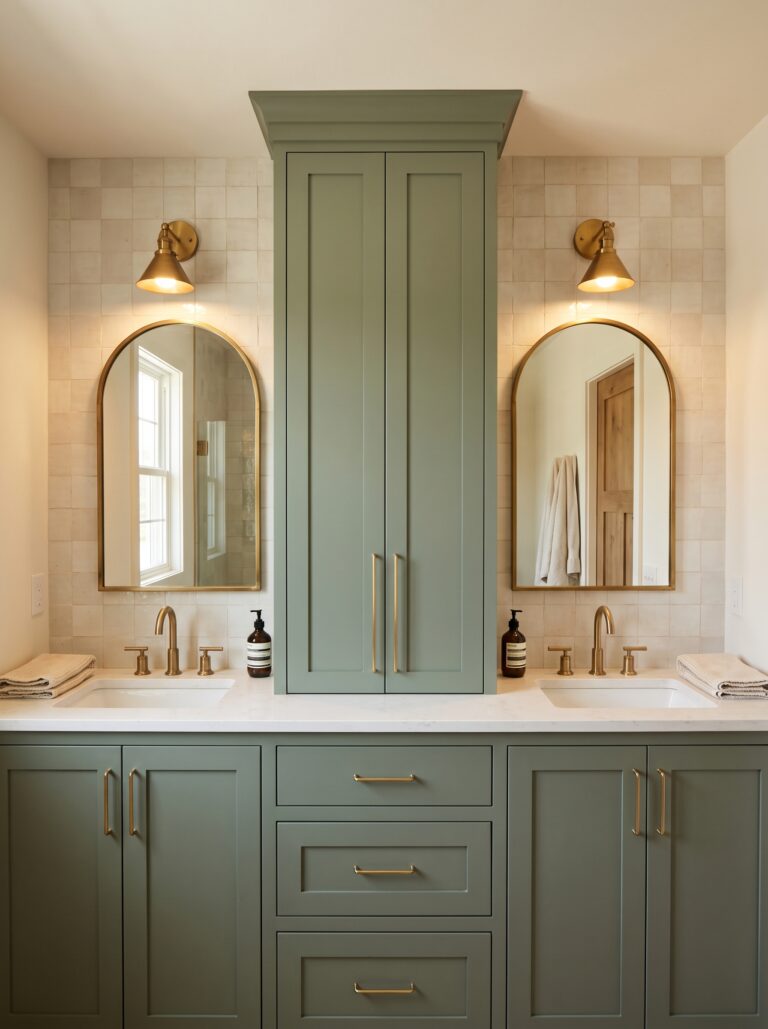
Quartz Bathroom Countertops: When It Wins and When It Loses
Quartz bathroom countertops are the right pick for most daily-use vanities: they never need sealing, resist stains and cost less than marble. Look elsewhere if a hot flat iron lands on your counter, if sun hits the top all day, or if you want real marble and can live with etching.
Nearly every guide to the best bathroom countertop material crowns quartz and stops there. This one shows where it loses, what a vanity-sized top really costs in dollars, and what to ask a fabricator before you sign.
Prices come from named sources plus my own arithmetic. Every material gets a plain rule for when it beats quartz.
Affiliate disclosure: this post contains Amazon affiliate links. If you buy through one, we may earn a small commission at no extra cost to you.
Table of Contents
Why quartz bathroom countertops suit a daily-use vanity
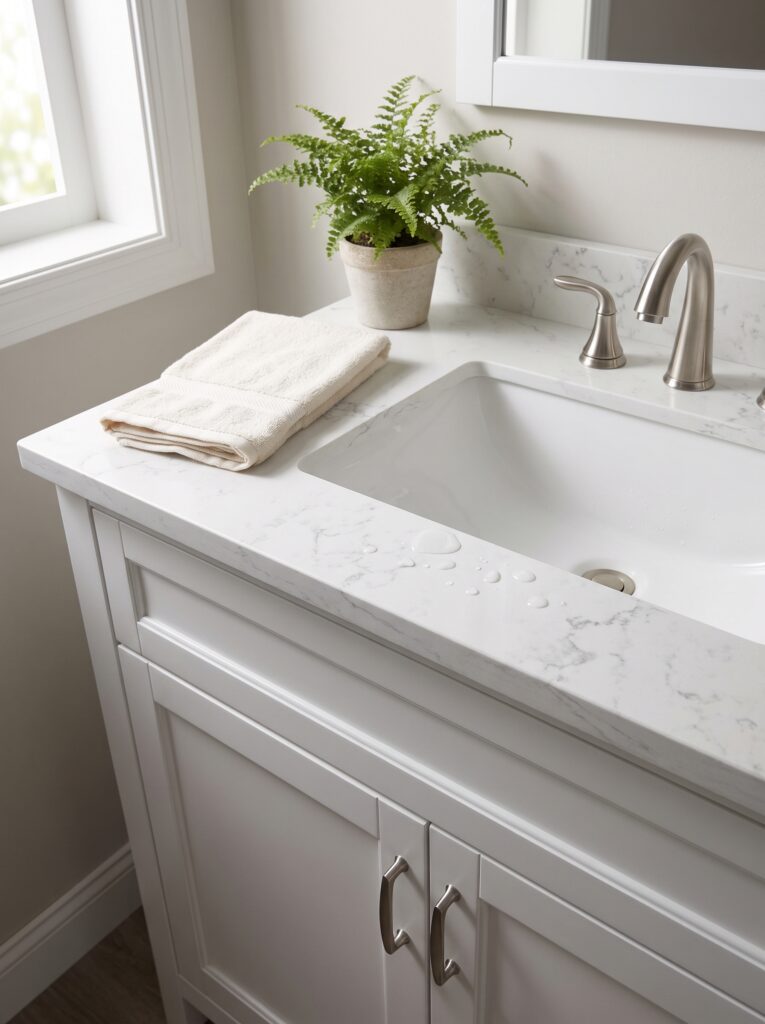
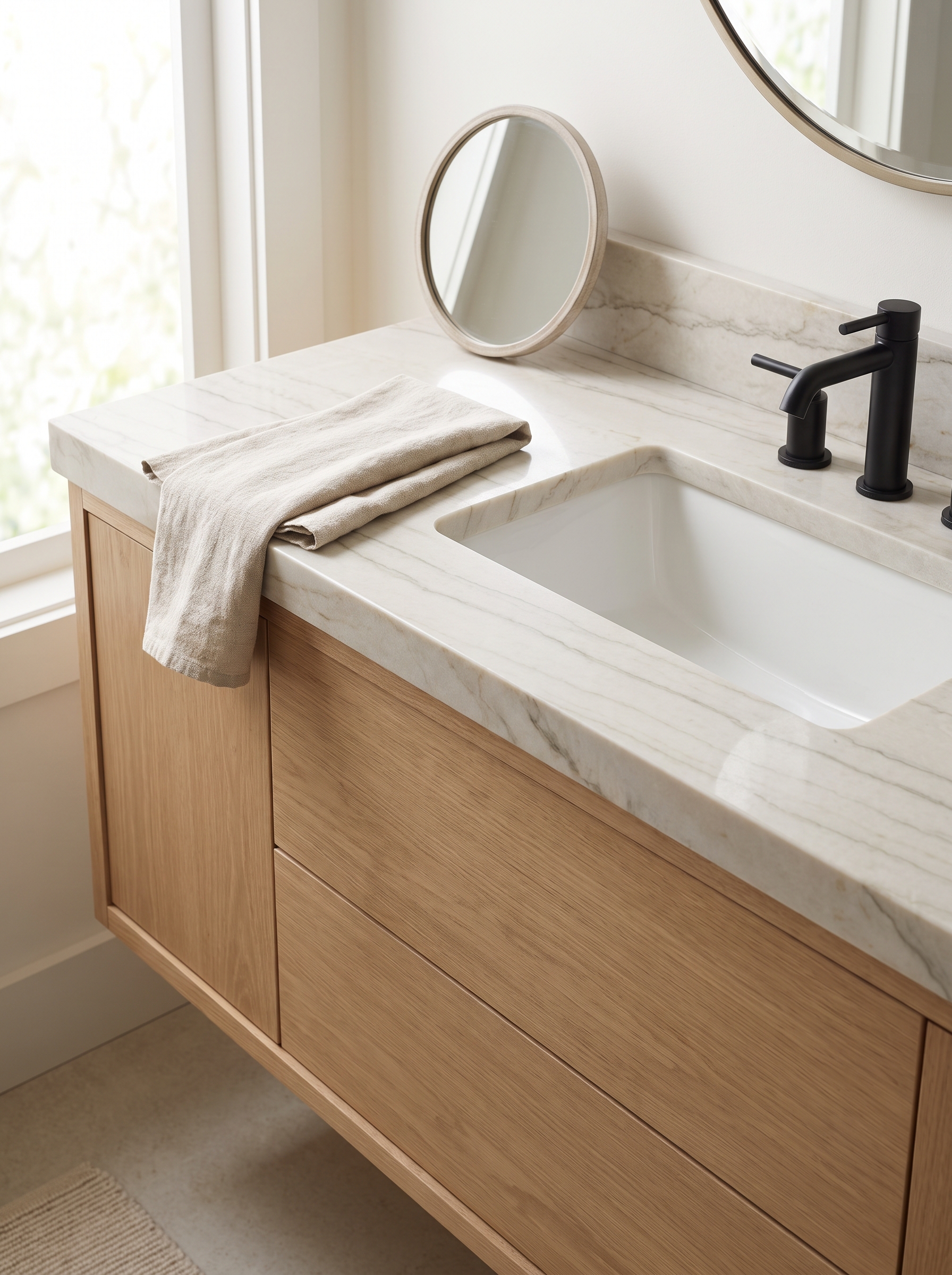
Buyers often assume quartz is a slab of natural quartz. Not so. Engineered quartz is roughly 90 to 94 percent crushed quartz held together by 6 to 10 percent polymer resin, a figure Boise Bath draws from Caesarstone and UMI Stone.
Resin fills the gaps between the crystals, so the surface is non-porous. Toothpaste, makeup, soap and water have nowhere to sink in. That is why a quartz vanity top needs no sealing schedule.
Hardness helps as well. Near 7 on the Mohs scale, SlabWise says, quartz outranks marble at 3 to 4 and keeps pace with granite at 6 to 7, so rings, keys and razors leave fewer marks.
Bathrooms also stress a top differently from kitchens. Moisture touches the surface all day, yet nothing gets chopped or dragged across it, so stain and moisture resistance matter more than scratch resistance. Built for that tilt, quartz suits bathrooms well.
Never read no sealing as no care. Gentle soap and water do the daily job, while bleach, scratchy pads and strong solvents such as paint stripper can do damage. Honed finishes hide water spots but show fingerprints; polished ones do the reverse.
Pattern predictability is a plus too. Factories control the look, so the finished top resembles the sample, which is a quiet reason designers like it.
Cost sits in the middle. Boise Bath puts quartz at about $50 to $130 per square foot installed, below marble and far above laminate.
Brand tier shifts the number. SlabWise lists Silestone and Caesarstone at $75 to $100, and premium Cambria, with a lifetime warranty, at $100 to $150 or more. Shoppers recognize quartz on sight, it adds, and read it as a quality material, which helps at resale.
Heat is the one real weakness, so test your hair tools first
Many buyers hear that quartz is heat resistant. Real as quartz countertop heat resistance is, it goes only so far. Binder resin can soften and discolor when heat lingers. Bathroom counters are exactly where hot tools linger.
Caesarstone advises against setting extremely hot cookware, above 300°F, straight onto its quartz. Long contact with very hot objects, or the heat they radiate, can cause thermal shock, discoloration or damage, it adds. Cambria publishes no number and simply asks for a trivet or hot pad.
Now compare that with a hair tool. Retail listings show flat irons and curling irons topping out between about 400 and 455°F, with CHI at 450, GHD at 420 and T3 at 430. Even the common styling range of 300 to 400°F meets or passes Caesarstone’s line.
Hot tap water is a non-issue. Household water heaters are commonly set between 120 and 140°F, far under that line, so the faucet will not hurt your top.
Pans leave a counter in seconds. Flat irons, by contrast, rest on the vanity while you finish your hair, so heat soaks in for the whole stretch. Expect a pale scorch ring as the usual ending.
Audit your own habit before you decide. Over one week, notice where the iron, wand and dryer actually rest after use. If the answer is the counter beside the basin, treat quartz as a conditional pick.
Two paths work. Keep quartz and park every hot tool on a silicone mat or in its heat-proof pouch, or pick a stone that tolerates heat if the habit will never change. Mats cost far less than a new top, which makes them the easier fix.
Seven bathroom vanity countertops side by side for a 6 square foot top
Per-square-foot prices mislead on a vanity, because a bathroom top is small. Take a 36 by 22 inch top: about 5.5 square feet. Stretch to 48 inches and you reach roughly 7.3. Most single-sink tops run 3 to 8 square feet, SlabWise says, while a double-sink master bath may hit 15 to 20.
| Material | Installed per sq ft | About 6 sq ft (my math) | Sealing | Heat | Etching |
|---|---|---|---|---|---|
| Engineered quartz | $50 to $130 | $300 to $780 | Never | Weak above about 300°F | No |
| Granite | $50 to $120 | $300 to $720 | Every 6 to 12 months | Strong | Mostly no |
| Marble | $75 to $200+ | $450 to $1,200+ | For stains only | Good | Yes |
| Quartzite | $30 to $150 | $180 to $900 | Every few years | Strong | Rarely |
| Porcelain slab | $55 to $120 | $330 to $720 | Never | Strong | No |
| Solid surface | $26 to $80 | $156 to $480 | Never | Weak | Not stone |
| Laminate or cultured marble | $20 to $100 | $120 to $600 | Never | Weak | Not stone |
Ranges come from Boise Bath’s 2025 to 2026 roundup of manufacturer and installer figures. Column three is my own math at 6 square feet. Treat all of it as planning bands, not quotes.
Try the math on a 36-inch quartz top. At 5.5 square feet and $50 to $130, material and install land near $275 to $715, before a sink cutout that adds about $100 to $200. Call that a typical single-vanity budget.
Sources disagree on quartz, and the gap is worth understanding. One installer lists $105 to $185 installed, one manufacturer lists $10 to $30 for material alone, and most land near $50 to $130. Cutouts, edges and labor explain the spread.
Small jobs also carry a catch. Some fabricators set minimums, commonly $300 to $500, SlabWise says, so a cheap material on a tiny top can cost more than the math suggests. Its own all-in estimate for a 6-square-foot quartz top with an undermount sink is $400 to $700, with marble at $600 to $1,000.
Use the heat and etching columns as tie-breakers. Price rarely separates these materials on a top this small; habits do.
Granite beats quartz when heat or a natural look matters
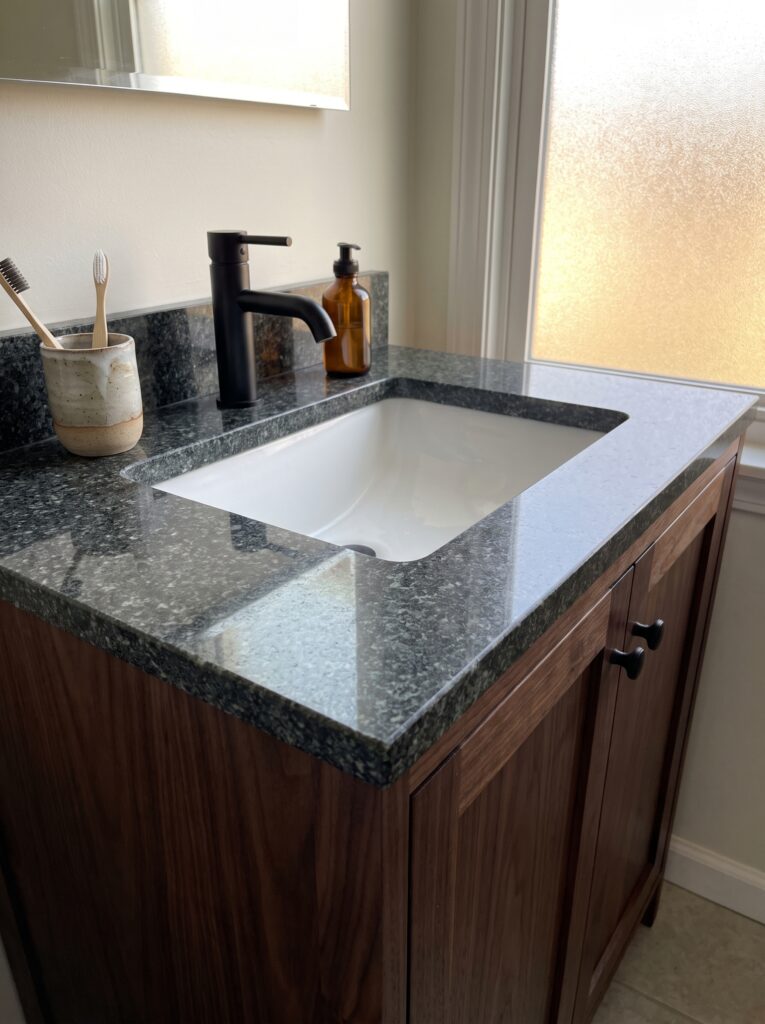
Granite gets written off as a kitchen stone. In a bathroom it has one big edge over quartz: it tolerates heat. Vanities that double as hair stations make that edge worth real money.
Pricing runs similar, roughly $50 to $120 per square foot installed, and no two slabs match. Dark, flecked slabs also hide toothpaste and water spots far better than plain white tops.
Sealing is where granite charges you. Porous stone needs it, and one installer guide cited by Boise Bath says to reseal about every 6 to 12 months. Wipe-on, wipe-off work, yet still work. Drip water on the top to check: if it darkens the stone within a few minutes, resealing is due.
Slab choice matters more with granite than with any engineered top. Colors and flecks run from near black to warm gold, and the yard lets you pick the exact piece. Fussy buyers should go and look.
Choose granite if you flat-iron daily, like stone with character, or can pick the exact slab at the yard. Avoid it if you want a calm, even white, because granite is rarely even.
Prefer to keep quartz? Then protect it. Silicone heat mats give hair tools a safe place to rest and cost a few dollars.
Shop it on Amazon: Lessmon Large Heat Resistant Mat for Hair Styling Tools, 11 x 7.5 in, Grey
Marble only wins in a powder room, and only if you accept etching
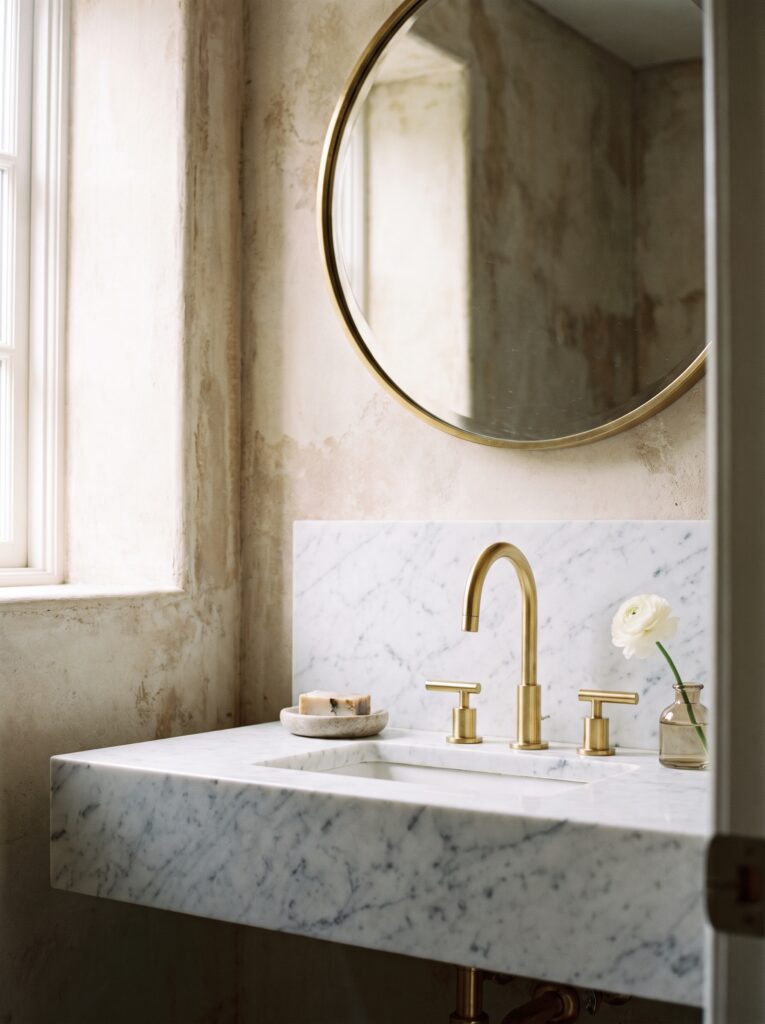
Marble looks better than anything else on this list, and every guide says so. Few guides reach the real problem.
Calcium carbonate is what marble is made of, so acids eat into it. Acids are everywhere in a bathroom: many cleaners, perfume, hair products, toothpaste and nail polish remover. Result: an etch, a dull cloudy patch in the stone itself rather than a stain on top.
Drop this myth: sealing stops etching. It does not. The Natural Stone Institute, quoted by Boise Bath, says sealers make stone more stain resistant, not etch proof.
Save marble for a guest bath or powder room that sees a few hand washes a day. Count on $75 to $200 or more per square foot, and keep hair spray and perfume off the stone.
Matte, honed marble hides etch marks better than polished marble. Request it by name.
Still set on marble for a primary bath? Plan a tray under every bottle and a weekly wipe with a stone-safe cleaner. Accept that the top will pick up a patina, and choose it only if that history appeals to you.
Seal it anyway to hold off oil and soap stains. Penetrating sealers rated for marble, like the quart bottle below, do that job.
Shop it on Amazon: Tenax Hydrex Stone Sealer – Professional Penetrating Sealer for Granite, Marble, Natural Stone & Concrete
Quartzite gives the marble look without the marble worry

Quartzite sounds like quartz, and sellers count on the mix-up. Engineering has nothing to do with it. Nature made it, and Granite Guy, via Boise Bath, rates it around 7 to 8 on the Mohs scale, a little harder than granite.
Looks are the draw. Soft veining over a creamy white or pale gray base reads as marble to most visitors, and a true quartzite does not etch the way marble does.
Slabs swing from about $30 to $150 per square foot. Less porous than granite, the stone often needs sealing only every few years.
Watch for one trap. Impostors exist: softer stones, dolomite marble among them, sometimes ship under the quartzite name. Get the exact stone name in writing, then drip lemon juice on a sample for a few minutes. True quartzite will not dull.
Each slab of quartzite is different, and fabricators sell it by the slab. Visit the yard, choose the exact piece, and ask for the same slab to be reserved for your top before the template visit.
Households that crowd a bathroom every morning can live well with quartzite if they accept a little sealing. Too much sealing? Marble-pattern quartz vanity tops get close for less.
Porcelain slab beats quartz near a window and on heat, but its edges chip
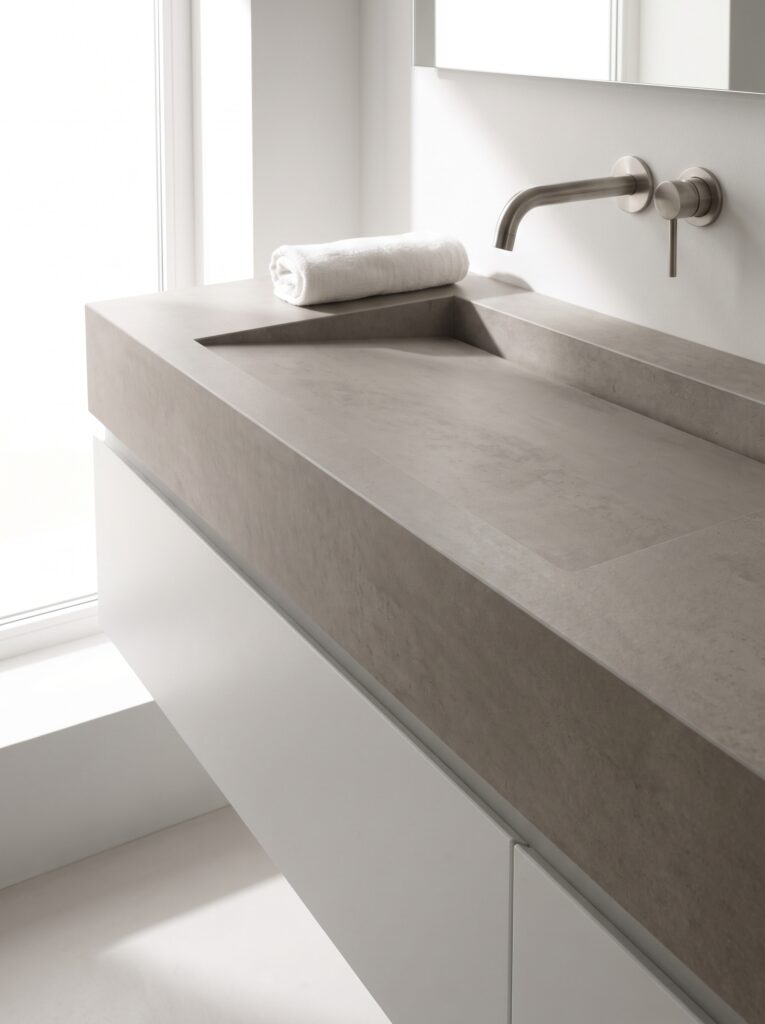
Porcelain slabs are the newest rival, and they fix both of quartz’s weak spots.
Fired at extreme heat, porcelain handles hot tools and sunlight without fading, according to KB Authority, and Boise Bath rates its heat resistance as excellent. By nature it is non-porous, so it needs no sealing, and acids and bleach barely touch it.
Windows matter here. LX Hausys, a quartz maker, advises keeping quartz away from windows because long sun exposure can yellow it.
Practical downsides exist. Chipping tops the list: edges and corners can chip under a hard knock, the pattern is often printed on the surface instead of running through the slab, and fewer shops cut it well. Vet the installer, Boise Bath tells buyers.
Large slabs let a shop cover a whole top, backsplash and sink wall with one continuous pattern. Tiles cannot easily match that look, and it is one reason porcelain is the fastest-growing option in bathroom vanity countertops, KB Authority says.
Installed, porcelain runs about $55 to $120 per square foot. Sunny windows, hot-tool habits and thin, sleek edges all suit it. See a finished porcelain vanity in person before you commit.
Solid surface wins when you want the basin and top in one piece
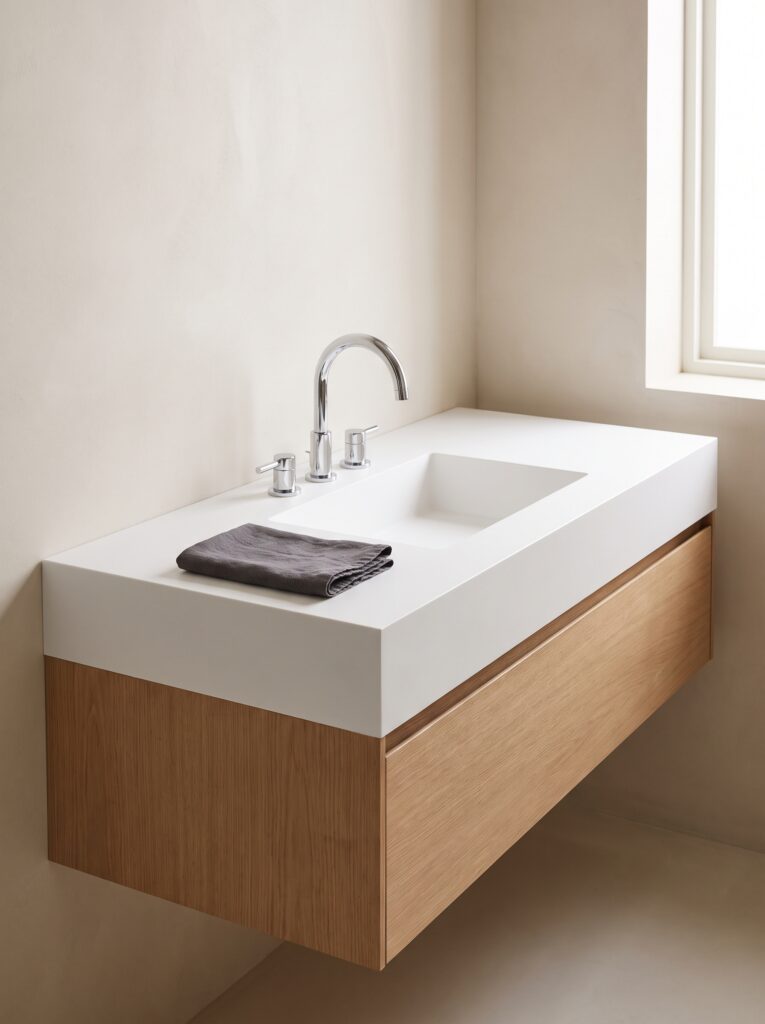
Solid surface is the one material that can be molded into a seamless basin. No rim, no caulk line, no seam where grime collects.
Corian is the best-known brand. Non-porous and blended from acrylic and resin, it runs roughly $26 to $80 per square foot installed, never needs sealing and resists mold and mildew. Sanding removes scratches and minor burns.
Toughness is what you give up. Softer than stone, it dents and scratches more easily and is heat sensitive, Caesarstone US notes.
One-piece tops suit a wall-hung vanity, a modern bathroom or a kids’ bath. Choosing the basin too? Our guide to bathroom basin design lists the measurements to check before you buy.
Repairs are the quiet strength here. Fabricators can sand and blend a worn spot, so a family bath that takes daily abuse can look fresh again after years of use. Stone and quartz cannot be refreshed that way.
Gloss shows every mark, so choose a matte finish if scratches bother you.
Laminate and cultured marble only make sense on a tight budget
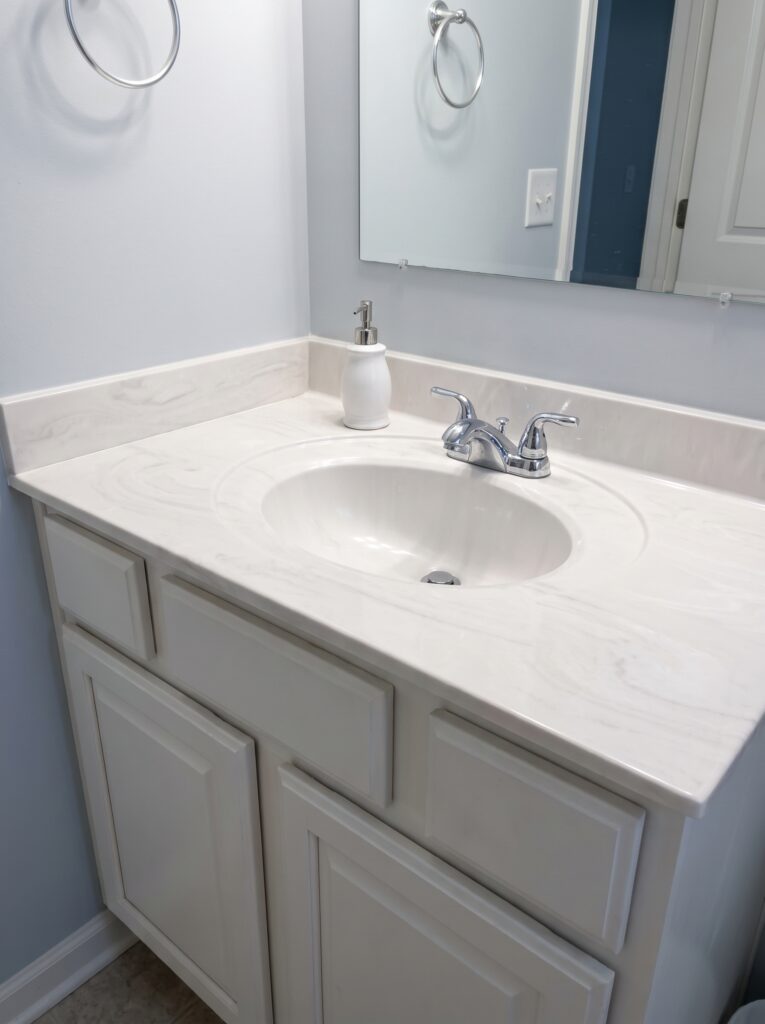
Cheap tops get a bad name, and some of it is fair.
Cultured marble is cast resin and crushed stone under a gel coat, usually $30 to $100 per square foot with the sink molded in. Service life runs near 20 years, Boise Bath cites. Ready-made drop-in units go for $80 to $200 before installation, SlabWise says, and can leave the store the same day.
Scratches come easier on a gel coat than on stone, and a hot iron can scorch it for good. Guest and kids’ baths can live with that trade.
Laminate runs about $20 to $50 per square foot and carries a real bathroom flaw. When water reaches a seam or edge near the sink, the particleboard core swells and never recovers. Reserve it for a rental or a low-splash room, never a daily sink.
Neither pairs well with an undermount sink, because the exposed edge soaks up water. Drop-in or molded basins are the better fit.
Pick by bathroom, not by material
Material rankings flatter whatever the writer sells, while your room is a better guide. Find the line that sounds like your bathroom, and for more help with surfaces, browse our materials, fixtures and layout guides.
Kids’ bathroom or a busy shared sink? Either quartz or porcelain suits it, since each is non-porous and wipes clean.
Hair tools live on the counter? Lean toward granite or porcelain, unless you will use a mat every single time.
Sun hits the counter most of the day? Pick porcelain or granite, because long sun can yellow quartz.
Love the marble look but have children? A checked quartzite or quartz in a marble pattern fits.
Powder room for guests only? Genuine marble is fine, since little water and few acids reach it.
Half bath with a 3 square foot top? Splurge, because even $200 per square foot stone costs only $600.
Poor ventilation? Skip porous stone unless you will seal it, since damp pores can grow mold.
Renting, or watching every dollar? Go with a cultured marble top and molded sink, or a drop-in laminate top.
Wall-hung vanity with a one-piece look? Molded solid surface fits.
Big double-sink top of 15 to 20 square feet? Pricey stone adds up fast at that size, so quartz or granite keeps the bill sane: marble at $75 to $200 per square foot would reach $1,125 to $4,000.
Staging a home for sale? Quiet, neutral quartz reads as quality to shoppers, SlabWise says.
Three mistakes that cost more than the countertop
Buying on a showroom photo is mistake one. Polished white Carrara looks perfect there, yet in a daily-use bathroom with hard water, acidic soap and kids, SlabWise warns, it will etch and mark within months.
Pairing the wrong sink with the wrong top is mistake two. Undermount basins need a material that can take a polished exposed edge at the cutout. Four materials qualify: quartz, granite, marble and solid surface. Typically, laminate and cultured marble do not.
Skipping the template visit is mistake three. Plain rectangles can hide an out-of-square wall, a backsplash conflict or a plumbing rough-in that sits slightly off. Template visits cost $50 to $150, SlabWise says, and they cut the odds of an expensive remake.
Height deserves one more check. Thick 3 cm tops on cabinets built for thinner ones can push the counter a little high, and a vessel sink wants the base lower, around 30 to 32 inches rather than 34 to 36.
Six questions to ask the fabricator before you sign
Good quotes answer these without a pause, and a vague answer tells you something too.
- Do you cut wet? Cutting dry throws off respirable silica dust, and an OSHA and NIOSH alert says engineered stone can contain more than 90 percent crystalline silica.
- Is the top 2 cm or 3 cm? Common on vanities, SlabWise says, is 2 cm, and some shops charge a little extra for 3 cm.
- What is your minimum charge? Minimums of $300 to $500 on small jobs are common, and that can outweigh a cheaper material.
- Does a remnant of my stone exist? Leftover pieces from bigger jobs can cost a fraction of a slab, and a 6-square-foot top fits easily.
- Will you template first, and what does the sink cutout cost? Visits run about $50 to $150, and an undermount cutout adds roughly $100 to $200, per SlabWise.
- Which warranty terms apply, and who honors them? Lifetime warranties come from premium brands like Cambria, SlabWise notes, so compare terms brand by brand.
On the silica point, Australia banned engineered stone benchtops nationwide from 1 July 2024, and in the US OSHA caps worker exposure to respirable crystalline silica at 50 micrograms per cubic meter over an eight-hour shift. Reputable shops cut with water and have a plain answer ready.
Edges deserve a line of their own. Eased ones come in the base price, SlabWise says, while ogee profiles add $5 to $15 per linear foot and waterfall edges roughly double the stone used on that side.
Lead time runs 1 to 3 weeks from template for custom stone, while prefab cultured marble can leave the store the same day.
What the weeks look like from quote to finished top
Timing surprises people, because a bathroom top feels like a small job. Quotes come first, and for a plain rectangle many shops price from photos and measurements.
Next comes the template visit, where the shop measures the real walls and plumbing. Out-of-square corners get caught there, which is why skipping it costs more than it saves.
Custom stone is cut to order, so expect 1 to 3 weeks from template to install, according to SlabWise. Shops busy with kitchens can stretch that, so ask for a date in writing.
Low-cost options skip the wait. Prefab units sit on store shelves and can leave the same day, which suits a rushed rental refresh.
Finally comes install day. Plumbing reconnection is almost always a separate line item, SlabWise notes, so ask who reconnects the faucet and drain before the old top comes out.
Take a sample home and run three tests for a week
Showroom lamps hide everything. Samples set on your own vanity tell the truth, and most shops hand them out.
First comes the acid test, for natural stone only. Put a drop of lemon juice or vinegar on the sample for five minutes, then rinse. Dull spots are etches, and the real top will do the same.
Second is the stain test. Dab foundation, lipstick and toothpaste on the sample, leave them an hour, then wipe with the cleaner you plan to use every day. Anything left behind will show up every morning.
Third is the light test. Check fingerprints and water spots at the hour you use the sink most. Fingerprints show on honed finishes and water spots on polished ones, so see which annoys you less.
Hold on to samples for a full week, and ask for two if you are torn. Living with them beats staring at them.
Finish with a visit. Ask the shop for a photo, or better a visit, of a finished bathroom top in the exact material, since a small sample cannot show edges, seams or how a large piece reads in a room.
Cleaner choice matters too. Harsh products can strip sealers from stone and dull some finishes, so use a pH-neutral stone cleaner for the stain test and for daily wiping.
Shop it on Amazon: Granite Counter Cleaner for all Stone Countertops – 1 Quart
Care routines that keep each top looking new
Least effort comes with quartz and porcelain. Mild soap, water and a soft cloth do the daily work, and bleach or abrasive pads stay in the closet. Wipe splashes before they dry, since hard water leaves white spots on dark tops.
Natural stone like granite and quartzite wants a pH-neutral cleaner and a sealer on schedule. Test with a little water every few months, and reseal if it darkens within minutes.
Trays or coasters belong under every bottle on marble, because perfume, hair spray and many cleaners are acids. Spills should come off at once, and a wet bottle should never stand on the stone.
Soap and water suit solid surface and cultured marble well, and minor scratches on solid surface can be sanded out. Both stay away from hot tools, since each is heat sensitive.
Drying the seams and edges around the sink matters most with laminate, since that is where swelling starts.
Which vanity top to order this week
Order quartz if your bathroom is busy, your counter is mostly clear of hot tools and no window beats on it. Families of most kinds fit that description, which is why quartz bathroom countertops lead nearly every guide.
Switch to granite or porcelain when heat or sun is part of your day. For the marble look without etching, pick quartzite; for a one-piece basin, solid surface. Leave real marble to the powder room.
Roughly $300 to $780 buys a 6-square-foot quartz top before any fabricator minimum, and $400 to $700 all-in is SlabWise’s estimate. Budget builds can go with cultured marble.
Whatever you pick, get a sample, ask the six questions and settle the price in writing, and your quartz bathroom countertops, or whatever you choose instead, will look the part for years.
Save this pin so you can find this quartz bathroom countertops guide when you are ready to order your vanity top.