Bathroom Rug Ideas: Size, Placement and Fabric That Dries
The best bathroom rug ideas start with the spot, not the style. Size a vanity mat to the cabinet, a tub mat to your step-out and a runner to the long wall, then choose a cotton or microfiber weave that dries in a day. Add a grippy backing and you can pick any color you like.
Most guides hand you 25 pretty rugs and a size chart. The twelve ideas below work the other way around. Each one starts with a place in your bathroom, gives you a measurement or a test, and says what to look for in the fabric and the backing.
The numbers come from the size guides that rank for this search, including Best Bath Rugs, D&G Flooring, Kirmen Rugs and Ruggable, and each source is named when a figure isn’t common knowledge. Laundry advice is where those guides disagree most, so that section picks a side and explains why.
Affiliate disclosure: this post contains Amazon affiliate links. If you buy through one, we may earn a small commission at no extra cost to you.
Table of Contents
Start your bathroom rug ideas with a mat as wide as the vanity
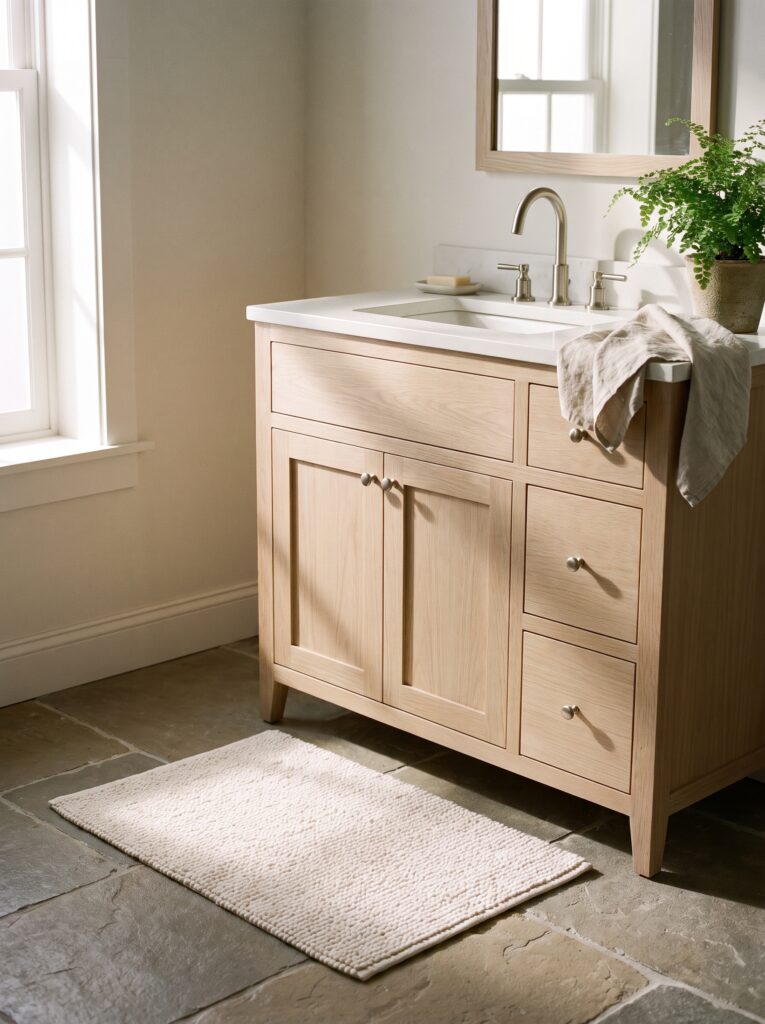
A single vanity needs a mat that spans roughly the width of the cabinet. D&G Flooring says that proportion looks balanced and catches drips, while a mat half that size looks like a doormat dropped in front of the sink.
Measure the cabinet, not the room. Most single vanities run 30 to 36 inches wide, which points to a 20 by 32 or a 24 by 36 inch mat. Best Bath Rugs keeps the small 17 by 24 size for powder rooms.
Line the mat up with the front of the cabinet and leave a few inches of bare floor at the toe-kick, so drawers and doors can open without dragging it.
Choose a mat with a non-slip backing, since glazed tile and polished stone both turn slick when a splash lands. Lowe’s lists rubber-backed grip rugs for exactly that reason, and the backing matters more at the vanity than the weave does.
Stand where you brush your teeth and look down. If your heels land on bare tile, the mat is too small.
Run the tub mat 2 to 3 inches past each side of the step-out zone

Stepping out of a tub is where you need the biggest mat in the room, because your feet land in a different place every time. Best Bath Rugs says to measure the step-out area and add 2 to 3 inches on each side, with a depth of 24 to 36 inches.
The most popular bath mat size is 20 by 32 inches, and it fits most standard tubs. Kirmen Rugs, which sells handwoven rugs, goes bigger and treats 3 by 5 feet as the minimum for a full tub front, a better fit if several people share one bath.
A long waffle weave works well here because water drains through the open texture and the mat dries faster. Check that the far end stays clear of the door swing and the toilet.
Check the length of the tub itself. If the mat is shorter than the tub front, the feet that land beyond it hit cold tile. A full-length mat also gives you a dry place to stand while you towel off.
Stretch a bathroom runner along both sinks of a double vanity

A double vanity looks calmer with one long runner than with two small mats, which read as two separate rugs. D&G Flooring recommends a runner or a large rug that stretches along both sinks for a unified look.
Ruggable lists 2.5 by 7 feet for a run along a single or double vanity. Pick a runner close to the length of the cabinet and leave a few inches of bare floor at each end, so the edges don’t curl against the side panels.
Stripes and flat weaves suit this spot because they lie flat under cabinet doors and hide splashes. Choose a low profile, since a thick pile catches on the toe-kick, and add a grippy backing, because a long rug on tile creeps.
A bathroom runner also settles the morning crush. When two people brush at once, each sink gets its own standing zone on the same piece, and nobody ends up half on the mat and half on the tile.
Walk the whole length once with the door open. Nothing on the floor should catch, fold or rise at the edges.
Park a thick mat at the open end of a doorless shower
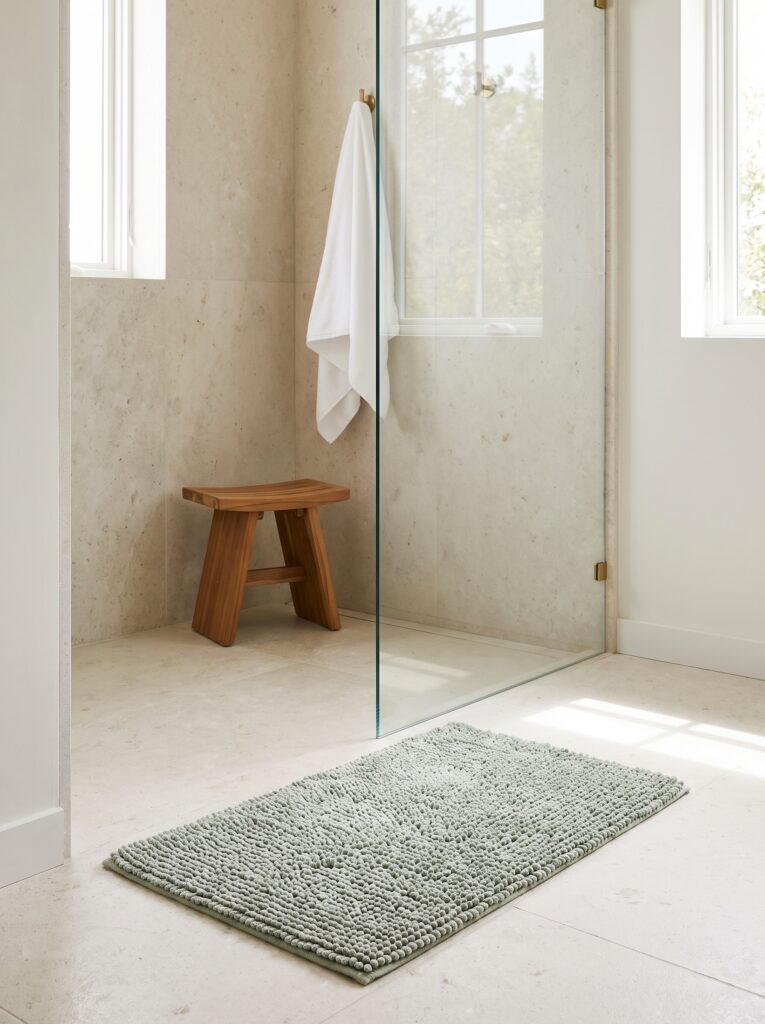
With no door to stop the water, a walk-in shower drips across the floor. Put an absorbent mat where you step out, not in the middle of the room, and size it so both feet land on it.
Best Bath Rugs says the rug should be at least as wide as the shower opening and extend 24 to 36 inches outward. For most open walk-ins that points to a mat near 24 by 36 inches, not the little square that comes in a set.
Chenille and microfiber suit this spot because they soak up a lot of water. D&G Flooring describes chenille as dense and cushiony and microfiber as quick to dry, so either one works if you can hang it up afterwards.
Keep a towel hook within arm’s reach of the mat, so wet feet go straight from shower to mat to towel without a detour across bare tile.
Planning the rest of the room around the shower? Our bathroom decor and storage guides cover the hooks, stools and shelves that keep this corner tidy.
Lay a low runner down a narrow bathroom and check the door swing

A runner makes a long, narrow bathroom feel longer, as long as it doesn’t fight the door.
Best Bath Rugs calls door clearance the mistake most people overlook. A rug that jams against a swinging door bunches up, loses its grip and becomes a tripping hazard. Open the door fully, then pick a low, flat weave that clears it by a comfortable margin.
D&G Flooring puts runners at around 22 by 60 inches and up, which leaves room to walk down the middle. Keep a few inches of bare floor between the rug edge and the walls or cabinets, and the room won’t feel stuffed.
Natural fibers like jute look warm, but they soak up water and dry slowly. Keep them out of the splash zone, or choose a tight cotton weave instead.
Put a non-slip backing or a pad under the runner. Runners creep more than any other rug, because people turn at the sink and push the edge sideways with every step.
Use one light rug in a very small bathroom
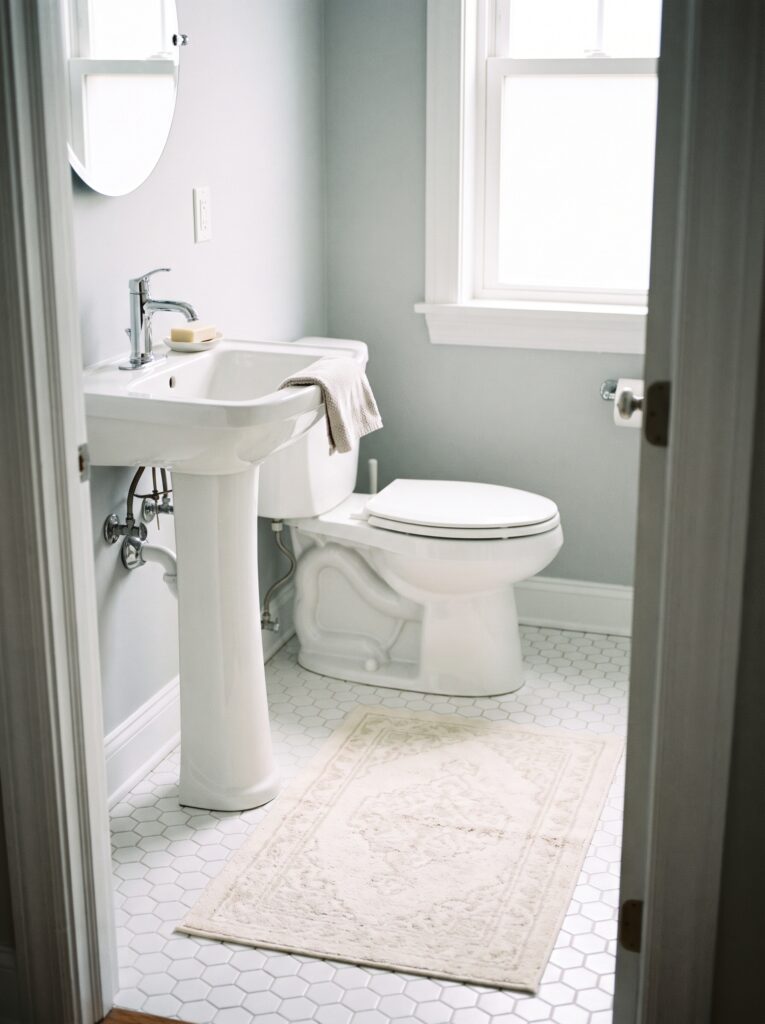
In a bathroom under 5 by 7 feet, one rug beats three. Best Bath Rugs says these rooms typically use a 17 by 24 or a 20 by 32 inch mat, and a set of small mats only chops the floor into pieces.
Choose a pale tone close to your floor so the rug blends into the room. A faint tonal pattern adds texture without a color break, while a dark rug on white tile pulls the eye straight down.
Skip the toilet contour rug. Best Bath Rugs says it traps moisture and needs frequent washing, and in a tiny room it is easier to leave that patch of floor bare.
With a pedestal sink, set the rug in the open floor between the sink and the tub, not under the toilet base. Keep it clear of the door swing, like every other rug in this list.
For more ways to dress a compact room without crowding it, see our bathroom decor ideas.
Let one big rug anchor a large primary bathroom

A big bathroom with only a tiny mat feels unfinished. One 4 by 6 or 5 by 7 foot rug, sizes both Kirmen Rugs and Ruggable suggest for large primary baths, ties the vanity and tub zones into one room.
Choose a flatweave in a stripe or a quiet pattern. It lies flat under bare feet and under the door, and a machine-washable one copes with the splashes this much floor collects. Leave a border of visible floor around it.
Keep the rug out of the wet zone and add a smaller bath mat right at the tub edge. A large rug that gets soaked takes a long time to dry.
Check your washing machine before you order. A 5 by 8 foot rug won’t fit most drums, so look for a washable cover, or a rug you can shake out and spot clean, and measure the drum first.
Tape the outline on the floor first. Kirmen Rugs suggests a strip of tape where your feet land, and you’ll see right away whether the rug crowds the vanity doors.
Choose cotton, chenille or microfiber by how fast you need it to dry
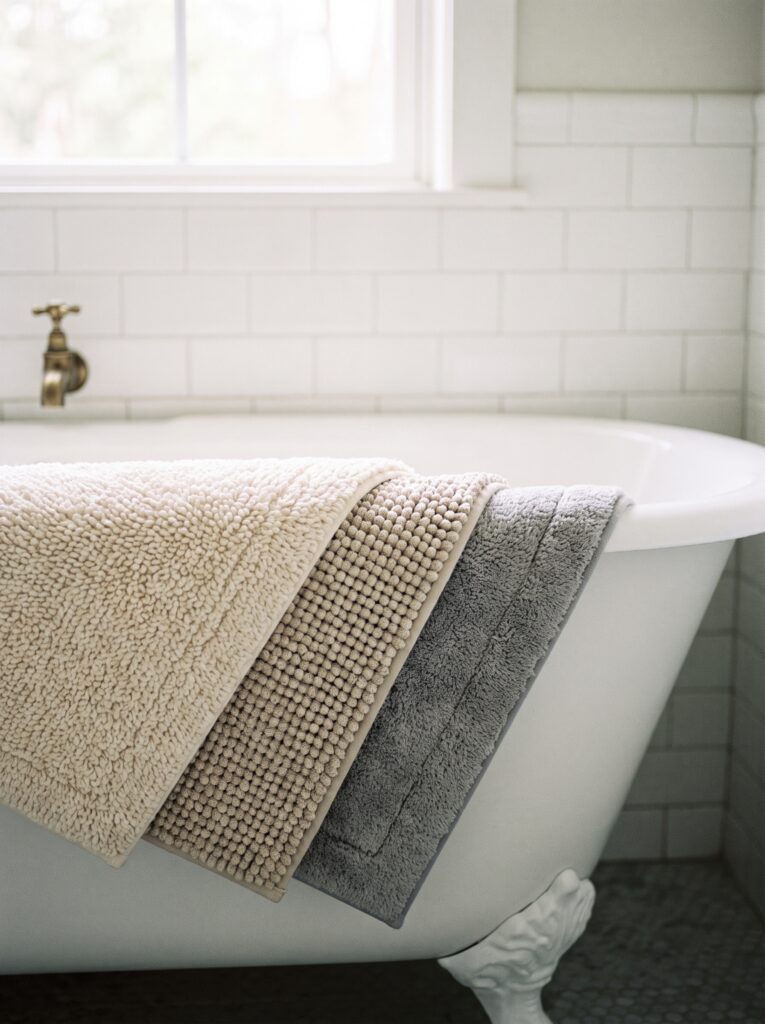
Fabric decides how long a mat stays damp, and a damp mat is where mildew starts. D&G Flooring calls cotton the most popular all-around choice: soft, absorbent and machine washable.
Chenille is dense and cushiony and soaks up water from wet feet. Microfiber is highly absorbent and quick to dry. Memory foam feels softest, but D&G notes it can take longer to dry, so it suits a dry guest bath better than a family tub.
Cotton wins on laundry and price, chenille on cushioning and microfiber on drying speed. If your bathroom has no window or fan, choose microfiber, because the room dries slowly and so does everything in it.
A reversible 100% cotton mat in 21 by 34 inches is an easy default. Flip it every few days so the damp side gets air, and choose a color that matches your towels.
Shop it on Amazon: Bedding Craft Cotton Bath Mat Rug, Reversible, Machine Washable, 21×34
Try a teak or bamboo slat mat where water pools
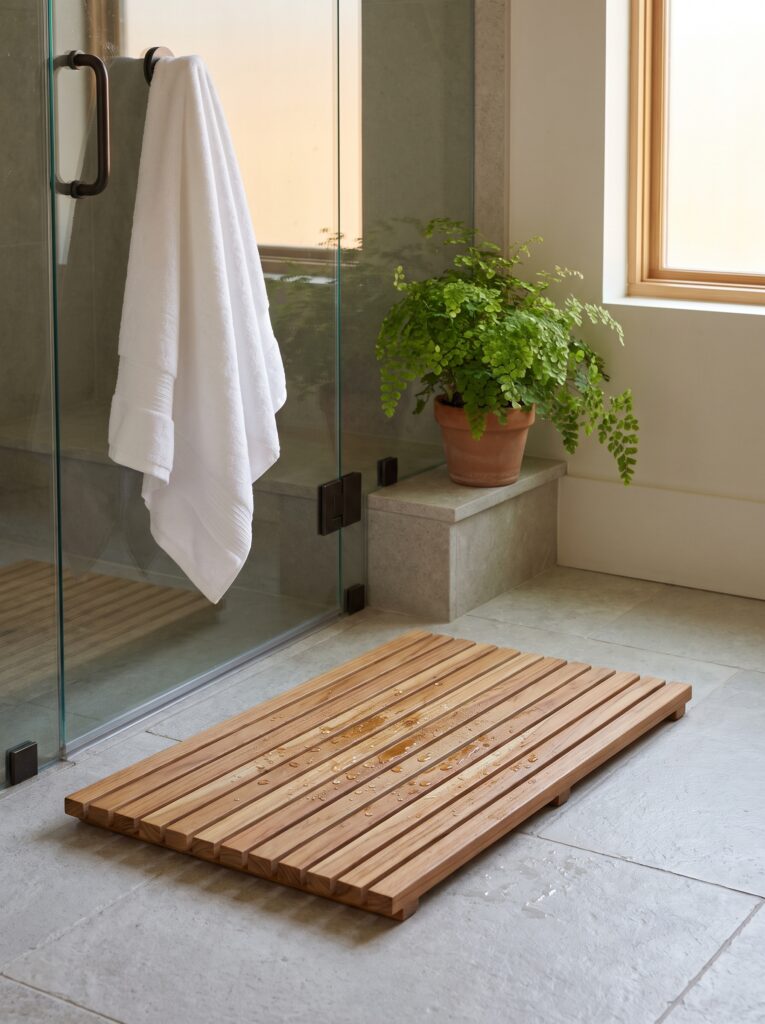
Most people reach for fabric, but a slatted wood mat dries faster than any weave. D&G Flooring lists bamboo and teak mats as water-resistant and quick to dry, and they suit a spa look.
Open slats let water run through and let air reach the floor underneath, so nothing stays wet. Choose solid wood with rubber feet so the mat doesn’t slide, and check that the gaps between slats aren’t wide enough to catch a heel.
Wood is hard underfoot, so pair it with a soft mat at the vanity. Wipe it dry now and then, and expect it to fade slowly to a silvery tone, which suits quiet, natural palettes.
Teak is naturally oily, which is why it handles steam. If you ever want the honey color back, rub on a thin coat of teak oil; otherwise let it age. Either way, lift the mat when you mop so water doesn’t sit under it.
Shop it on Amazon: StrongTek Large Teak Bath Mat, 35.4″ x 20″ Solid Wood Shower Mat with Slatted Design
Dry the mat between uses and wash it without fabric softener
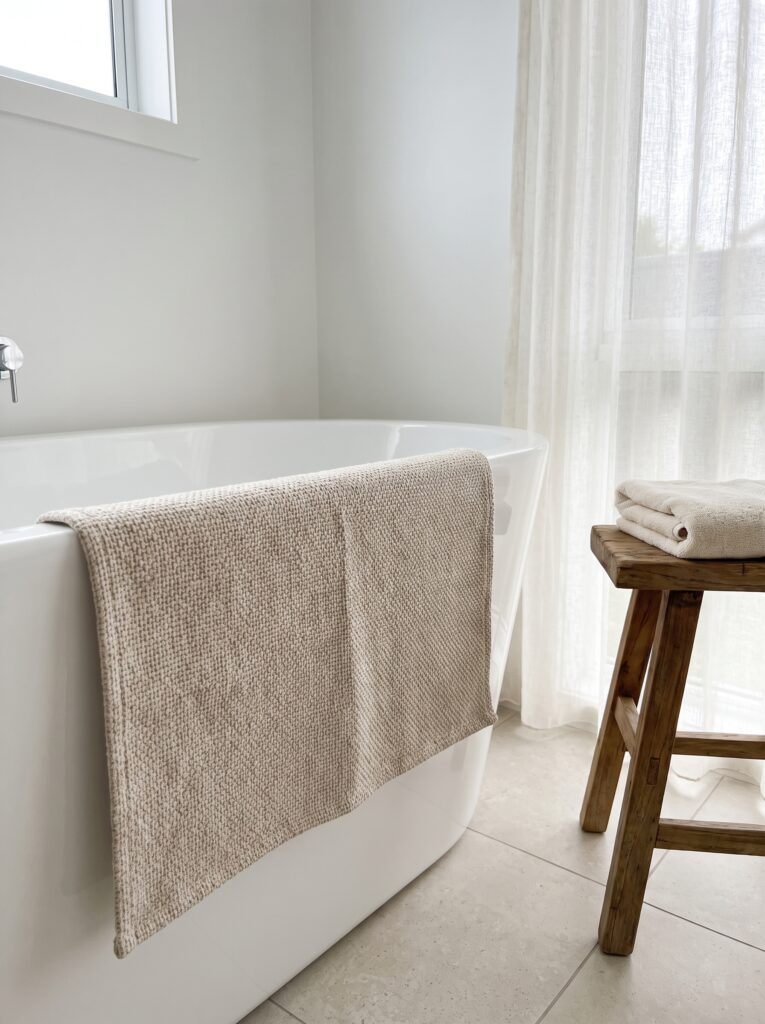
A bath mat that stays wet starts to smell musty, so hanging it up after each shower matters more than which rug you buy. Draping it over the tub edge or a towel rail lets air reach both sides.
The guides disagree on washing. Ruggable says to shake out the rug weekly and wash it every two to four weeks, while D&G Flooring says every week or two. In a family bathroom, go with the weekly end, and wash any mat that smells damp.
Skip fabric softener. It coats cotton fibers and lowers absorbency, and none of the 15 guides read for this piece mentions it. Use plain detergent, and follow the care label.
D&G Flooring warns that harsh heat can wear down the rubber grip on a backing, so dry on low and check the grip before you put the mat back on tile.
Rotate two mats if you can. While one dries over the tub, the other does the work, and both last longer than a single mat that never gets a full day to dry.
Add an open-weave pad and keep latex off heated floors
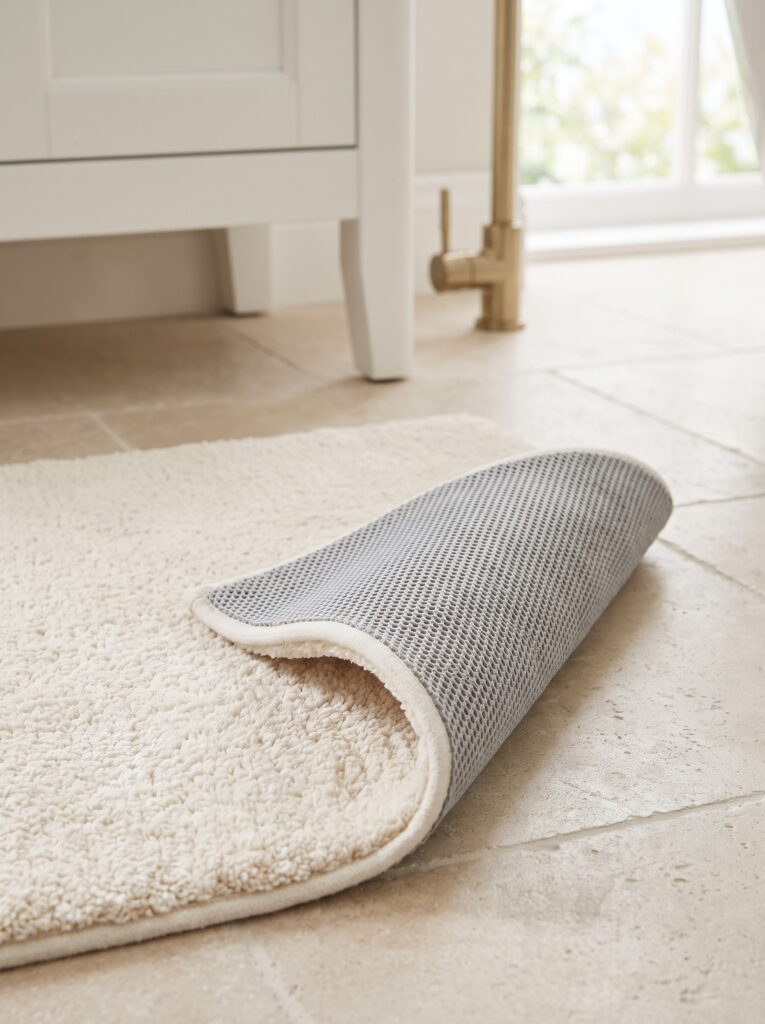
Tile gives almost no grip, but the wrong pad can trap moisture. Kirmen Rugs advises an open-weave, rubber-backed pad in damp rooms, because it lets air circulate under the rug instead of holding water against the floor.
Cut the pad one to two inches smaller than the rug on every side so its edge never shows or curls. The grey mesh in the photo is a built-in backing, and a flatweave runner without one needs a separate pad.
Heated floors change the rule. Rugvista suggests choosing a bath mat without latex, or adding an anti-slip accessory, if your bathroom has heated floors.
Skip the pad if the mat already has a grip backing, since two layers of rubber can hold moisture between them. Lift a corner, as in the photo, and check the mesh is intact and not peeling.
Shop it on Amazon: ITSOFT Non Slip Area Rug Pad Carpet Underlay Mat on Hard Floor Runner Extra Strong Grip, 2 x 4 Feet
Pick stripes, checks or a tonal weave that hide splashes and tie to the vanity
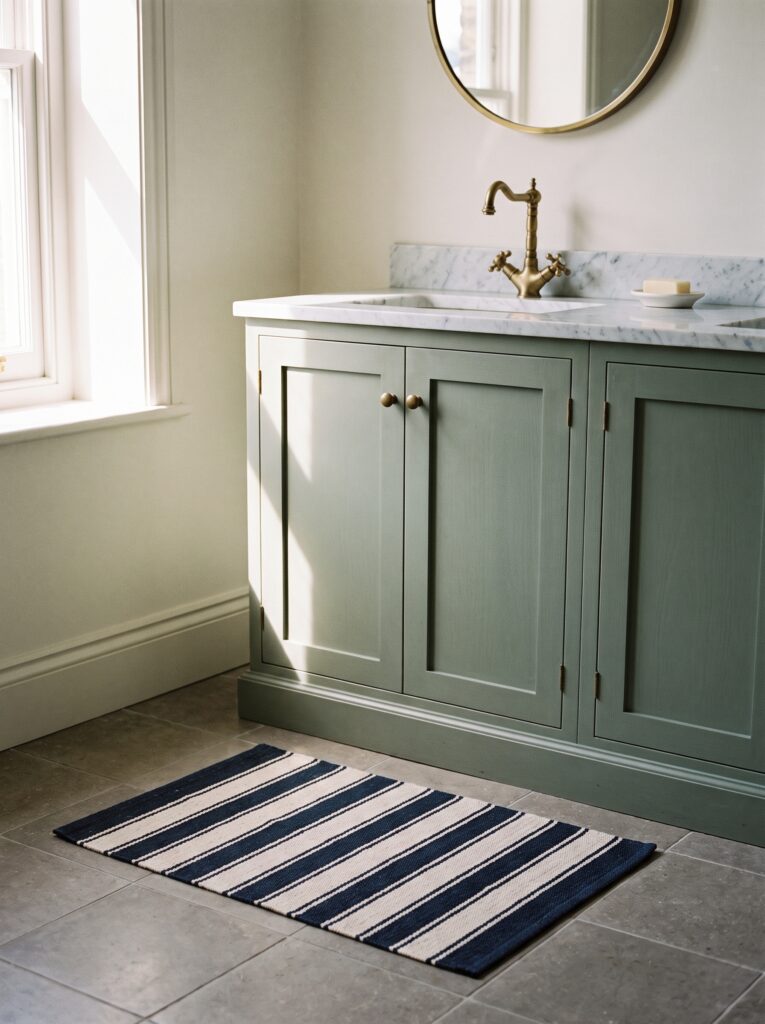
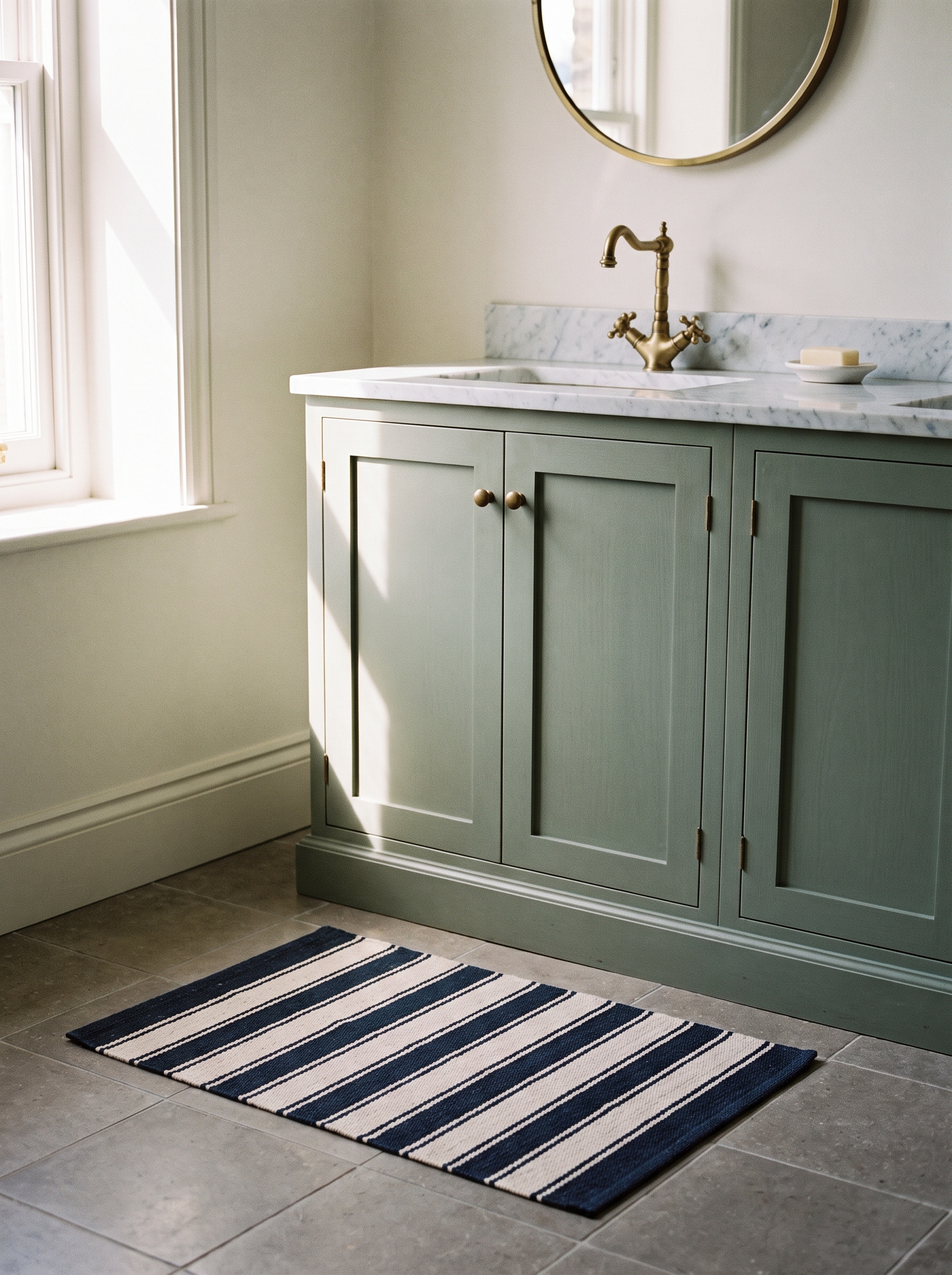
Plain white shows every footprint, so choose a stripe, a check or a textured weave that breaks up splashes. Stripes also pull the eye along the floor, which helps a short room.
Tie the rug to something that doesn’t move. The Rugs suggests matching your towel or tile color for a cohesive look, and a navy stripe against a sage vanity does the same job with a cooler accent.
Check the dye before you commit. Colorfast cotton keeps its stripes crisp after washing, so rub a corner with a damp white cloth before the first wash.
Use the stripe direction to fix the room. Stripes running toward the door make a short room feel longer, and stripes running across make a narrow one feel wider.
Stay with two colors beyond the tile. More than that turns the floor into the loudest thing in the room.
Check four bathroom rug myths before you buy
Four bits of advice come up again and again, and each one costs money when it’s wrong.
| The myth | What to do instead |
|---|---|
| Bigger is always better. | Leave 3 to 6 inches of bare floor around the rug, depending on the guide, and keep it clear of the door swing. |
| A rug pad stops every slip. | Use an open-weave, rubber-backed pad one to two inches smaller than the rug, never a solid layer that holds water. |
| Fabric softener makes it plusher. | It lowers absorbency. Wash with plain detergent and dry on low. |
| A matching 3-piece set is the best deal. | Best Bath Rugs says most sets include a piece you won’t use. Buy only the sizes your zones need. |
| Natural fibers are the best spa look. | Jute and sisal soak up water and dry slowly. Choose teak or bamboo slats for a natural look that dries. |
Start with the myth that fits your room. If the mat is soaked every day, the drying rule beats the size rule, and if the floor is tile, the pad rule comes first.
Start with the one spot that gets wet first
Walk through your morning and note where your feet land wet. Tape a rectangle there, check the door swing, and buy the right bathroom rug size for that one spot before anything else.
These bathroom rug ideas work best one zone at a time. Fix the tub or shower step-out first, add the vanity mat next, and leave the rest of the floor bare until the room asks for more.
Save this pin to your bathroom decor board so the sizes stay close when you shop for your bathroom rug.