
18 Stunning Bathroom Accent Wall Ideas for a Spa Retreat
The right bathroom accent wall material depends mostly on where the wall sits. Behind a vanity or toilet, almost anything works, including paint, wood slats, or peel-and-stick tile. Inside a shower or tub surround, stay with real tile or sealed stone. Renters should choose removable options only. One caveat: pick the wall you see first when the door opens, not the largest one.
Most roundups of bathroom accent wall ideas hand you forty photos and no way to tell them apart. You end up saving six pins, then stalling at the store because nobody mentioned that the look you loved costs $900 in stone, or needs a tile saw you do not own. The photo was never the hard part. Choosing the material was.
So this list is sorted by what the wall is actually made of. Each bathroom accent wall below names its material, what it takes to install, and the kind of bathroom it suits. Some of these you can finish on a Saturday with a level and a caulk gun. Others need a contractor and a real budget. Both belong here, as long as you know which is which before you start.
The eighteen walls ahead cover tile, wood, paint, plaster, wallpaper, brick, and stone. They run from a rented powder room where nothing can be permanent to a primary bath with a skylight and a marble slab. Sizes vary too, from narrow alcoves barely wide enough for a sink to double vanities with room to spare. For more ways to layer texture and storage into a small space, our bathroom decor and storage guides go deeper on the pieces that sit in front of these walls.
This post contains affiliate links. If you buy through them, I may earn a small commission at no extra cost to you.
Vertical white oak slats behind a floating vanity

Thin white oak slats run floor to ceiling here, and the ridges catch late morning light so the wall reads striped without any paint. A walnut floating vanity sits below with a white quartz top and a small backsplash lip. Two brass sconces flank a round black mirror, and a snake plant in a terracotta pot breaks up the grain.
Slat panels usually come in 94.5 inch lengths, which clears a standard 8 foot ceiling with a couple of inches to spare. Measure your ceiling before ordering a slat accent wall, because trimming the top of a panel is far more visible than trimming the bottom where the vanity hides it. If you want to build the look from individual boards instead of panels, our DIY wood accent wall walkthrough covers the spacing and adhesive steps.
Shop it on Amazon: White Oak Wood Slat Acoustic Wall Panels, 2 Pack
Emerald zellige tile stopped at the window sill
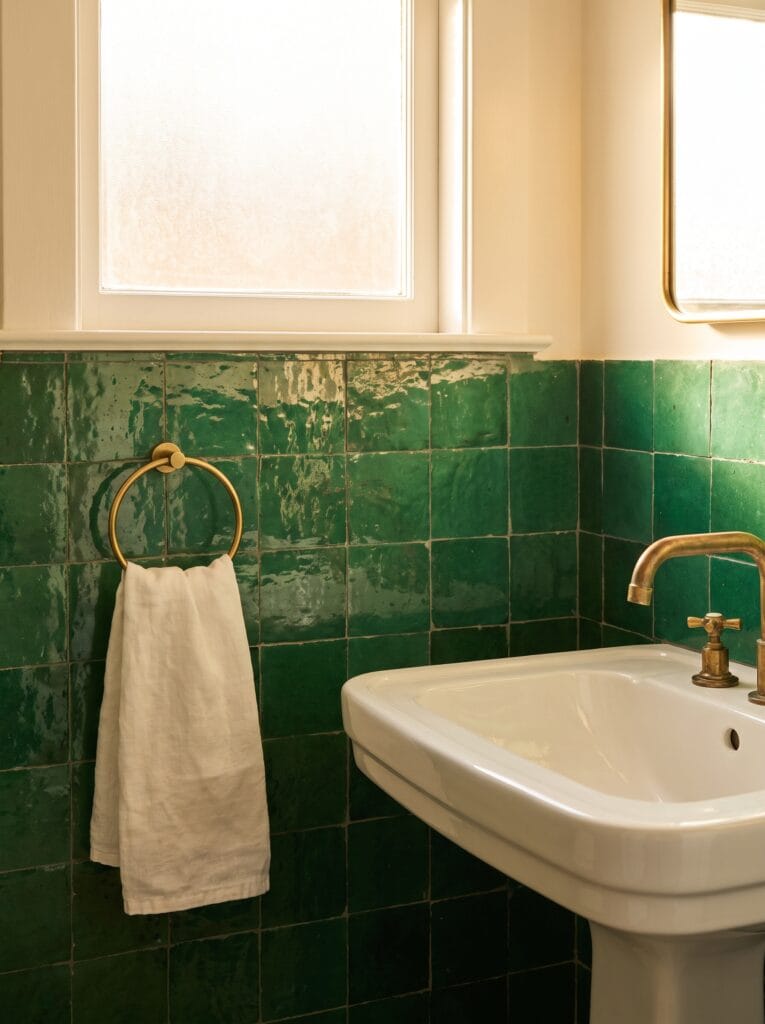
Glossy emerald zellige covers the lower two-thirds of this wall and stops clean at a white sill cap. No two tiles reflect the same way, so the green shifts from near black in the shadows to bright jade where the frosted window light hits it. A white pedestal sink and an aged brass faucet keep the rest quiet.
Zellige is handmade, so expect chipped edges, uneven thickness, and color that varies tile to tile. That irregularity is the entire appeal, but it also means you should order 20 percent extra rather than the usual 10, because you will reject some pieces on sight. Ending a tile accent wall at sill height instead of running it to the ceiling also cuts the material cost by roughly a third.
Floor-to-ceiling checkerboard in a powder room

Black and white checkerboard runs the full height of this narrow powder room, behind and beneath a white console sink. A chunky wood-framed round mirror sits dead center, a bare bulb hangs off to one side, and brass wall-mounted taps come straight out of the pattern. A jute basket of rolled towels grounds the bottom.
A bold accent wall in a tiny room works better than most people expect, but the trick is committing to one wall and leaving the other three plain white. Center the pattern on the sink, not on the wall, so the squares line up with the thing people actually look at. Peel-and-stick versions let you test the scale for under $40 before you commit to real tile.
Shop it on Amazon: RoomMates StickTiles Black and White Checkerboard Peel and Stick Tile
Sage board and batten with a hook rail

Soft sage battens run vertically to about chest height and cap off with a molded rail that doubles as the mount for four brushed nickel hooks. A striped Turkish towel hangs from one. Above the rail the wall goes back to warm cream, and a white oak floating shelf holds a textured vase with eucalyptus.
Board and batten is the cheapest accent wall with real dimension, since you are mostly buying primed 1×2 strips and paint. Set the cap rail at 42 to 48 inches if you plan to hang towels from it, which is higher than the standard 32 inch chair rail but keeps wet towels off the baseboard. Space the battens 12 to 16 inches apart so the panels read deliberate.
Creamy beadboard behind a clawfoot tub

Narrow beadboard grooves climb the full wall behind this clawfoot tub, painted a creamy off-white that turns almost yellow in the afternoon light. Black cross handles and exposed black supply lines stand out against it. A waffle blanket hangs over the tub edge, and ferns in terracotta pots sit on wide plank floors.
Beadboard gives an accent wall the same vertical rhythm as slats for a fraction of the cost, and it comes in 4×8 sheets one person can carry. Prime the back of the sheet as well as the front before installing, because unsealed MDF beadboard swells at the seams in a bathroom within a couple of years. Caulk the top edge where it meets the wall.
Navy paint color-blocked two-thirds up the wall

Deep navy climbs about two-thirds of this wall and stops in a crisp horizontal line, with flat white above it. White subway tile wraps the tub corner and meets the navy at a clean vertical edge. A small aged brass shelf holds a lit candle and a stack of design books, and the whole thing sits over honey wood floors.
Color-blocking is the lowest-cost accent wall on this list and takes an afternoon. Run the line at roughly two-thirds ceiling height rather than halfway, since a true half split makes ceilings look lower. Use a laser level and press the tape down with a putty knife, then paint the wall color over the tape edge first so any bleed is white on white.
Botanical peel-and-stick wallpaper in a rental

Watercolor eucalyptus leaves in soft green cover a cream ground here, wrapping the corner behind a plain white vanity. A round rattan mirror sits centered, a fern in a speckled pot balances the counter, and two linen towels hang from hooks on the return wall. Nothing about it is permanent.
A peel-and-stick accent wall holds best on smooth satin or semi-gloss paint, and fails fastest on flat paint or heavy orange-peel texture. Wipe the wall with rubbing alcohol and let it dry fully before you start, since even light hairspray residue will cause the seams to lift within weeks. Buy one extra roll so you can pattern match at the corner. Our small-space wallpaper guide covers which prints hold up in a windowless room.
Shop it on Amazon: HAOKHOME Green Botanical Leaf Peel and Stick Wallpaper
Book-matched marble slab under a skylight

Two marble slabs meet in the center so the grey and ochre veining mirrors itself, running vertically like a butterfly wing behind a freestanding stone tub. A skylight above throws a hard diagonal of light across the surface. Matte black tub filler, dark stone floor, one wood stool with a rolled white towel.
Book-matching only works if you or your fabricator select the actual slabs in person, since the veining is the entire point and photos will not tell you enough. Ask for the pair to be cut from sequential slices of the same block. This is the most expensive accent wall here by a wide margin, so if you love the look on a smaller budget, our Carrara marble ideas show cheaper ways in.
Vertically stacked tile with charcoal grout

Long white tiles stack vertically in a shower, with thin charcoal grout lines drawing the eye straight up to a ceiling-mounted rain head. A recessed niche holds a single amber bottle on a white marble sill. Water still beads on the tile, and the tiled window reveal to the right catches the daylight.
Dark grout against white tile is the cheapest way to make an ordinary tile accent wall look intentional, and it hides soap film far better than white grout does. Stacking the tile vertically instead of the usual horizontal offset adds visual height, which matters in a shower with a low ceiling. Use unsanded grout for joints under 1/8 inch to keep the lines this crisp.
Dusty rose penny round in a narrow alcove

Small dusty rose penny rounds fill this alcove wall from floor to ceiling, and the white grid of grout between them softens the pink into something closer to clay. A round brass mirror hangs left of a milk glass sconce, and a white wall-hung basin with a brass bottle trap floats below a slim wood shelf.
Penny round comes on mesh sheets, which makes it far more forgiving on a narrow accent wall than large-format tile, because you can cut the sheet between tiles instead of through them. Grout color does most of the work with this shape, so order a sample board and view it under your actual bulbs. Warm brass fixtures keep dusty pink from tipping juvenile.
Shop it on Amazon: ANDY STAR 24 Inch Brushed Gold Round Bathroom Mirror
Seamless microcement in warm greige

Hand-troweled microcement covers this wall in a soft mushroom greige with faint cloudy mottling and no grout lines at all. A rough-cut travertine trough basin cantilevers off it, paired with a matte black wall-mounted spout. An oak shelf above holds a stoneware jug with an olive branch, and daylight from the right rakes across the texture.
Microcement is only 2 to 3 millimeters thick, so an accent wall goes straight over existing tile without demo, which is why it costs a fraction of a full retile. It has to be sealed properly to survive splash zones, and the sealer needs redoing every few years. Our microcement bathroom guide breaks down real pricing.
Whitewashed shiplap behind a double vanity
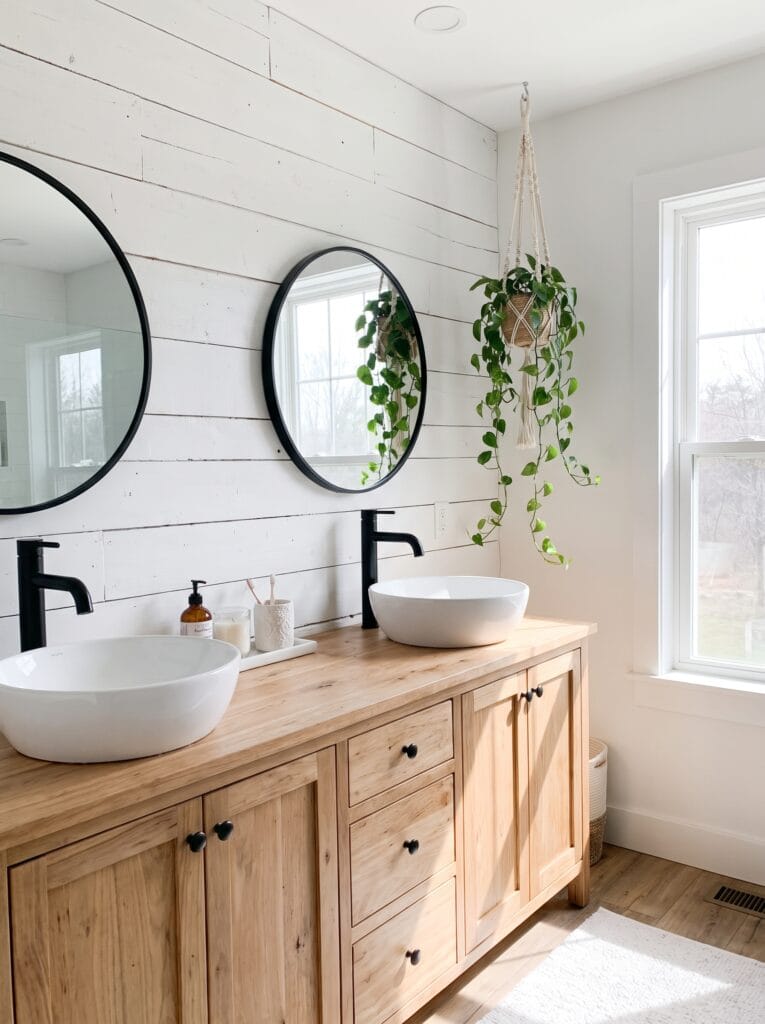
Wide horizontal planks painted a chalky white run behind a double vanity, with the seams and old nail marks left visible instead of filled. Two round black mirrors hang above white vessel bowls on a raw maple counter. A pothos trails from a macrame hanger, and a big window at the right floods the whole thing.
Horizontal planks pull a narrow bathroom wider, the opposite of what vertical slats do, so match your accent wall direction to the problem you have. Leave a nickel-width gap between boards for expansion and let the shadow line do the work. Sealing with a matte water-based poly keeps the whitewash from yellowing over a steamy shower.
Terrazzo slab with terracotta and charcoal chips
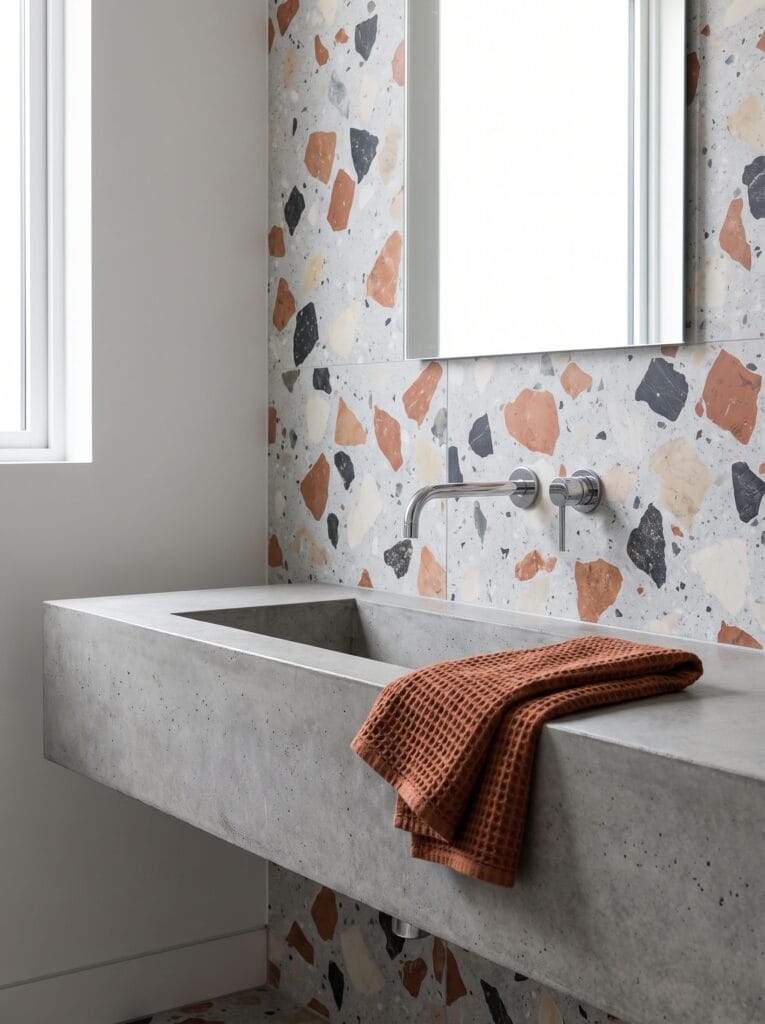
Big terrazzo panels cover this wall, a pale grey base scattered with large terracotta, black, and cream chips plus a fine speckle between them. A frameless mirror cabinet sits flush against it, chrome taps come straight out of the slab, and a polished concrete trough vanity cuts across with a rust waffle towel thrown over the edge.
Terrazzo with big chips reads as pattern from across the room and as texture up close, so it can carry an accent wall without any art or shelving. Pull one chip color into the textiles and stop there, since matching two or three turns busy fast. Large panels also mean fewer grout lines to scrub than a mosaic version of the same look.
Glossy white arabesque tile with a brass sconce
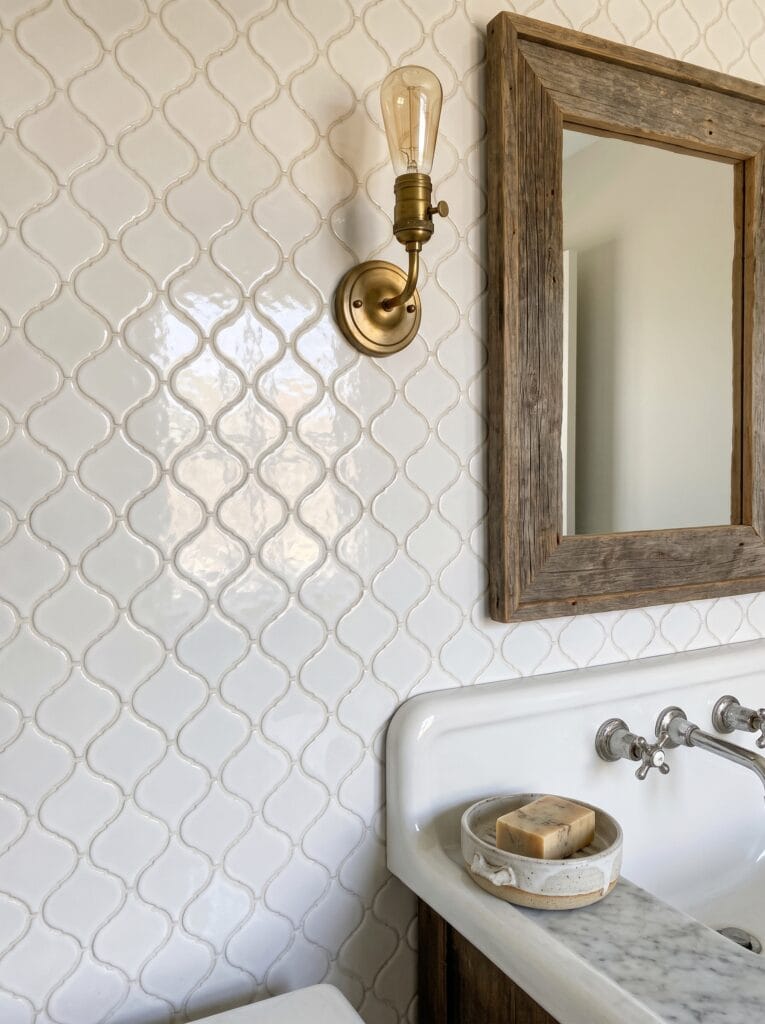
Glossy white arabesque tiles cover this wall in a lantern-shaped repeat, and the curved edges pick up light in a way flat subway never does. An aged brass sconce with a bare amber bulb sits mid-wall, next to a weathered barnwood mirror. Below, a vintage cast-iron sink with a marble ledge holds a speckled dish and a marbled bar of soap.
An all-white tile accent wall lives or dies on shape and sheen, so a hand-glazed finish with slight waviness will always outperform a perfectly flat matte one here. Keep the grout the same tone as the tile so the silhouette stays readable rather than turning into a grid. This shape suits older houses where a square tile would feel too new.
Charcoal slats behind a matte black tub

Black-stained vertical slats fill this wall, with the sawn grain still visible and deep shadow gaps between each board. A matte black freestanding tub sits tight against it, and an antique brass floor filler with a coiled handheld provides the only warm note. A rolled cream towel waits on a black stool, and light from the window slices across the slats.
Dark slats absorb light, so this accent wall only works with a real window or a strong warm fixture nearby, otherwise the corner turns into a black hole. The gaps between boards need to be dusted, and charcoal shows every speck, so keep spacing at 3/4 inch or wider to fit a vacuum brush. Brass or wood keeps it from feeling cold.
Grasscloth wrapping a windowless powder room

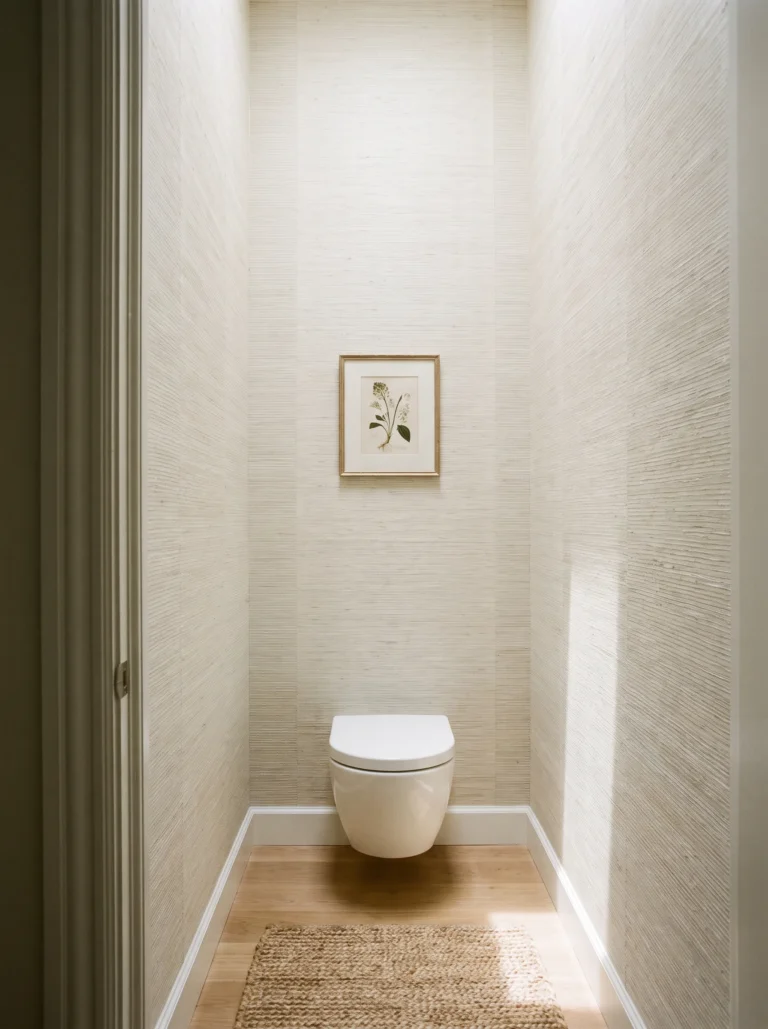
Natural grasscloth wraps both walls of this small powder room, and the woven fibers shift from sand to caramel depending on where the light lands. A brass swing-arm sconce leans out from the corner, a round brass mirror hangs from a ring, and a carved marble wall-hung sink with brass taps floats below.
Grasscloth stains permanently, so a grasscloth accent wall belongs in a powder room where nobody showers, never in a full bath. Accept that the seams will be visible, since that is normal for the material and trying to hide them is a losing battle. In a room with no window, a warm bulb around 2700K keeps the fibers looking golden instead of grey.
Terracotta limewash that changes with the light

Limewash in a warm terracotta clay tone covers this wall with cloudy, brushy movement that never repeats. Strong window light throws pane-shaped shadows across it, and where the sun lands the color washes out to pale blush. A round oak mirror hangs over a rustic plank vanity with a limestone top, brass taps, and a stone soap dish.
Limewash is mineral-based and breathable, so a limewash accent wall handles bathroom humidity better than most matte paints, and it deepens rather than peels as it ages. Apply it in loose criss-cross strokes with a wide block brush and never roll it, since rolling kills the cloudy movement entirely. Two thin coats beat one thick one every time.
Shop it on Amazon: Meoded Lime Wash Paint, Natural Matte Interior Finish
Whitewashed brick in a loft bathroom

Painted white brick runs the length of this loft bathroom, with the mortar joints and uneven paint coverage left rough on purpose. A black captain’s mirror hangs from a leather strap beside an industrial sconce, and a thick reclaimed wood shelf holds stacks of grey waffle towels. A clawfoot tub sits under a black steel grid window.
A brick accent wall needs breathable masonry paint rather than standard latex, which traps moisture and eventually flakes off in sheets. If you do not have brick to begin with, thin brick veneer runs about 1/2 inch thick and installs like tile. Leave some mortar showing through the paint, because full even coverage loses the texture that made it worth doing.
Which accent wall material should you actually choose?
Sorting these eighteen by look is easy. Sorting them by what they demand of you is more useful, so here is how the materials compare on the things that actually decide the project.
Cheapest and fastest: paint, limewash, and board and batten
A color-blocked wall costs the price of a quart and an afternoon. Board and batten adds real depth for the cost of primed 1x2s. Best for anyone testing a bold color before committing, and for bathrooms where the wall is nowhere near direct spray. The limitation is that paint alone adds no texture, so it reads flat in photos.
Best for renters: peel-and-stick tile and removable wallpaper
Both come off without damage if the wall underneath is smooth and properly cleaned first. Best for powder rooms, rentals, and anyone who changes their mind often. The limitation is real: neither survives a shower surround, and heavily textured walls will reject both no matter how carefully you prep.
Best for wet zones: real tile, stone slab, and sealed microcement
These are the only options here that belong inside a shower or directly behind a tub filler. Best for a full renovation where the wall gets wet daily. The limitation is cost and skill, since tile needs a saw and a level substrate, and slab needs a fabricator.
Best warmth per dollar: wood slats, beadboard, and shiplap
All three add shadow and rhythm that no flat finish can match. Best for a powder room or a vanity wall in a well-ventilated bathroom. The limitation is moisture, so keep wood out of direct spray, seal every cut edge, and run the fan.
If you are still stuck, start with the wall you see first when the door opens, then pick the cheapest material on this list that suits how wet that wall gets. That single rule eliminates most of the wrong answers.
Bathroom accent wall ideas: pick the wall first, then the material
A bathroom accent wall is one of the few upgrades where a weekend of work reads as a full renovation, as long as the material fits the wall. Paint and peel-and-stick handle the dry walls and the rentals. Tile, slab, and microcement handle the wet ones. Wood sits in between, warm and forgiving as long as you keep it out of the spray and seal the edges.
Whichever of these bathroom accent wall ideas you choose, pick your wall first, then your material, then your color. Doing it in that order is what keeps a project from stalling halfway through.
Save this pin so you have the material list handy when you start planning your own bathroom accent wall.