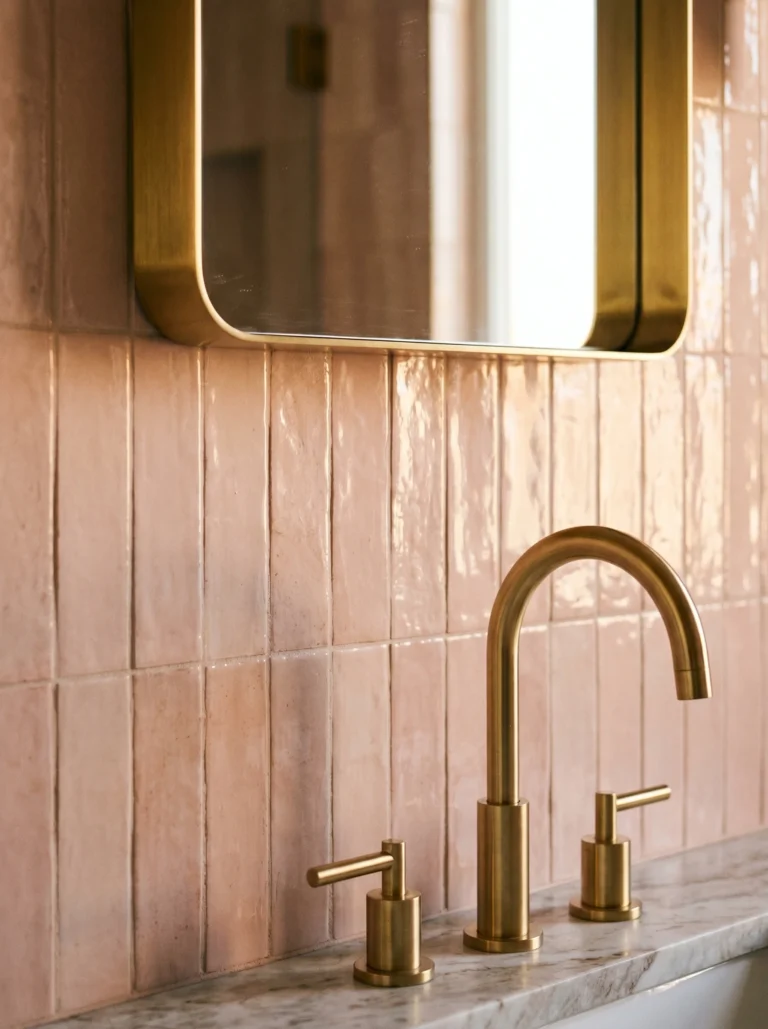

16 Dreamy Blue Bathroom Ideas That Feel Calm, Not Cold
Start with one blue surface, not four. A painted vanity, a tiled half wall, or a patterned floor gives you the color without the chill, and it works in almost any size room. Keep everything else white or wood. The one caveat: north-facing bathrooms need warm blues with a grey or green base, because cool blues go grey in weak light.
Blue is the most requested bathroom color and the easiest one to get wrong. Too much of it, in the wrong light, and a room meant to feel like a spa ends up feeling like a hospital corridor. The difference is almost never the shade itself. It’s how much of the room the blue covers and what sits next to it.
The blue bathroom ideas below are sorted by how much commitment each one takes, from a single painted cabinet to a fully tiled shower. Every one of them pairs the blue with a warming element, because that pairing is what separates the rooms that feel calm from the ones that feel cold.
You’ll find options here for rentals, powder rooms, family bathrooms, and full renovations, across pale sky blues, mid blues, and near-black navies.
This post contains affiliate links. If you buy through them, I may earn a small commission at no extra cost to you.
Paint the vanity navy and leave the walls alone
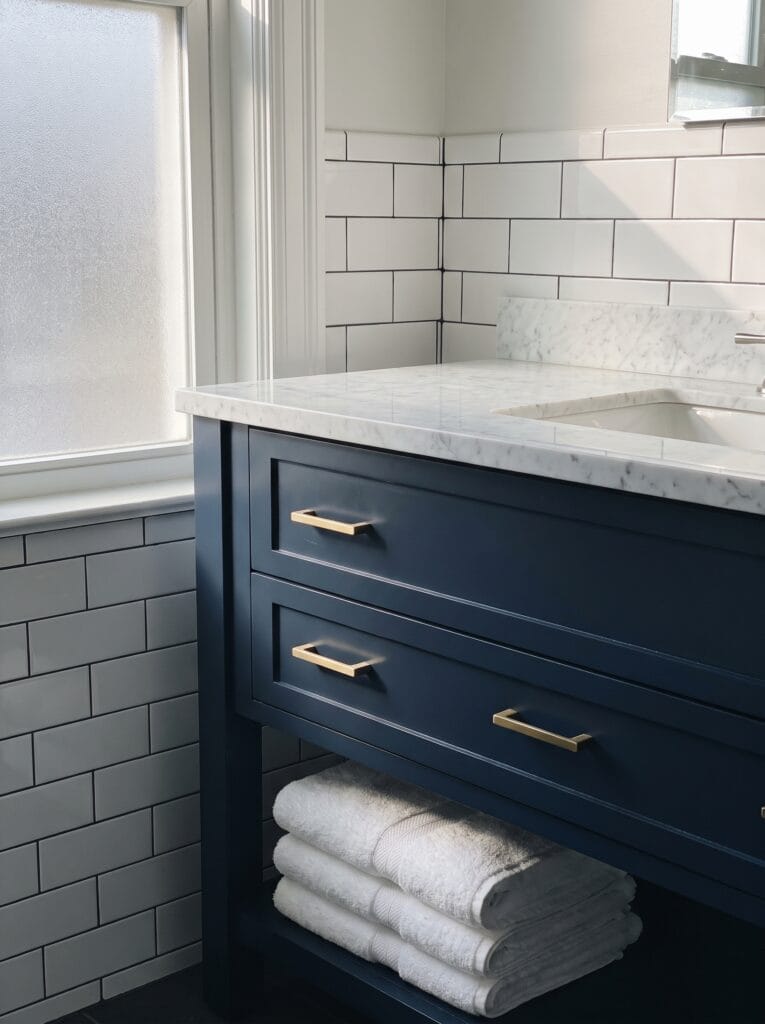
Most people start with the walls. The vanity is the smarter first move, because it delivers the same color hit across a fraction of the surface area and costs a fraction of the effort.
This navy cabinet sits against plain white subway tile with dark grout, under a white marble counter with grey veining. Brass bar pulls warm the navy up, and that pairing is doing the real work here. Navy with chrome reads cold. Navy with brass reads expensive.
Notice the open shelf at the bottom holding folded white towels. A vanity that’s blue on every surface gets heavy fast, so that white gap breaks it up and gives the eye somewhere to rest.
Swapping hardware is the cheapest version of this idea if your vanity is already a color you can live with.
Wrap a small powder room in one soft blue
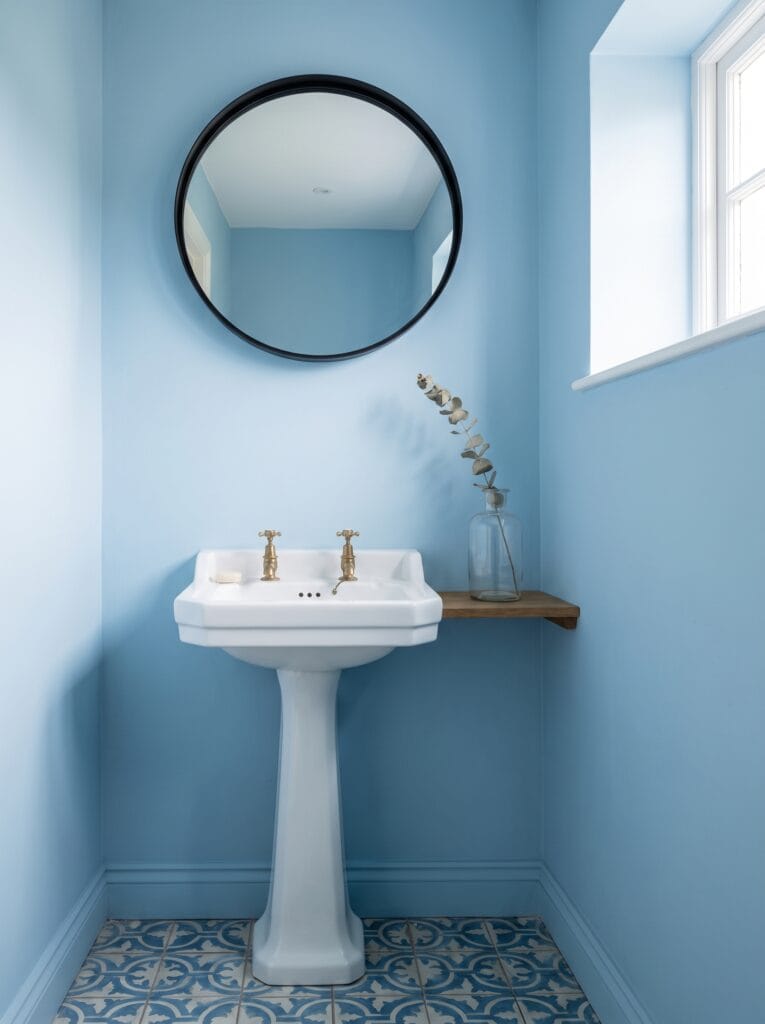
Saturating a small room in a single pale blue is what makes it read as a decision instead of an accident. Half-measures are what make tiny bathrooms look unfinished.
Walls, ceiling, and trim here all wear the same soft cornflower, so there’s no line where the color stops and the eye keeps moving. A white pedestal sink and a black-framed round mirror punctuate it, and the blue and white patterned floor tile picks the color back up underfoot.
A light blue bathroom like this also holds its color better than a mid-blue would at this scale, because pale shades bounce what little daylight the room gets. The narrow oak shelf beside the sink matters more than it looks. In a room with no vanity, you still need somewhere to put a bottle, and a 6 inch deep shelf solves that without crowding the floor.
Tile a shower in glossy blue if it gets real daylight

Reach for handmade glossy tile when your shower has a window. Uneven glaze needs direct light to show what makes it worth the money, and in a dark shower it just reads as flat blue.
These cobalt zellige squares run floor to ceiling and across the ceiling itself, and the light coming through the high window catches every ripple in the surface. No two tiles reflect the same way, which is the whole point of the material.
Grout choice is doing quiet work here. A warm sand-colored grout instead of white keeps the grid from fighting the tile. Glossy blue bathroom tile also shows water spots less than matte, which matters on a wall that gets hit every day.
One teak stool in the corner is the only warm object in the room, and it stops the blue from feeling clinical.
Run beadboard halfway up a family bathroom

Splashes, wet hands, and towel hooks destroy painted drywall in about two years. Beadboard wainscoting takes that beating and can be repainted in an afternoon.
Here it climbs to just above waist height in a chalky sky blue, with warm white plaster above and the window trim painted to match. The clawfoot tub and the wide-plank wood floor keep the whole thing from tipping into nursery territory.
A brass sconce with exposed bulbs and an oval brass mirror add the warm metal this palette needs. Woven seagrass holding rolled towels does the same job in texture.
Look for tongue-and-groove panels rated for damp rooms rather than standard MDF beadboard, which swells at the bottom edge where it meets the floor.
Let a patterned floor carry the whole room

Patterned floor tile costs more per square foot than plain tile and saves you from decorating every other surface. That trade is worth making in a small bathroom where there isn’t room for much else.
This blue and white encaustic pattern runs wall to wall under a vintage clawfoot tub, and the walls stay a plain warm off-white. Brass wall-mounted taps and two maidenhair ferns on wooden stools are the only other decisions in the room.
Encaustic cement tile needs sealing before and after grouting, and resealing every year or two. Porcelain versions of the same patterns skip that entirely and cost less, at the price of a slightly flatter finish.
Share a double vanity without losing the counter
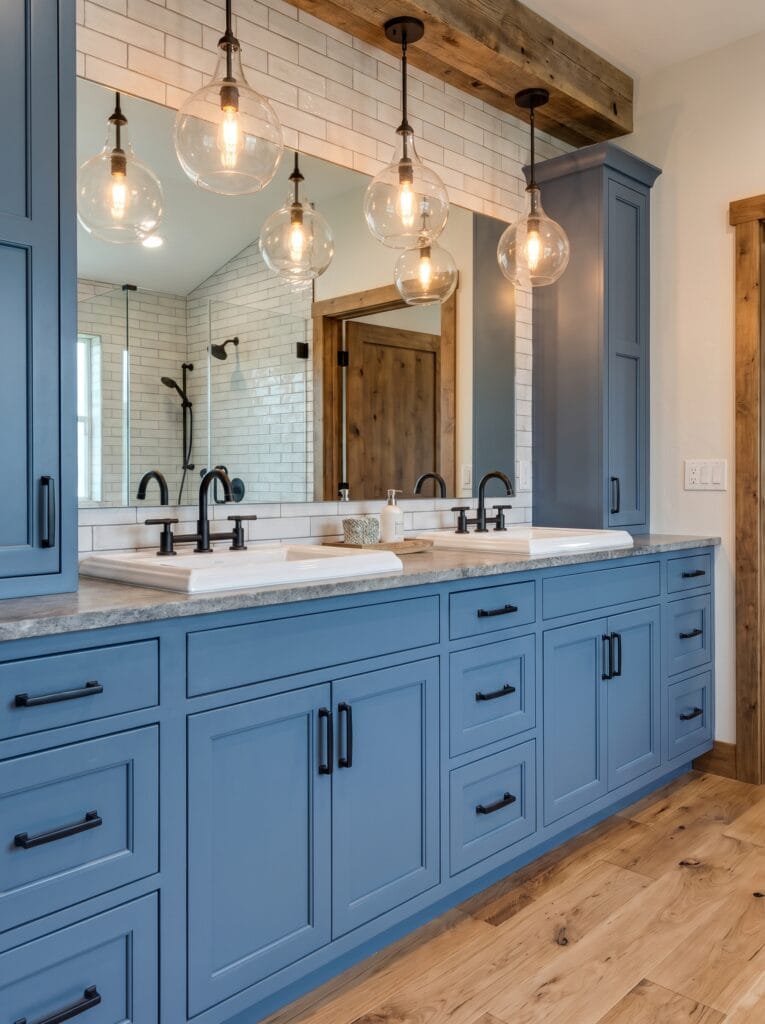
Two people sharing one bathroom run out of drawers long before they run out of style. This layout solves that first and happens to look good second.
The run of cabinetry is deep enough for a full column of drawers between the two sinks, plus a tall tower cupboard at the end. A honed concrete counter takes the color down a notch, and matte black taps and pulls keep it from reading traditional.
Five seedy glass globe pendants hang in a row instead of the usual pair of sconces, which spreads light evenly along the whole counter rather than pooling it at two points.
That reclaimed beam above the mirror is what stops all this blue from feeling corporate. One piece of rough wood in a room of painted cabinetry changes the temperature of the whole thing.
Paint the ceiling too when the room is small and odd

Awkward rooms get worse when you outline every angle in a different color. Taking one deep teal across the walls, the ceiling, and the sloped section removes every edge the eye could catch on.
The brass flush mount reads like jewelry against that depth, and the white waffle shower curtain and pedestal sink give the color something bright to sit against. Without those white elements the room would close in.
Deep colors like this need an eggshell or satin finish in a bathroom. Matte holds moisture and marks where hands touch the wall.
If you like the saturated approach but want something warmer, our modern burgundy bathroom ideas use the same trick in a completely different temperature.
Choose a blue tub before you choose blue walls
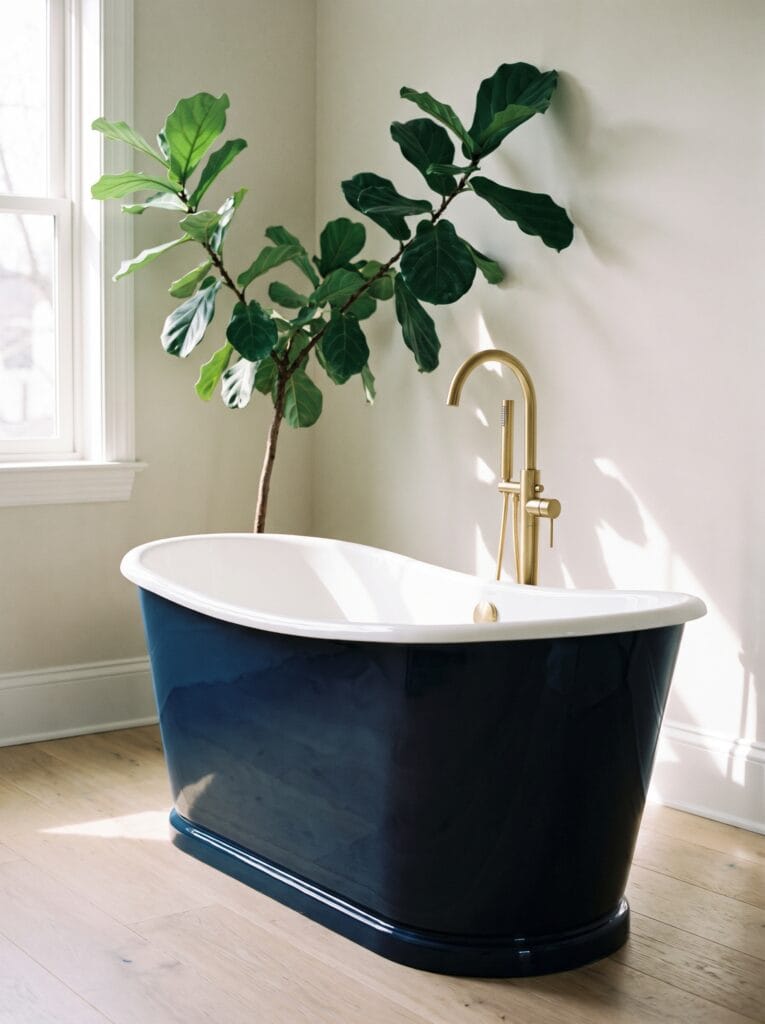
Painted tubs look like a decision you’d regret. They’re actually the easiest blue in the house to live with, because the color sits below eye level and the inside stays white.
This roll-top has a high-gloss navy exterior against greige walls and a pale oak floor. The brass floor-standing filler with its handheld shower repeats the warm metal, and a fiddle leaf fig fills the corner behind it.
Freestanding tubs need roughly 4 to 6 inches of clearance on all sides to actually clean around them. Measure that before falling for one.
Add a removable feature wall in a rental

Nothing permanent is allowed in a rental, and most rental bathrooms are the same builder beige. One wall of peel and stick wallpaper fixes that in an evening and comes off cleanly when you move.
Only the wall behind the toilet is papered here, in a blue and white triangular geometric. The remaining walls stay white, which is what keeps a bold pattern from overwhelming a small room.
A reclaimed wood shelf on black brackets holds a glass jar of cotton rounds and a trailing pothos. Putting a plant at shelf height lets it spill down over the pattern and softens the hard geometry.
Wipe the wall with rubbing alcohol before you start. Adhesive fails on bathroom walls because of invisible hairspray and cleaning product residue, not because of steam.
Shop it on Amazon: FunStick Navy Blue Geometric Peel and Stick Wallpaper
Hang a painted cabinet where you can’t retile
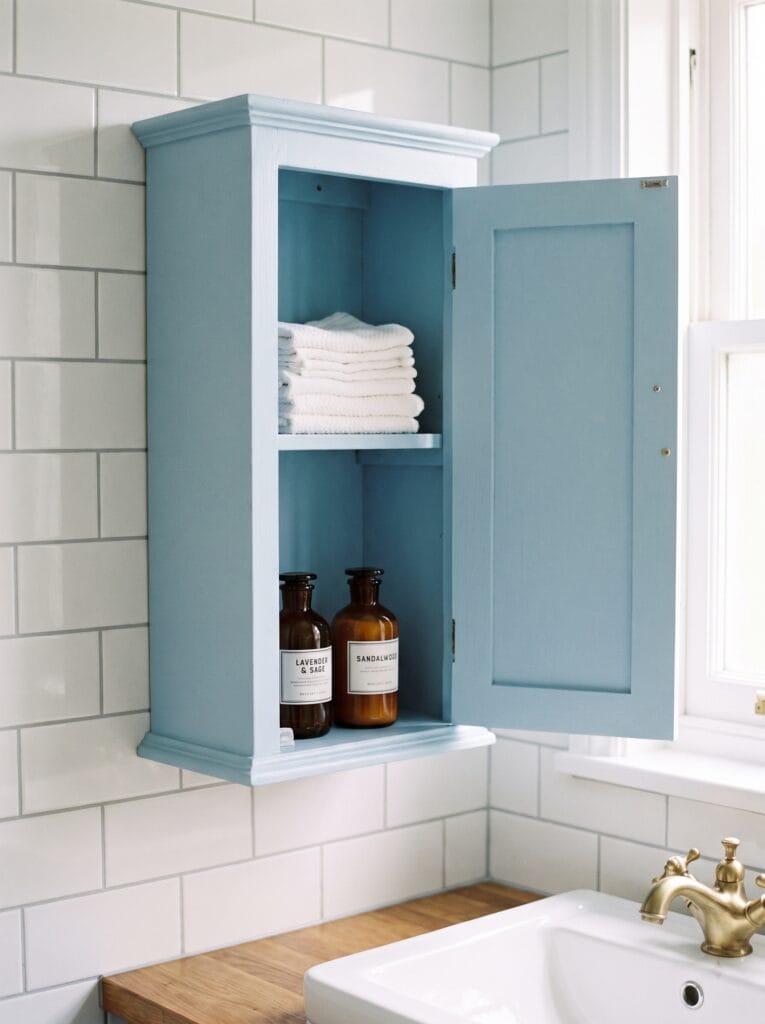
A painted wall cabinet is the cheapest way to get color into a bathroom whose tile you’re stuck with. It also buys you storage, which no amount of paint will do.
This one wears a soft powder blue inside and out, mounted on white subway tile above an oak counter. The open door shows folded white towels on the upper shelf and two amber apothecary bottles below.
Painting the interior the same blue is the detail most people skip. An open cabinet door showing raw white melamine undoes the whole effect.
Decanting shampoo into matching bottles sounds fussy, but it’s the reason this shelf looks styled instead of stocked.
Stop the tile at chair height and paint above it
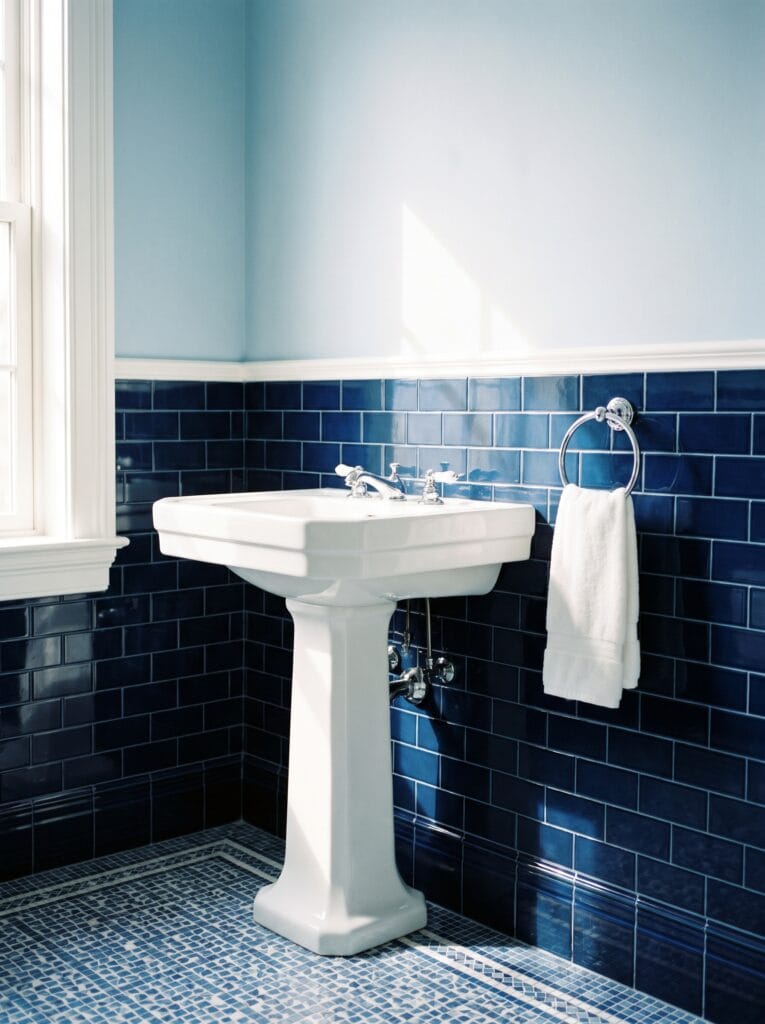
Full-height tile doubles your material cost and often looks colder than you expected. Stopping at chair height costs about half as much and looks more considered.
Glossy navy subway runs up to a white chair rail, with pale blue paint carrying on above it. That two-tone approach makes the ceiling feel higher because the dark band anchors the bottom of the room.
Underfoot, a blue mosaic floor with a darker border frames the space like a rug. The white pedestal sink and chrome towel ring sit against all that blue without competing.
In a house built before about 1940 this is period-correct, and it’s the cheapest way to make a newer bathroom feel original.
Keep coastal blue to the textiles
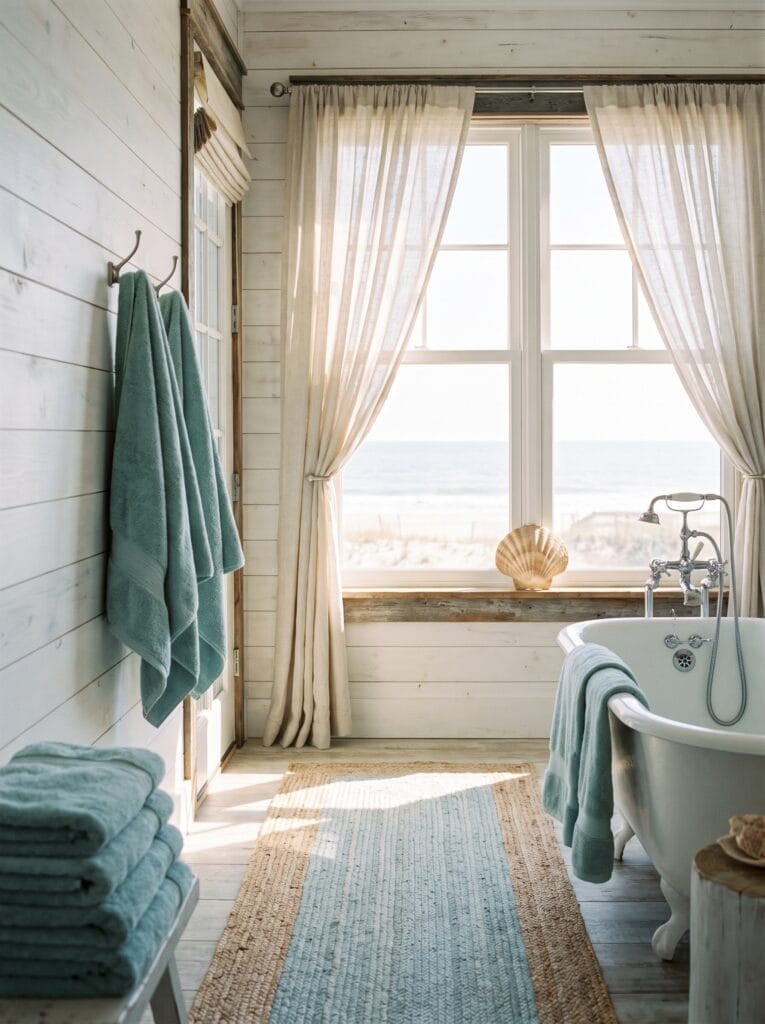
Coastal schemes tip into kitsch when the blue goes onto the walls. Leaving the architecture white and putting every bit of color into the textiles is what keeps it looking like a real house.
The shiplap here is whitewashed, the floors are pale, and the linen curtains are undyed. All the blue lives in the seafoam towels on the hooks, folded on the bench, and draped over the clawfoot tub.
A jute and blue striped runner grounds the middle of the room. Natural fiber underfoot is what stops white-on-white from feeling like a showroom.
Shop it on Amazon: Luxury 6-Piece Cotton Bath Towel Set in Teal
Lay plain tile in a herringbone instead
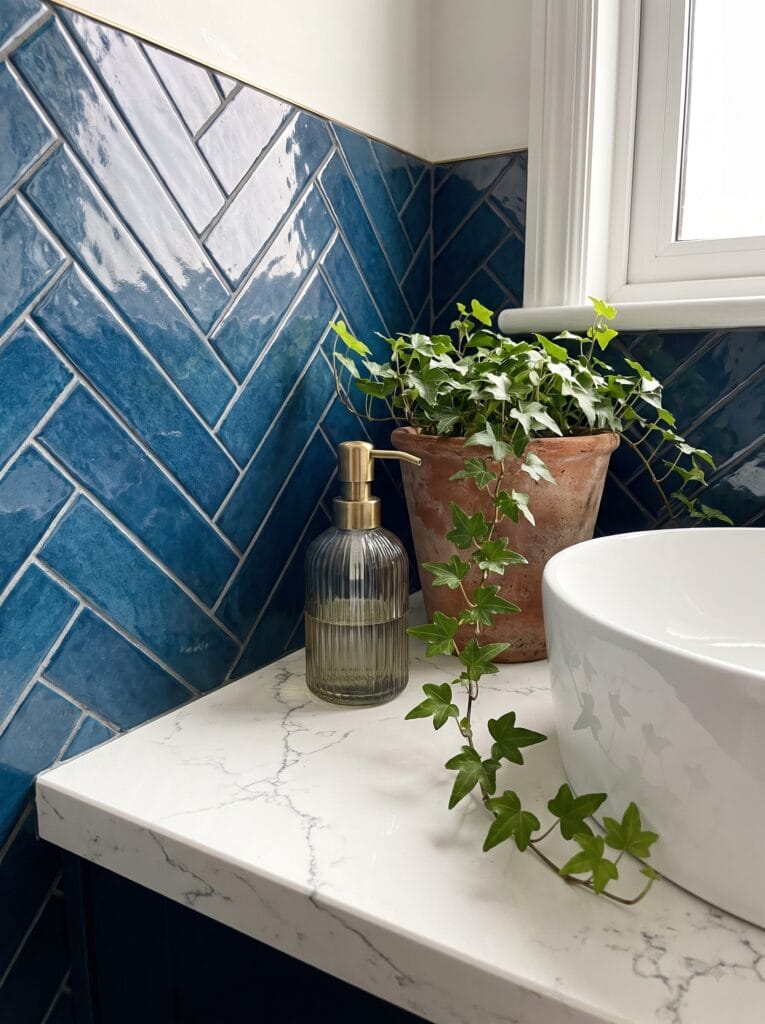
Set your tile in a herringbone when the tile itself is simple. The pattern does the decorating, so you can buy an inexpensive plain rectangle and still get a wall worth looking at.
These mottled blue tiles run up the wall behind a white marble counter, with a thin brass trim strip capping the top edge. Glaze variation between tiles gives the wall depth that a uniform tile would not have.
A trailing ivy in a terracotta pot spills across the counter beside a ribbed glass soap dispenser. Terracotta and blue is an underrated pairing, and the orange in the clay is what makes the blue look bluer. The same warm-and-cool logic runs through our brown and blue bathroom ideas, if you want to push that contrast further.
Herringbone uses roughly 10 to 15 percent more tile than a straight lay because of the cuts at each end. Order accordingly.
Go near-black navy in a windowless powder room
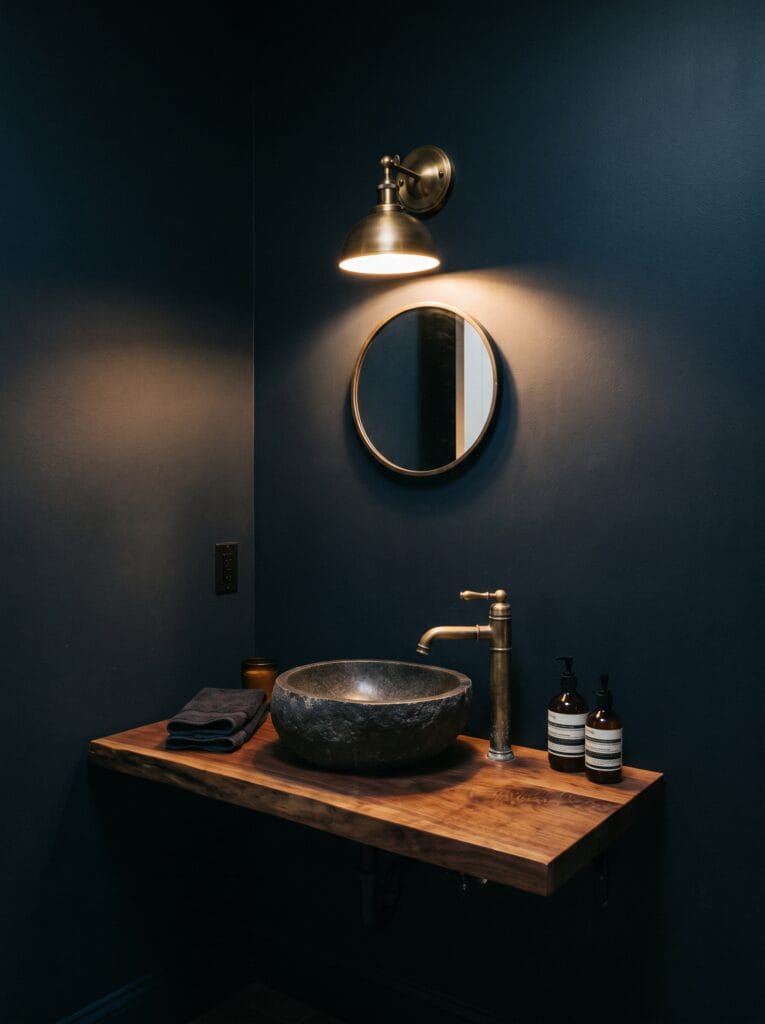
Dark paint is supposed to shrink a room. In a small windowless powder room it does the opposite, because you stop being able to see where the walls are.
A navy blue bathroom this dark lives or dies on its lighting. This one is painted an inky navy on every surface, lit by a single brass dome sconce above a round brass mirror. The light pools warm and leaves the corners soft.
A rough grey stone vessel basin sits on a live-edge walnut shelf, and the contrast between that raw stone and the smooth painted walls is the whole design. Two dark amber bottles are the only styling.
Powder rooms are the right place for this risk. Nobody lingers in one, so it can be dramatic in a way a family bathroom can’t.
Shop it on Amazon: PASSICA DECOR Antique Brass Wall Sconces, Set of 2
Pick fluted fronts to make a plain vanity look custom
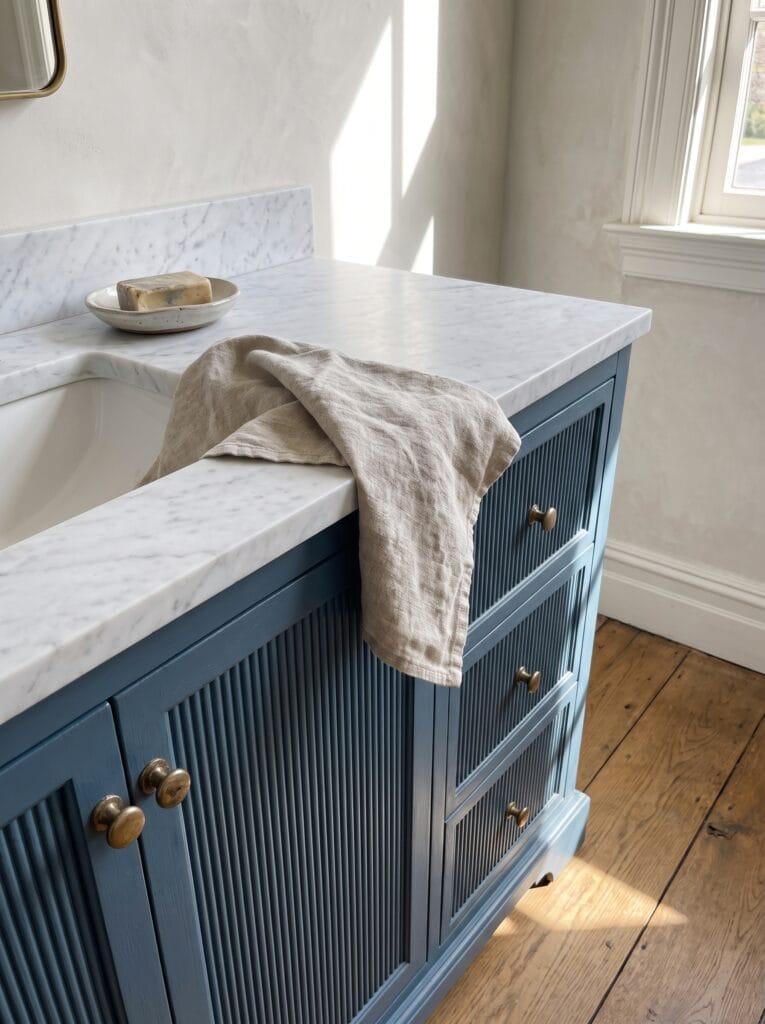
Fluted cabinet fronts are the detail that separates a custom-looking vanity from a flat-pack one. They cost very little extra and read as joinery rather than furniture.
The vertical grooves here catch light down the whole face of a dusty mid-blue vanity, topped with Carrara marble and a matching marble upstand. Aged brass knobs, not pulls, suit the smaller scale of the doors.
That grey-leaning blue is the one to copy if your bathroom faces north. Blues with a grey base hold their color in weak light, while clean sky blues drift toward grey and look washed out.
You can buy fluted panel sheets and glue them onto existing flat cabinet doors, which is a genuine weekend project rather than a renovation.
Give the niche the color instead of the whole shower
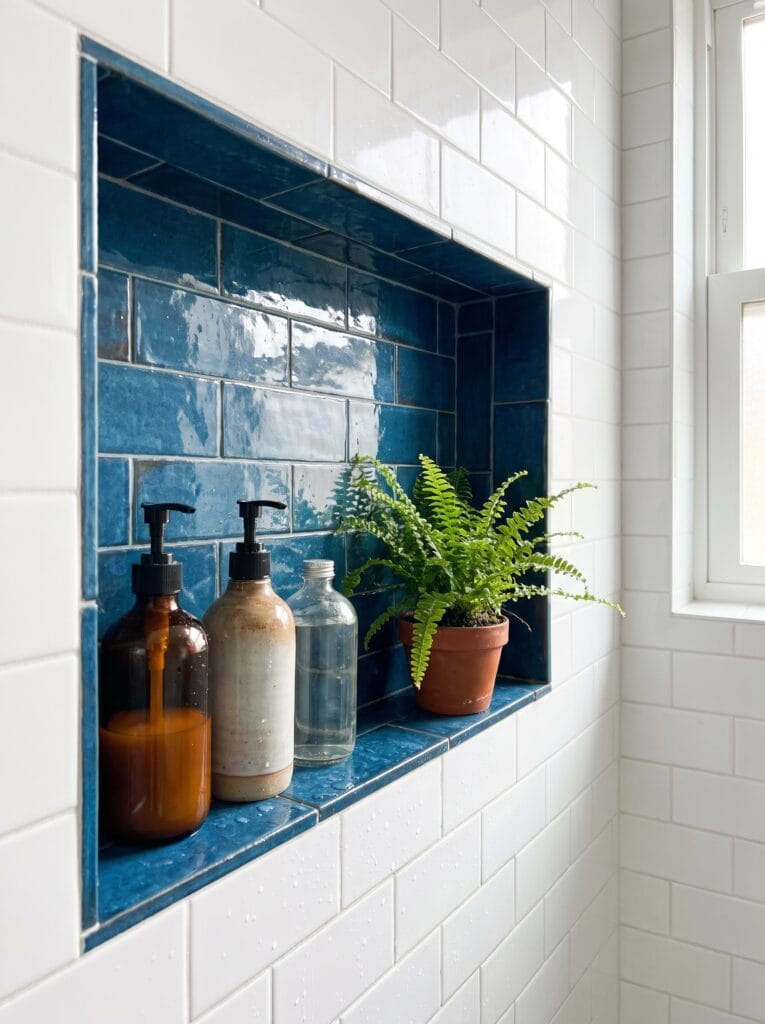
Bottles balanced on the tub edge are what make a clean bathroom look messy. A recessed niche fixes that and costs almost nothing extra when the wall is already open.
Here the shower is plain white subway, and only the niche interior is glossy blue. That inversion is smart: you get a jolt of color exactly where the eye lands, without committing to a blue shower.
The niche is set at roughly chest height and sized to fit tall bottles standing up. Build yours to the height of your tallest shampoo bottle, not to a round number.
A small fern on the ledge survives happily on shower steam. Blue tile with green foliage against white is a combination that works in any size bathroom.
How much blue is right for your bathroom?
The honest answer depends on light and size more than taste. Here’s how the blue bathroom ideas above sort out.
One painted element (vanity, cabinet, or door). Best for north-facing bathrooms and anyone testing whether they actually like living with color. Benefits: reversible in a weekend, cheap, works with tile you already have. Limitation: it won’t transform a room on its own. Best for renters and first-timers.
Blue on the floor or a half wall. Best for small and mid-sized bathrooms with at least one window. Benefits: anchors the room, hides water marks better than pale floors, feels deliberate. Limitation: it’s a real installation with real cost. Best for a bathroom you’re already renovating.
Full saturation, walls and ceiling. Best for powder rooms and windowless spaces. Benefits: dramatic, hides awkward angles, unforgettable. Limitation: it makes a room feel enclosed, which is wrong for a bathroom you spend an hour in. Best for rooms used briefly.
Blue only in textiles and accessories. Best for anyone who changes their mind often, and for shared or rented homes. Benefits: zero commitment, seasonal, cheap. Limitation: it reads as decorated rather than designed. Best for a bathroom whose fixed surfaces you already like.
Whichever tier you land on, pick your blue against the room’s actual light at the time of day you use the bathroom most. A sample board that looks perfect at noon can look grey at 7am.
Where to start with your own bathroom
Pick the surface you’d be happiest repainting in three years, and put the blue there first. That single choice decides how the rest of the room follows. For most people that’s the vanity, and for renters it’s a wall of removable paper or a stack of towels.
Then warm it up deliberately. Brass, oak, terracotta, or jute, chosen on purpose rather than left to chance, is the difference between every calm blue bathroom above and the cold ones you’ve stood in and disliked. More color-led schemes are collected in our bathroom styles and aesthetics guides.
Save this pin to keep these blue bathroom ideas handy when you’re ready to start.