Small Bathroom Color Ideas: Best Paint for No Windows
You don’t have a space problem — you have a light and color problem, and in a windowless bathroom, paint is the single fastest fix that doesn’t require a contractor. Most advice tells you to slap on a coat of white and call it done. But white in a room with zero natural light and a single overhead fixture? That reads cold, flat, and slightly institutional.
Here’s the thing: small bathroom color ideas, and paint colors for small bathrooms with no windows in particular, only work when you account for your actual light source. A windowless bathroom runs entirely on artificial light — usually one warm-toned fixture above the mirror. That changes which windowless bathroom paint colors expand the space and which ones make it feel like a supply closet. The right hue paired with the right bulb temperature can make 40 square feet feel like a spa retreat.
This guide gives you 9 specific, tested color approaches — with exact paint names from Sherwin Williams, Benjamin Moore, and Behr — plus the mistakes that waste your money and the budget shortcuts that actually deliver.
1. Warm White With Depth (Not Builder-Grade White)
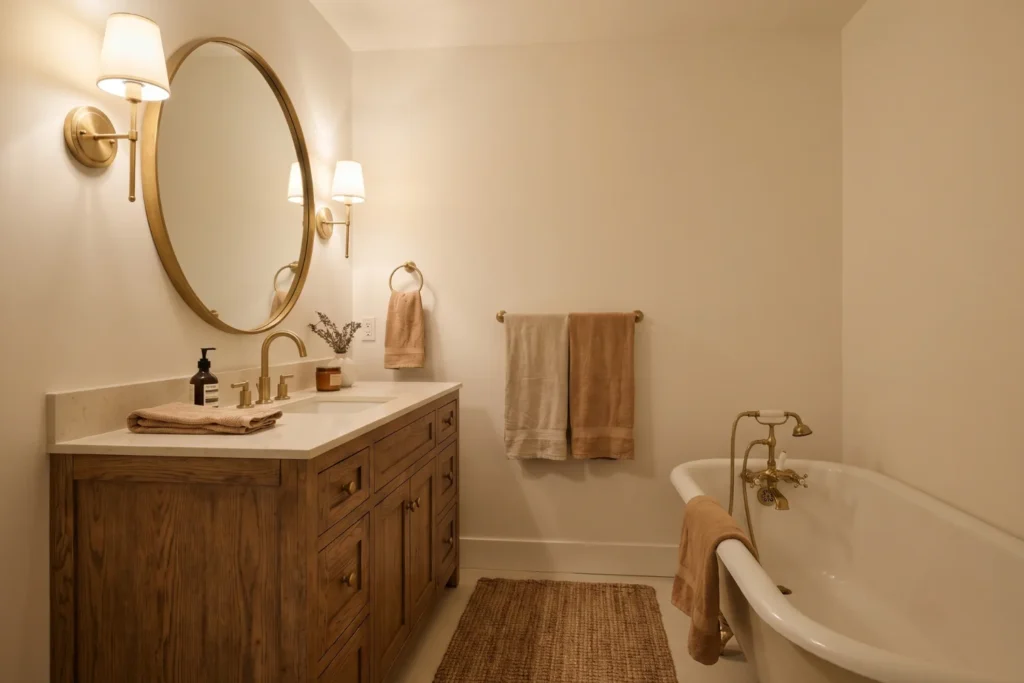
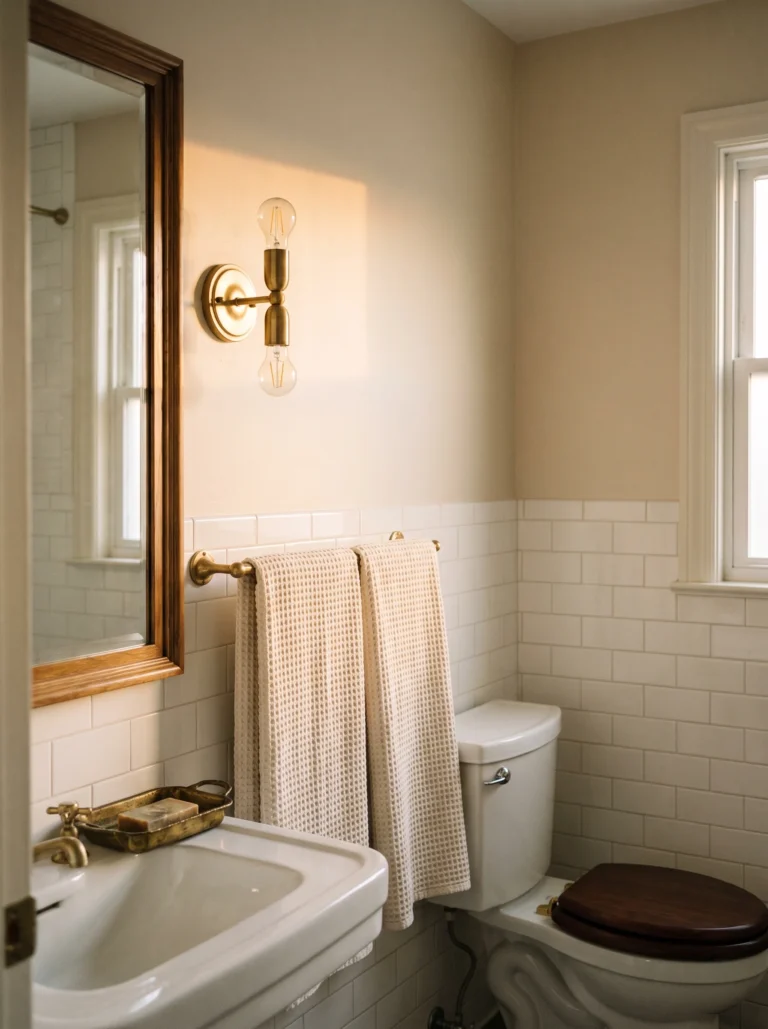
Builder white — the flat, blue-tinted white that came with your bathroom — is the number one reason windowless spaces feel sterile, and replacing it with a warm white that has yellow or pink undertones immediately adds warmth without shrinking the room.
I learned this the hard way when I painted a guest powder room in a “bright white” that looked perfect in the hardware store. Under the 3000K vanity sconces, it turned slightly purple-gray. Switching to Sherwin Williams Alabaster (SW 7008) — a white with a subtle cream undertone — made the same room feel like it had a window.
- Best picks: Sherwin Williams Alabaster, Benjamin Moore White Dove (OC-17), Behr Cameo White
- Works with: gray tile, brass fixtures, wood-toned vanities
- Avoid if: your lighting is already very yellow (it’ll push too warm)
Quick Answer: Warm whites with yellow or cream undertones outperform pure white in windowless bathrooms because they compensate for the absence of natural daylight and prevent the space from feeling clinical.
2. Soft Gray That Actually Reads Gray (Not Purple, Not Blue)
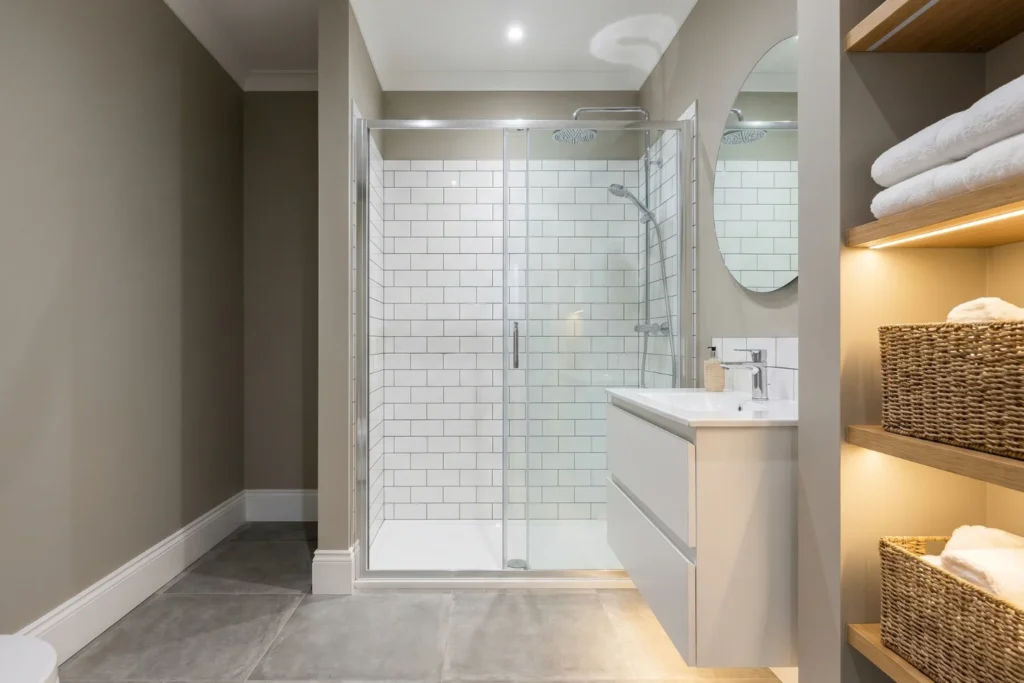
Gray is the most-returned paint color in America because it shifts dramatically under artificial light — in a windowless bathroom, you need a gray with a green or warm taupe undertone to stay true.
According to a 2023 Sherwin Williams color trend report, greige (gray-beige) tones remain the most-requested neutral for small bathrooms. The trick: test your swatch at night with only your bathroom light on. That’s the only light it’ll ever see.
- Best picks: Benjamin Moore Revere Pewter (HC-172), Sherwin Williams Repose Gray (SW 7015), Behr Silver Drop
- Works with: white subway tile, chrome fixtures, marble counters
- Pair with: white ceiling, matching trim
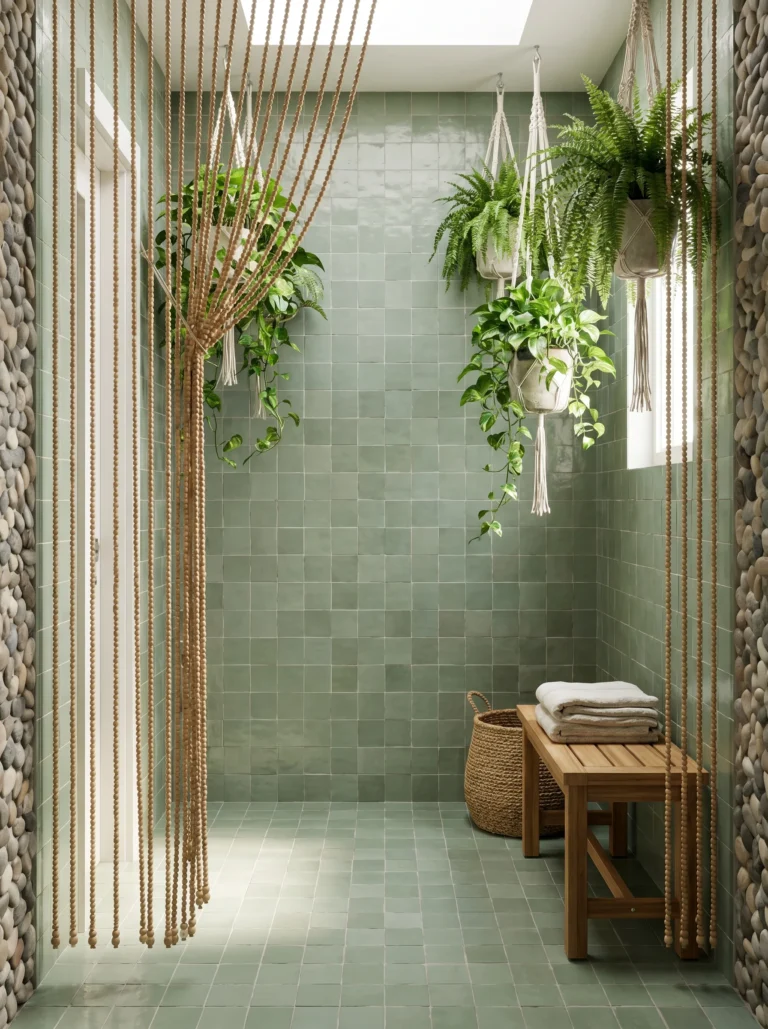
3. Sage Green for Organic Warmth Without Darkness
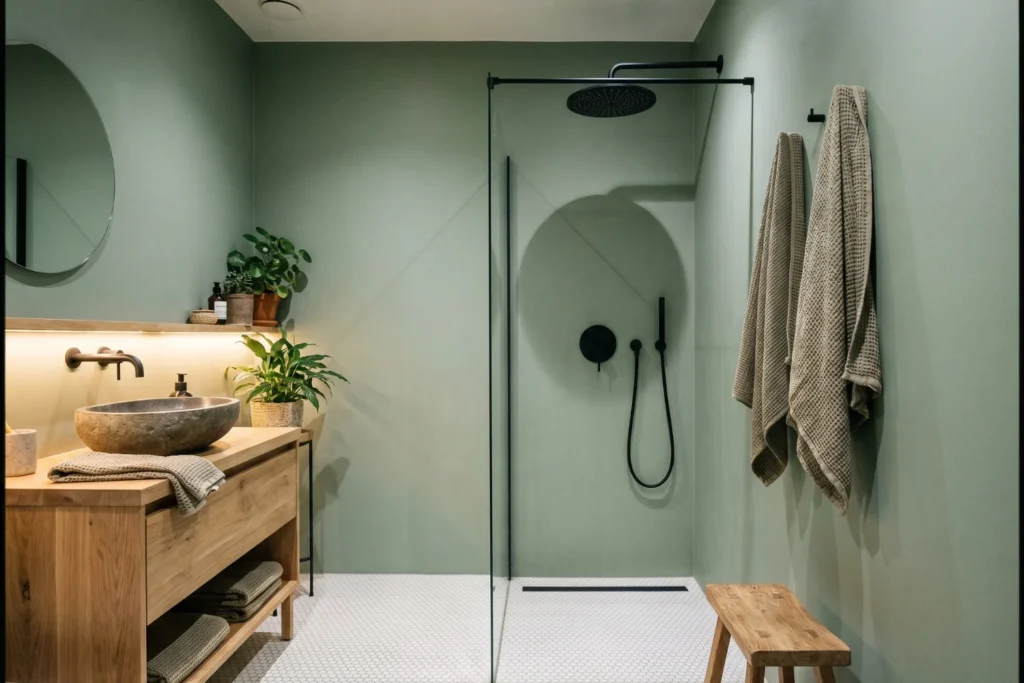
Sage green is the color that makes small windowless bathrooms feel like they belong in nature — it reads fresh without needing sunlight to activate it, which is why designers keep recommending it for interior rooms.
This isn’t the hunter green of the ’90s. Modern sage sits in a muted, gray-green range that pairs beautifully with both warm wood vanities and cool white tile. It also photographs well, which matters if you’re planning to sell or simply want your bathroom to look good in the mirror.
- Best picks: Behr Breezeway (N410-1), Sherwin Williams Evergreen Fog (SW 9130), Benjamin Moore Sage Wisdom (652)
- Works with: white grout, matte black fixtures, natural wood shelving
- Skill level: Easy — sage is very forgiving of imperfect cutting-in
Save this: Sage green works in windowless rooms because it doesn’t need sunlight to feel fresh — pair with Behr Breezeway or Sherwin Williams Evergreen Fog.
4. Two-Tone Walls to Fake Height and Depth
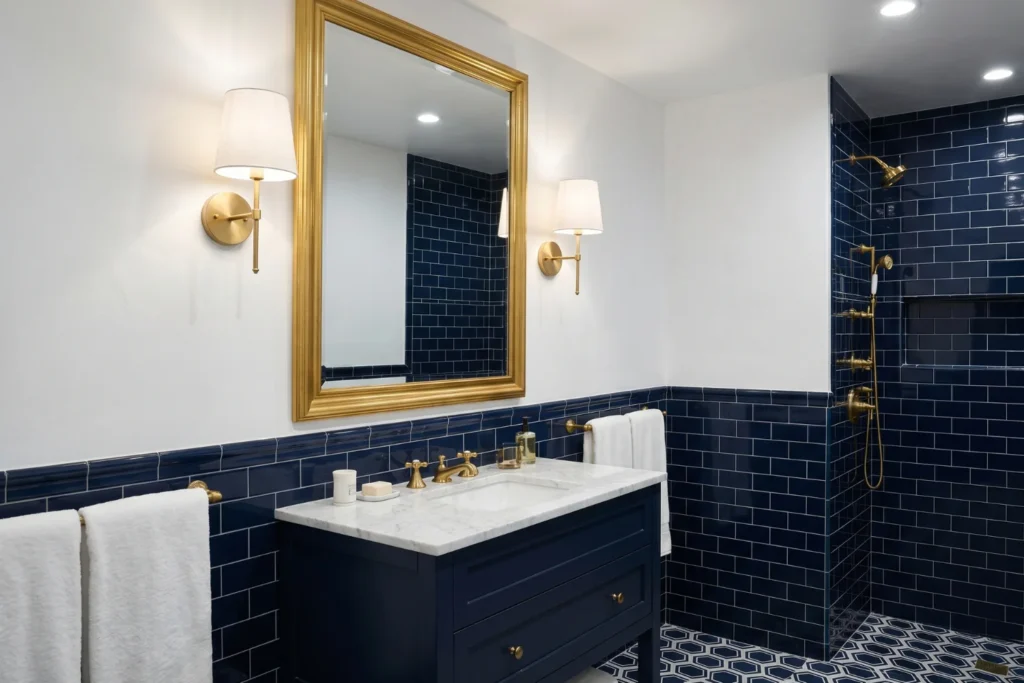
Painting your walls a single color floor-to-ceiling is the most common approach — and also the one that does the least to help a small windowless room feel taller or more dimensional.
Two-tone walls use a darker shade on the lower third (or upper two-thirds) to create visual architecture where none exists. This technique tricks the eye into perceiving more height. In practice, I’ve used painter’s tape at the 36-inch mark, painted the bottom in Benjamin Moore Hale Navy and the top in White Dove, and the bathroom instantly felt like a designed space rather than a box.
- Split options: darker bottom + lighter top (adds height), lighter bottom + darker top (adds coziness)
- Best ratio: 1/3 to 2/3 split works in rooms under 60 sq ft
- Pro move: Run a thin chair rail or painted stripe at the divide
“Two-tone walls create architecture where none exists — and in a windowless bathroom, that perceived depth is everything.”
Quick Answer: Two-tone walls visually expand small windowless bathrooms by creating a perceived height difference. Paint the lower third darker and the upper two-thirds lighter for maximum effect using a 1:3 to 2:3 ratio split.
5. Pale Blue That Mimics Daylight
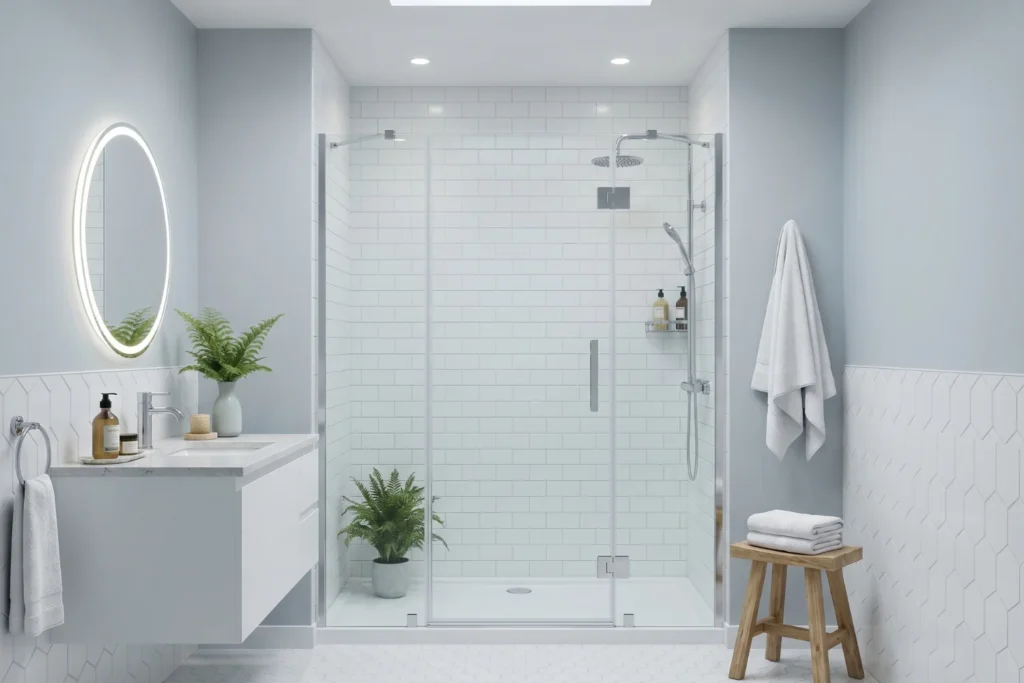
Pale blue is the closest you’ll get to faking a window — it reads as sky, as water, as open space, even under artificial light, which makes it uniquely effective in bathrooms with no natural light source.
The key is choosing a blue with enough gray in it to prevent it from reading “nursery.” You want sophisticated coastal, not baby shower. If you’re coordinating with 12 Bathroom Aesthetic Ideas That Actually Make Your Space Feel Better, pale blue anchors nearly every spa-inspired palette.
- Best picks: Sherwin Williams Sleepy Blue (SW 6225), Benjamin Moore Breath of Fresh Air (806), Behr Light Drizzle
- Works with: white penny tile, brushed nickel, glass shower doors
- Avoid if: your existing tile has strong pink or peach undertones
Save this: Pale blue mimics daylight in windowless bathrooms — Sherwin Williams Sleepy Blue and Benjamin Moore Breath of Fresh Air are the safest picks.
6. Earthy Warm Neutrals (The 2026 Trend That Actually Works Here)
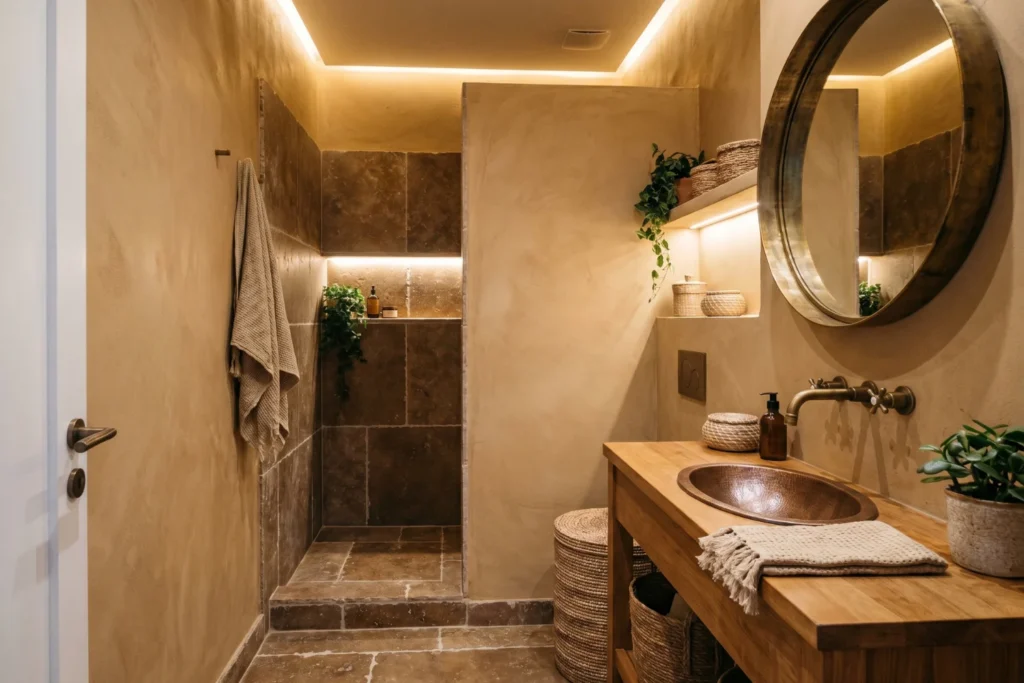
Earthy neutrals — think warm clay, soft terracotta, and sandy beige — are the biggest color trend for 2026, and they happen to work exceptionally well in windowless bathrooms because warm undertones compensate for missing sunlight.
This is a departure from the cool-gray decade we just left. According to the Sherwin Williams 2025–2026 Colormix Forecast, warm earth tones dominate residential interiors, with clay and terracotta seeing a 34% increase in sampling requests year-over-year.
- Best picks: Sherwin Williams Warm Stone (SW 7535), Benjamin Moore Soft Satin (2164-60), Behr Canyon Dusk (S210-3)
- Works with: brown tile, rustic wood, aged brass
- Caution: Goes muddy under cool-white (5000K+) bulbs — use 2700K–3000K
Quick Answer: Earthy warm neutrals like clay, terracotta, and sandy beige are the top 2026 bathroom color trend. They work especially well in windowless spaces because warm undertones counteract the flat quality of artificial-only lighting.
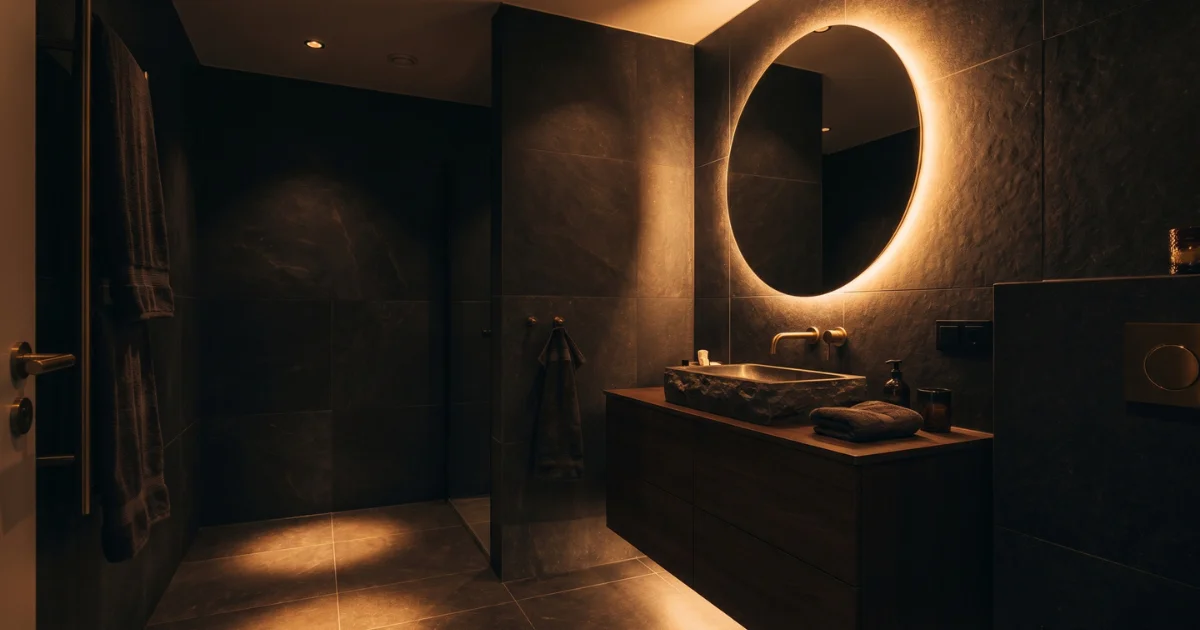
7. Moody Navy for Drama Without Claustrophobia
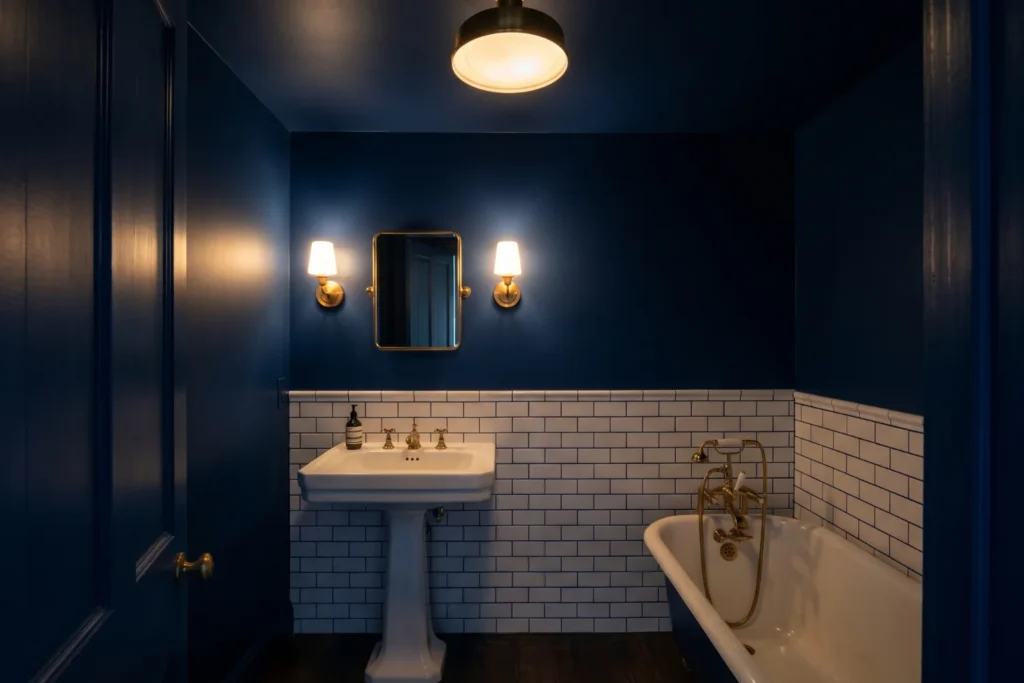
The counterintuitive truth about dark colors in small bathrooms: a saturated navy can actually make a windowless room feel larger by eliminating the visible boundary between wall and ceiling — but only if you commit fully and paint everything the same shade.
Most people paint one accent wall navy and leave the rest white. That creates visual fragmentation in a tiny room. Going all-in — walls, ceiling, trim, same navy — wraps the room and makes dimensions harder to perceive. The fixtures become the focal point, not the walls closing in.
- Best picks: Benjamin Moore Hale Navy (HC-154), Sherwin Williams Naval (SW 6244), Behr Compass Blue
- Must-have: At least two light sources (vanity sconces + ceiling) at 3000K
- Finish: Satin or semi-gloss reflects more light than matte in dark colors
“Dark walls don’t shrink a bathroom — visual fragmentation does. Go all-in or don’t go dark at all.”
Save this: Navy works in small windowless bathrooms ONLY if you paint walls, ceiling, and trim the same shade — Benjamin Moore Hale Navy or Sherwin Williams Naval in satin finish.
8. Soft Pink That Flatters Skin Tone (The Secret Weapon)
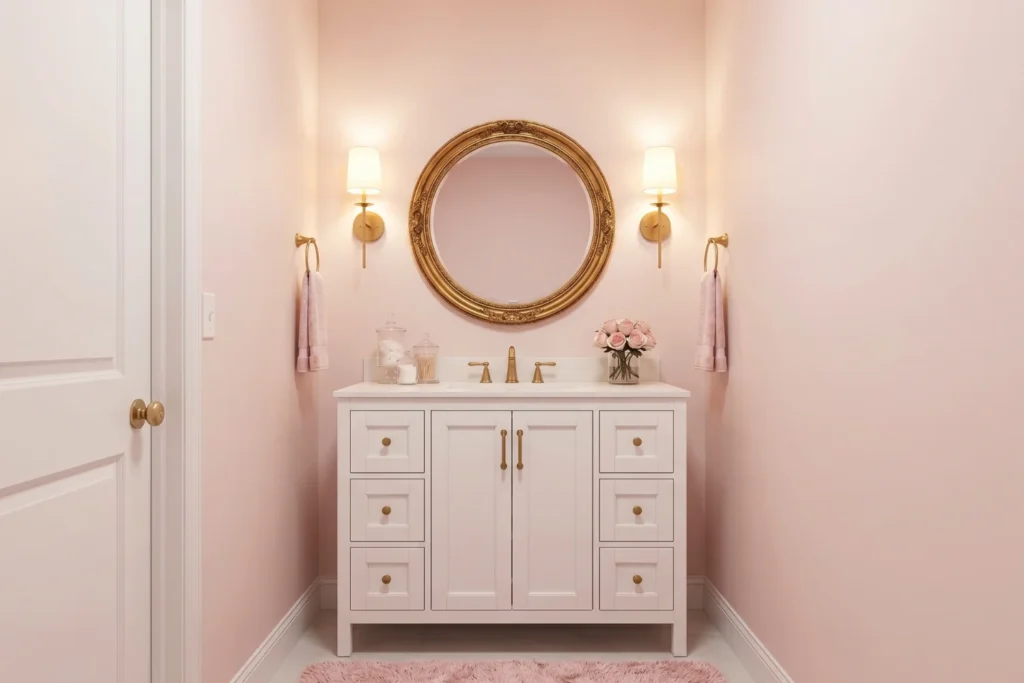
Here’s something nobody in the small bathroom color conversation talks about: you look at yourself in this room every single day, and soft pink is the one color that makes skin look healthier under artificial light.
This isn’t about trends. It’s physics — warm pink undertones in paint bounce flattering tones onto your face, working like a permanent Instagram filter on your bathroom mirror. Makeup artists have known this for decades. It’s why high-end dressing rooms use it.
- Best picks: Benjamin Moore Pale Pink Satin (008), Sherwin Williams Intimate White (SW 6322), Behr Stolen Kiss
- Works with: white marble, gold fixtures, clear glass
- Pairs with: For a broader overhaul, Bathroom Ideas That Solve Real Problems, Not Just Look Pretty covers layout changes that complement a new palette.
9. Color-Drenched Green for a Bold Windowless Statement
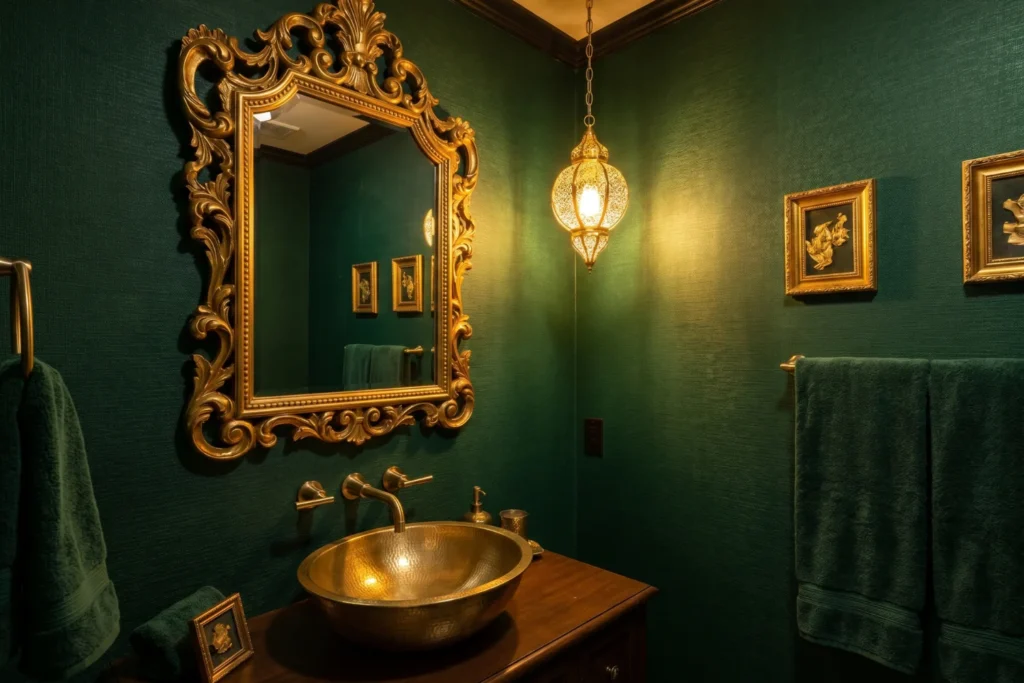
If sage feels too safe, a saturated forest or emerald green turns a windowless bathroom into an intentional jewel box — the lack of window actually helps because consistent artificial lighting keeps the color stable all day.
This works for the same reason navy works: full commitment. Paint everything the same deep green. Add brass or gold hardware. The room becomes a deliberate mood, not an accident of architecture.
- Best picks: Benjamin Moore Forest Green (2047-10), Sherwin Williams Cascades (SW 7623), Behr Vine Leaf
- Must-have: Warm metallic fixtures (brass or gold) to prevent the room feeling cold
- Best for: Powder rooms and half-baths where you want impact over practicality
Quick Answer: Deep green and emerald work as bold small bathroom color ideas because consistent artificial lighting keeps the saturation stable. Commit to painting walls, ceiling, and trim the same shade and add warm metallic fixtures for contrast.
Save this: Saturated forest green or emerald in a windowless bathroom creates a jewel-box effect — consistency is key, paint everything the same shade.
Mistakes That Make Bathrooms Look Worse, Not Better
Every one of these sounded reasonable at the time — and every one made the room feel worse.
- Choosing paint from a digital screen — screens emit light, walls reflect it. The color you save on Pinterest will look different on your wall. Always test a physical swatch.
- Using pure bright white in a windowless room — without sunlight, stark white reads blue-gray and institutional rather than clean and airy.
- Painting one accent wall in a room under 50 sq ft — it fragments the space and makes it feel smaller, not more interesting.
- Ignoring your tile undertone — beige tile with blue-gray paint creates a visual fight. Match warm with warm, cool with cool.
- Leaving the ceiling standard white when walls are bold — the ceiling becomes a lid. Paint it the same shade as walls for a wrapped, expansive feel.
- Picking matte finish for dark colors — matte absorbs light, making dark rooms even darker. Use satin or semi-gloss for dark shades in small windowless spaces.
FAQ
How Do I Make a Small Bathroom Look Bigger With Paint?
The main strategy is using light, warm-undertone colors in a consistent shade across all surfaces — walls, ceiling, and trim — to blur boundaries and make the room’s edges harder to perceive.
Quick Answer: Light warm whites and pale blue-grays make small bathrooms look bigger by reflecting artificial light and eliminating visual boundaries. Paint walls, ceiling, and trim the same color for maximum effect. Avoid contrasting trim that outlines the room’s edges.
Here’s the thing — it’s not just about going light. It’s about going consistent. The moment you use white trim against colored walls in a 40 sq ft bathroom, you outline the box. Your eye traces every edge. That makes it feel contained.
Instead, paint trim the same shade as walls. Choose satin finish to bounce more light. And add at least one secondary light source to prevent flat, single-direction shadows that flatten depth perception.
The visual expansion trick that matters most isn’t which color — it’s how consistently you apply it.
Should I Use Dark Colors in a Small Bathroom?
Yes — but only if you commit fully. A single dark accent wall in a small room creates visual fragmentation that makes the space feel smaller, while wrapping the entire room in one dark shade dissolves boundaries.
Quick Answer: Dark colors work in small bathrooms when you paint all surfaces — walls, ceiling, and trim — the same shade. This eliminates visible edges and creates a cocooning effect. Use satin finish and warm (3000K) lighting. Never do just one accent wall.
The reason most people fail with dark paint in small bathrooms is timidity. They paint one wall navy and leave three walls white. Now the room has a clear “back” and “front” — and it feels tighter.
Full-commit dark rooms need two things: satin or semi-gloss finish (to reflect what light exists) and at least two light sources at 2700K–3000K. A single overhead in a dark room creates a pool of light surrounded by shadow. Two sconces plus a ceiling light distribute illumination evenly.
“Dark paint in a small room either looks intentional or accidental. Full commitment is the only difference.”
What Are the Trending Bathroom Colors for 2026?
The biggest shift for 2026 is away from cool grays and toward warm earth tones — clay, terracotta, warm stone, and olive greens dominate forecast reports from Sherwin Williams, Benjamin Moore, and Behr.
Quick Answer: Trending 2026 bathroom colors include warm clay, terracotta, olive green, warm stone, and soft caramel. Cool grays are declining. Brands like Sherwin Williams (Warm Stone), Benjamin Moore (Soft Satin), and Behr (Canyon Dusk) lead the shift toward earthy warmth.
This isn’t just aesthetic preference. Post-pandemic design continues to favor rooms that feel grounding and organic. The Sherwin Williams 2025–2026 Colormix Forecast explicitly names “earth reconnection” as a primary residential theme.
For windowless bathrooms specifically, this trend is good news. Warm earth tones thrive under artificial warm light — they don’t need sunshine to look correct. Cool grays, by contrast, can shift purple or blue without natural light balancing them.
What matters most is pairing the trend with your fixed elements — tile, vanity, and hardware you aren’t replacing.
Choosing Paint Colors for Small Bathrooms With No Windows
You spend the first and last minutes of every day in this room. It shapes your morning mindset and your wind-down ritual. Getting the color right isn’t vanity — it’s environment design for a room you can’t avoid.
Start today:
[ ] Buy one paint sample in a warm white, sage, or pale blue and tape it to your wall for 48 hours under your actual lighting.
[ ] Swap your bulb to 2700K–3000K if it’s currently cool white.
[ ] Clear your vanity to three items maximum so you can actually see the wall color working.
Your windowless bathroom isn’t a limitation, and the right paint colors for small bathrooms with no windows prove it. It’s a room with perfectly consistent light — and that’s actually easier to design for than a room where sunlight changes every hour.
Save this article to your bathroom ideas board so you always have it when you’re ready.
You’ll Also Love
- Bathroom Ideas That Solve Real Problems, Not Just Look Pretty
- 12 Bathroom Aesthetic Ideas That Actually Make Your Space Feel Better
- 13 Stunning Outdoor Bathroom Ideas That Blend Comfort With Nature
For more bathroom color palettes and design aesthetics to pull inspiration from, see our guide on brown and beige warm neutrals that actually work.