13 Stunning Outdoor Bathroom Ideas That Blend Comfort With Nature
Outdoor bathroom ideas transform your backyard into a functional retreat for summer 2026. I spent last summer showering under a birch tree in Maine — and I mean I actually installed a showerhead on a branch. The water pressure was terrible, the bugs were relentless, and I loved every second of it. That experience taught me something most bathroom articles miss: outdoor bathrooms are not about perfection. They are about feeling the air on your skin while you wash off the day.
Most people think an outdoor bathroom requires a full renovation budget and professional contractors. The real barrier is knowing which materials survive weather, how to create privacy without a fortress, and which fixtures actually work outside. This guide gives you 13 specific outdoor bathroom ideas, from simple and small outdoor bathroom ideas to full backyard bathroom builds, each with a budget version and a splurge version, so you can build what you want without guessing.
“12 Bathroom Counter Ideas That Actually Work” → 12 Bathroom Counter Ideas That Actually Work post
Table of Contents
Does Your Outdoor Bathroom Actually Feel Good? Here’s Why It Might Not
Your outdoor bathroom probably has one of these three problems, and you have gotten used to it:
- Clutter with no designated home — products sitting on the ground, towels draped over random surfaces, nowhere intentional for anything.
- No privacy system — a beautiful shower setup that you are too uncomfortable to use because a neighbor can see in.
- Indoor materials that have already started failing — swollen wood, peeling paint, a faint smell you cannot quite locate.
I once worked with a client who insisted on using an indoor-style painted wooden cabinet for outdoor storage. Three months later, the cabinet door had swollen so badly it would not close, the paint was peeling in long strips, and the inside smelled like a damp basement. The smell of wet rotting wood mixed with mildew hit me before I even rounded the corner.
That cabinet was a $400 mistake. We replaced it with a simple weatherproof teak shelf and the space finally felt clean and functional. That single smell taught me more about material selection than any guide ever could.
If any of those problems sound familiar, keep reading. The fix is not a bigger space — it is smarter outdoor bathroom design from the ground up.
Quick Answer: The three most common outdoor bathroom problems are inadequate storage, no privacy system, and indoor materials that fail in weather. Each has a specific, affordable fix — and none of them require a full renovation.

13 Outdoor Bathroom Ideas That Work
1. Start Your Outdoor Bathroom Ideas With a Shower, Not a Tub
A simple outdoor shower is more practical, more affordable, and easier to integrate than a freestanding tub. A basic solar shower costs as little as $25. A plumbed unit with hot water runs $500 to $3,000. A full outdoor bathroom with toilet and sink averages $10,000 to $25,000. Start with the shower, make it work, then layer in additional elements over time.
I have seen more unfinished outdoor bathroom projects abandoned mid-build because the owner started with the most expensive element — a freestanding copper tub — before solving drainage, privacy, or flooring. The shower teaches you everything you need to know about how your space functions before you spend more.
Quick Answer: Start outdoor bathroom ideas with a shower, not a tub. A solar shower costs $25 and a plumbed unit runs $500 to $3,000 — far less than the $10,000 to $25,000 required for a full outdoor bathroom with plumbing.
2. Choose Materials That Survive Your Climate
The best materials for outdoor bathroom ideas are teak, ipe, porcelain tile, natural stone, and powder-coated aluminum. Here is what happens when you use indoor materials outside: mold, warping, and a repair bill that costs more than the original build. I watched a friend install a beautiful oak vanity on her patio. Three months later it looked like driftwood — and not in a good way.
- Teak for flooring and benches — naturally oily, resists rot, develops a silver-gray patina that looks intentional
- Porcelain tile for walls — non-porous, easy to clean, handles freeze-thaw cycles
- Powder-coated aluminum for fixtures — will not rust, lighter than stainless steel
- Natural stone for accents — handles temperature swings and absorbs heat during the day
Save this: Teak and porcelain tile are the two materials that will save you from the most common and most expensive outdoor bathroom mistakes.
Quick Answer: The best materials for outdoor bathroom ideas are teak, porcelain tile, natural stone, and powder-coated aluminum. These resist moisture, UV damage, and temperature swings without mold, warping, or rust.
3. Build Outdoor Bathroom Privacy With Plants, Not Walls
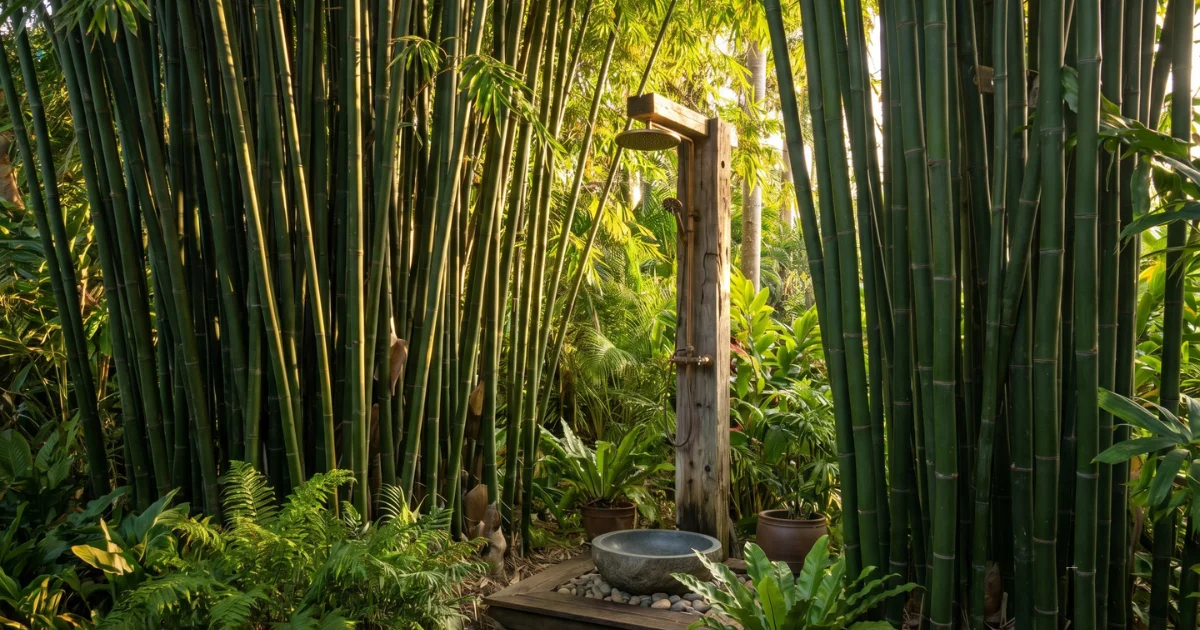
A 6-foot privacy fence feels like a cage. A row of bamboo or tall ornamental grasses creates a living wall that moves with the breeze, absorbs sound, and makes your outdoor shower feel more secluded than a solid wall ever could. I once designed an outdoor shower for a client who insisted on a cedar enclosure. It looked like an outhouse.
When we replaced it with clumping bamboo and giant miscanthus grass, the space opened completely — she could shower without feeling watched but she could still see the sky.
The best privacy plants for outdoor bathrooms are clumping bamboo (non-invasive, reaches 10 to 15 feet), giant miscanthus grass, evergreen arborvitae for year-round screening, and a trellis planted with climbing jasmine for fragrance.
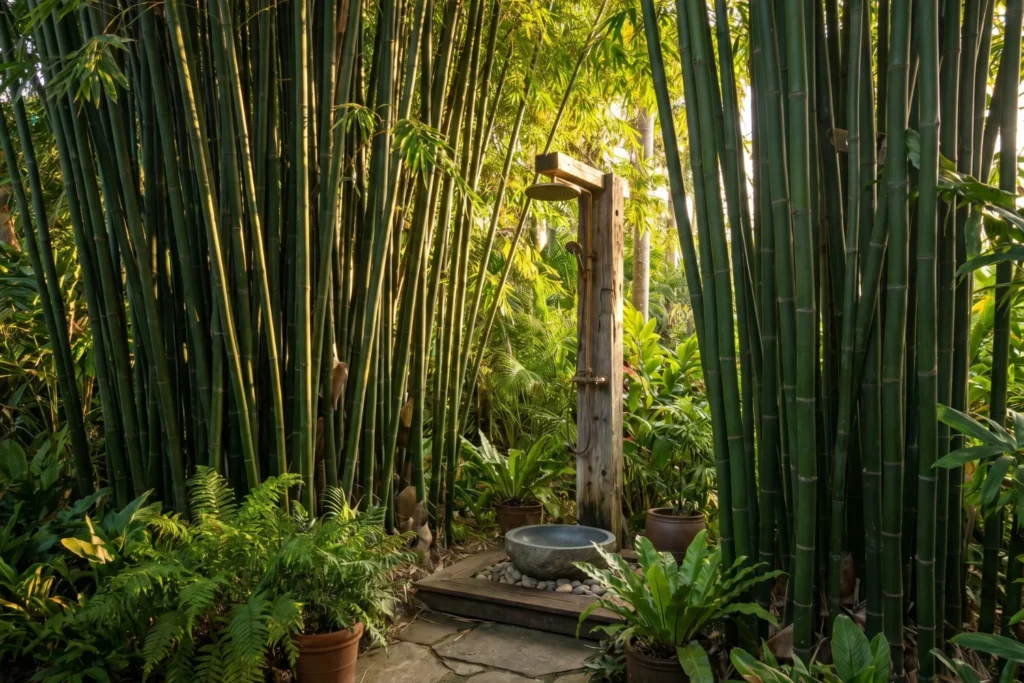
Quick Answer: Plants like clumping bamboo and giant miscanthus grass provide outdoor bathroom privacy without the closed-in feeling of solid walls. They also absorb sound, making the space feel more private than it is.
4. Place a Freestanding Tub Where It Catches the Last Light
A copper or stone-resin freestanding tub costs $800 to $4,000 new — but the secondhand market changes the equation entirely. I bought a copper tub for $300 on Facebook Marketplace with a dent the size of a fist. I filled it with epoxy, polished the rest, and placed it under a mature oak tree. That tub became the most photographed spot in my yard. The secret is placement: position the tub where it catches the last light of the day. You will actually use it.
Stone-resin tubs are lighter than cast iron, hold heat longer than acrylic, and survive outdoor temperature swings without cracking.
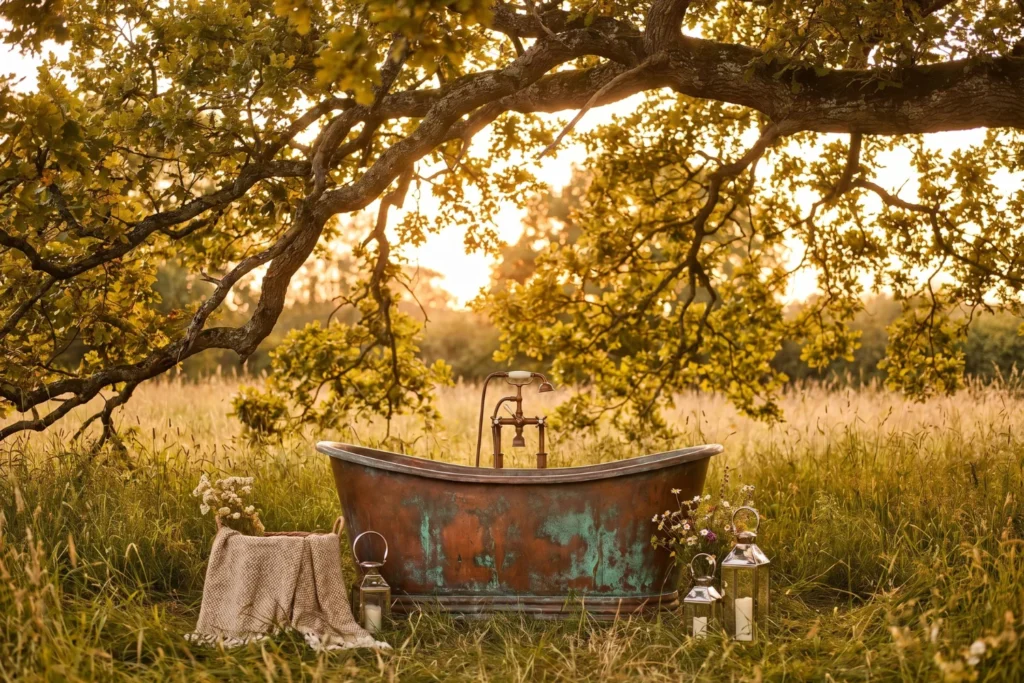
Save this: A secondhand copper or stone-resin tub placed under a tree is the single most impactful outdoor bathroom idea for under $500 — and the most pinned image type in the backyard design category.
Quick Answer: A freestanding copper or stone-resin tub costs $800 to $4,000 new or under $500 secondhand. Place it where it catches the last light of the day to create the focal point of any outdoor bathroom design.
5. Install Teak Flooring for the Foundation of Your Outdoor Bathroom
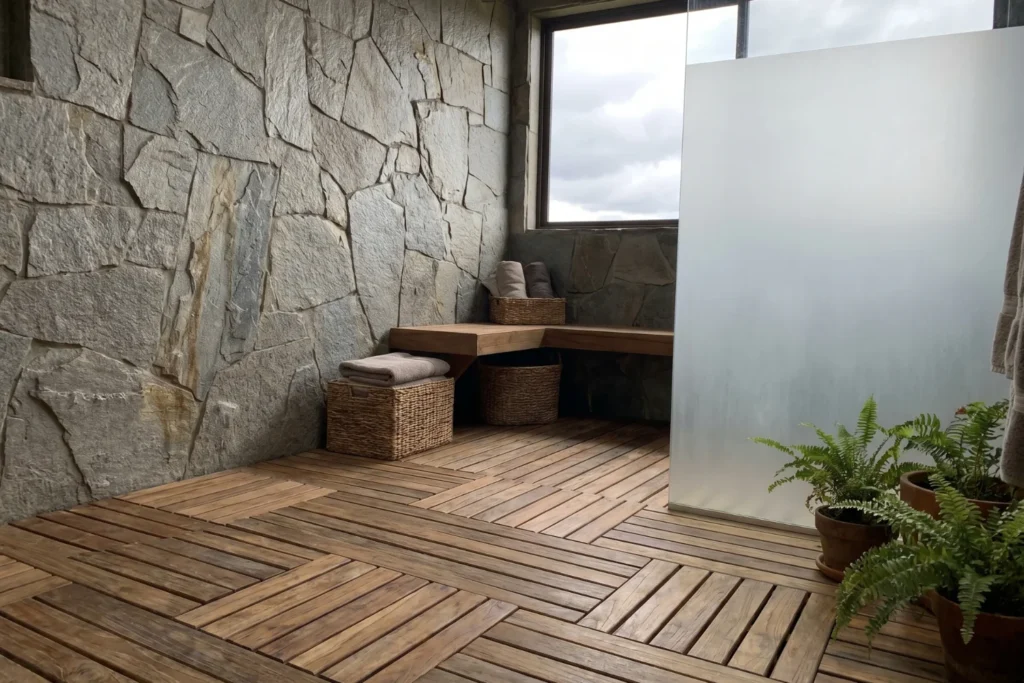
Teak does not splinter, does not rot, and develops a silver-gray patina over years that looks completely intentional. Most outdoor bathrooms fail because the flooring becomes slippery or grows algae. Teak solves both problems — the natural oils repel water and the slatted surface provides traction even when wet. It also elevates off the ground on small feet, which means water drains underneath rather than pooling on the surface.
Teak deck tiles ($15 to $25 per square foot) are available in interlocking panels that require no tools to install. They can be lifted, cleaned underneath, and reassembled in under an hour.
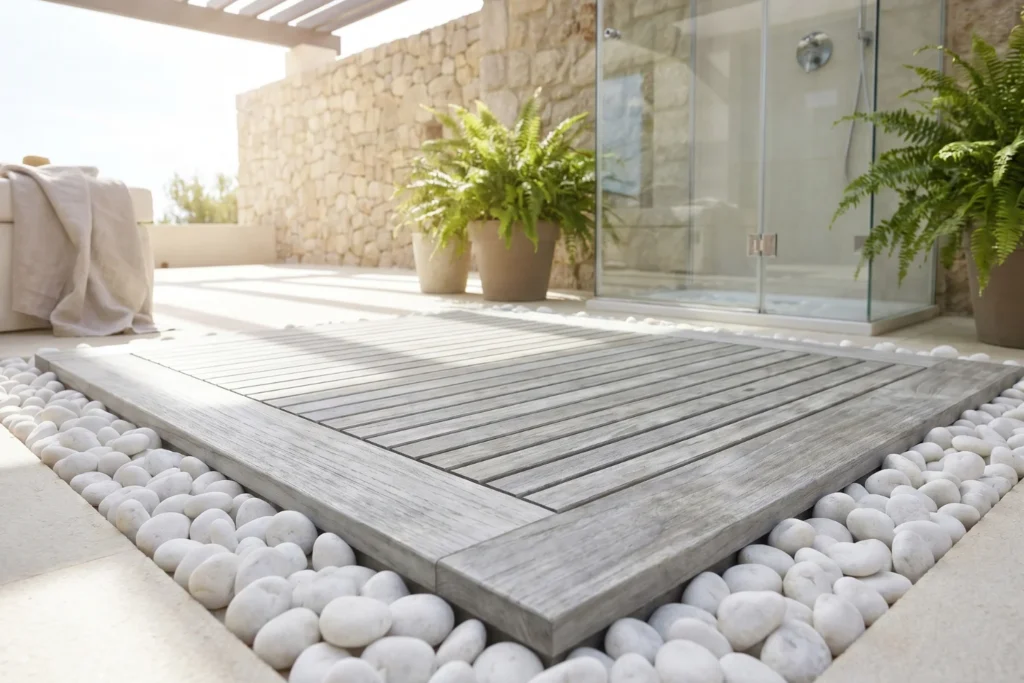
Quick Answer: Teak flooring is the single best investment for outdoor bathroom ideas because it resists rot, repels water, and provides slip-resistant traction. Interlocking teak deck tiles install in under an hour with no tools.
6. Mount a Rainfall Showerhead on a Freestanding Pole
A freestanding shower pole costs $50 to $200, requires zero wall mounting, and connects to a standard garden hose or permanent water line. Add a rainfall head for a luxury spa feel without any construction. This is the fastest way to create a functional outdoor shower in a single afternoon — no permits, no contractors, no concrete.
Place the pole near an existing fence or hedge to use the surrounding greenery as a natural backdrop. The rainfall head spread (10 to 12 inches) feels significantly more luxurious than a standard showerhead and costs only $20 to $50 more.
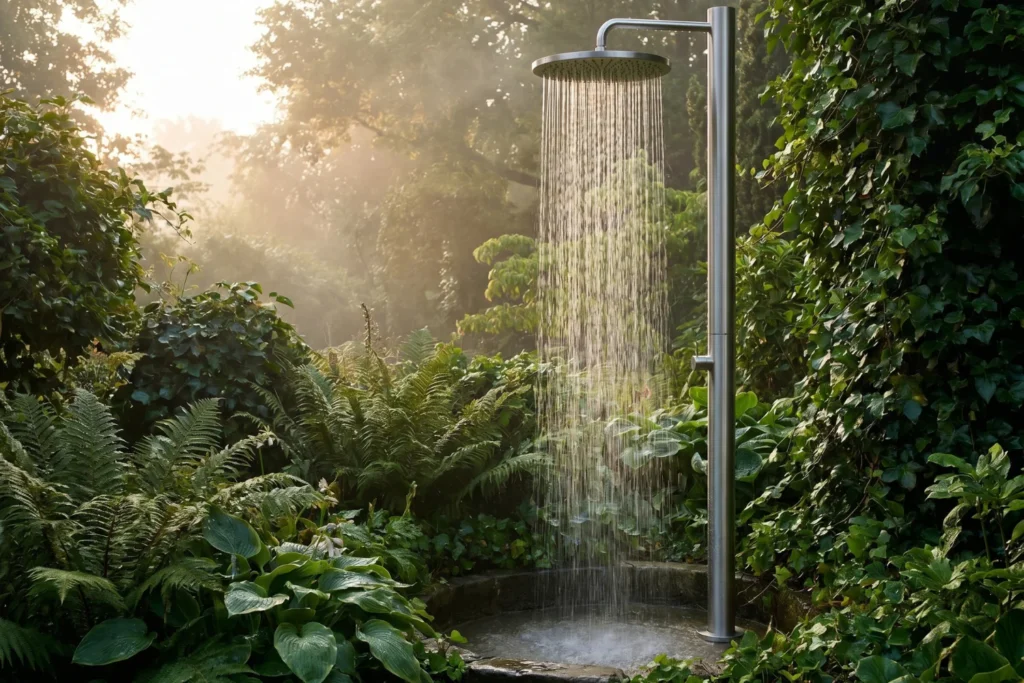
Quick Answer: A freestanding shower pole ($50 to $200) connects to a garden hose and installs in one afternoon with no construction. Add a rainfall head for $20 to $50 more for an immediate upgrade in feel.
7. Use a Half-Wall for Wind Protection Without Losing the View
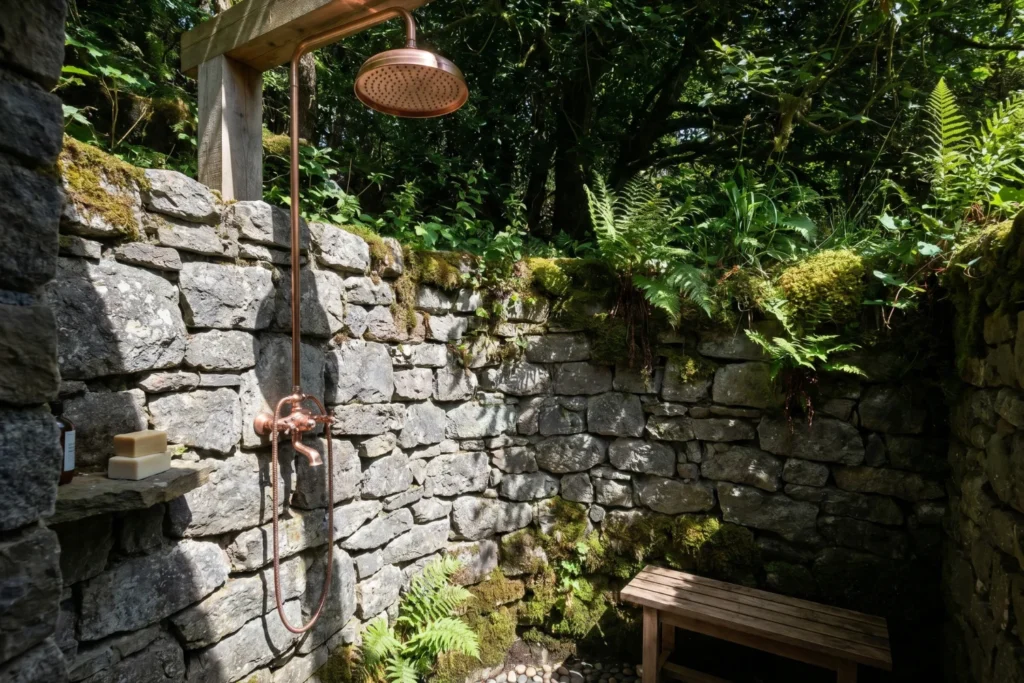
Full enclosures trap heat and feel claustrophobic. A half-wall made of stone, concrete block, or weather-resistant wood gives you privacy where it matters — from the waist down — while keeping the view open above. It also blocks wind at body level, which is where outdoor showers feel coldest, without creating the pressure differential that makes enclosed outdoor showers uncomfortably stuffy.
A dry-stacked stone half-wall costs $800 to $1,500 installed. A cinder block version with stucco finish costs $200 as a DIY project and can be painted to match your home’s exterior.
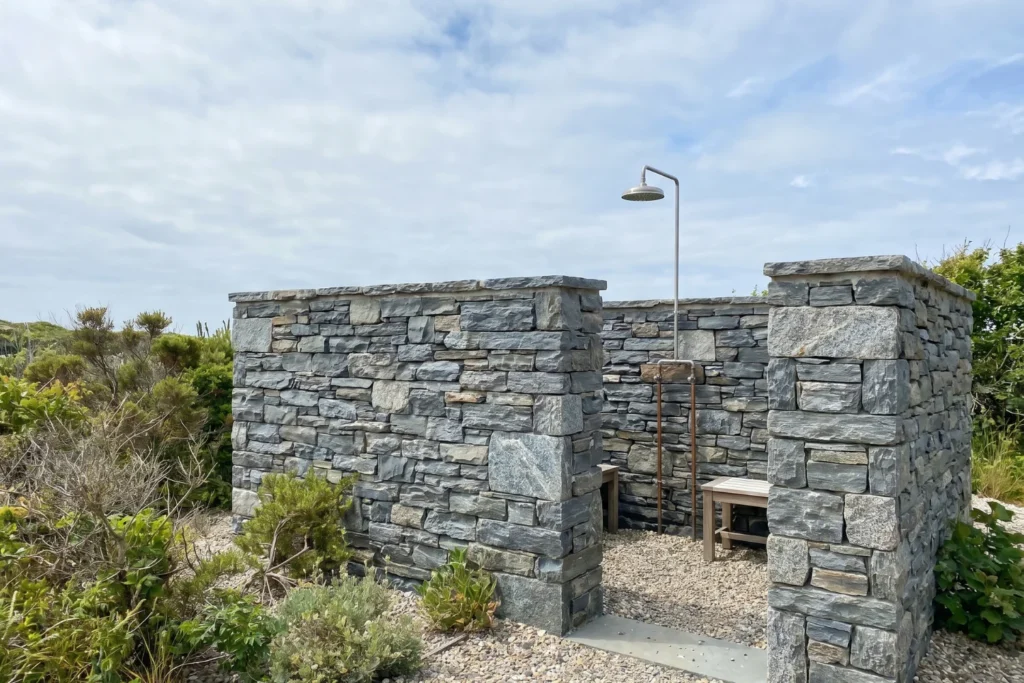
Save this: A stone half-wall is the most effective outdoor bathroom privacy solution for people who want to keep the open-sky feeling. It blocks wind and sightlines at body level while leaving the view above fully open.
Quick Answer: A half-wall made of stone or concrete blocks wind at body level and provides privacy where needed without the closed-in feeling of full enclosures. DIY cinder block versions cost around $200.
8. Hang Marine-Grade Outdoor Curtains for Softness and Flexibility
Outdoor curtains cost $30 to $100 per panel and transform a hard structure into a soft space. Use Sunbrella or similar marine-grade fabric — it resists mold, UV fading, and shrinkage in rain. Hang from a tension rod, a simple wire, or a pergola beam. The curtains move in the wind, add color, and create a sense of enclosure that can be completely opened or closed based on who is in the yard.
This is the most renter-friendly and fully reversible outdoor bathroom privacy solution — no installation required, no holes in walls, and the curtains fold flat when not in use.

Quick Answer: Marine-grade outdoor curtains ($30 to $100 per panel) add flexible enclosure, color, and softness to outdoor bathroom ideas without permanent construction. They are the best solution for renters.
9. Add a Cold Plunge for Contrast Therapy
A galvanized stock tank from a farm supply store costs $100 to $300 and doubles as a highly effective cold plunge. This is the outdoor bathroom trend that actually delivers measurable results — hot shower followed by cold plunge, repeated two to three times, improves circulation, reduces inflammation, and provides an alertness that outlasts any cup of coffee. Place it immediately beside the shower so the transition takes under five seconds.
Ice is optional. At ground temperature, well water or a garden hose fills the tank cold enough for contrast therapy in most climates from spring through autumn.
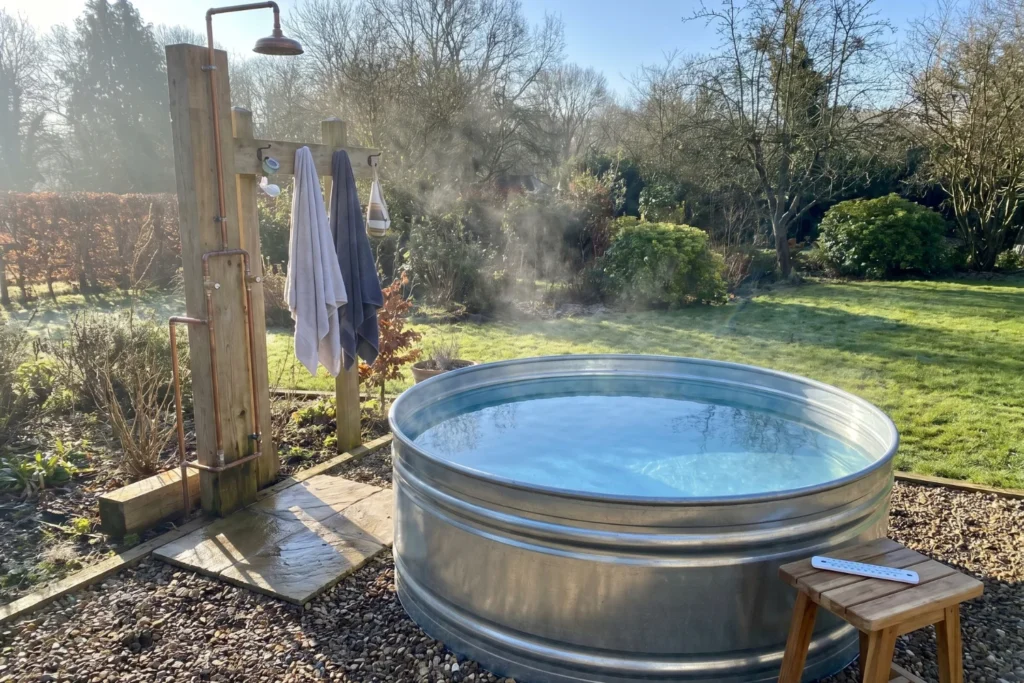
Quick Answer: A galvanized stock tank ($100 to $300) works as an affordable cold plunge beside your outdoor shower for contrast therapy. At ground water temperature, no ice is needed in most climates.
10. Install Motion-Sensor Lighting for Safe, Magical Night Use
Motion-sensor LED lights cost $20 to $80 and make nighttime outdoor showers feel both safe and magical. No fumbling for switches. No blinding floodlights. Soft warm lights that activate when you approach and fade when you leave. Place one light near the shower, one along the pathway from the house, and one near the towel area.
Use 2700K warm-tone LEDs rather than cool white — cool LEDs read as clinical and harsh against natural materials. Warm LEDs make teak glow, stone look rich, and plants look lush.
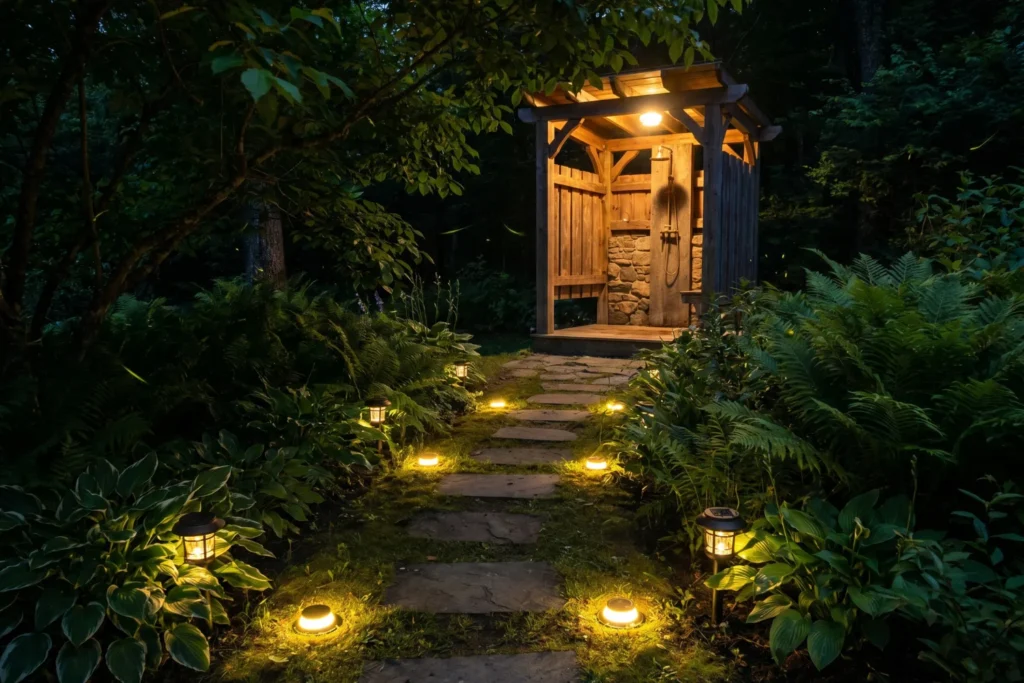
Quick Answer: Motion-sensor LED lights ($20 to $80) at 2700K create safe, warm nighttime outdoor shower lighting without switches or harsh floodlights. Place one at the shower, one on the path, and one at the towel area.
11. Add an Outdoor-Rated Mirror to Complete the Space
An outdoor-rated mirror with a sealed marine-grade backing costs $50 to $200 and will not develop the black edge corrosion that standard mirrors show within weeks outdoors. Look for mirrors made with marine stainless steel backing or acrylic faces — some include built-in LED strips for task lighting. Mount it on the half-wall, the shower pole, or a fence post.
The mirror serves both a functional role and a design role — it reflects garden greenery, makes the space feel larger, and signals that the outdoor bathroom is a finished, intentional space rather than a temporary setup.

Quick Answer: Outdoor-rated mirrors with marine-grade backing ($50 to $200) resist edge corrosion and fogging that standard mirrors develop quickly outdoors. Mount on a half-wall, fence post, or shower pole.
12. Use Stone Accents to Connect the Bathroom to the Landscape
Stacked stone or river rock on one accent wall or around the shower base adds visual weight, grounding texture, and thermal mass to any outdoor bathroom. Stone absorbs heat during the day and releases it slowly through the evening, keeping the space warmer after sunset. River rock around the drain base doubles as a drainage solution — water disperses through the gaps rather than pooling.
Peel-and-stick stone panels at $5 per square foot give the same visual effect as real stacked stone for a fraction of the cost and zero mortar work.
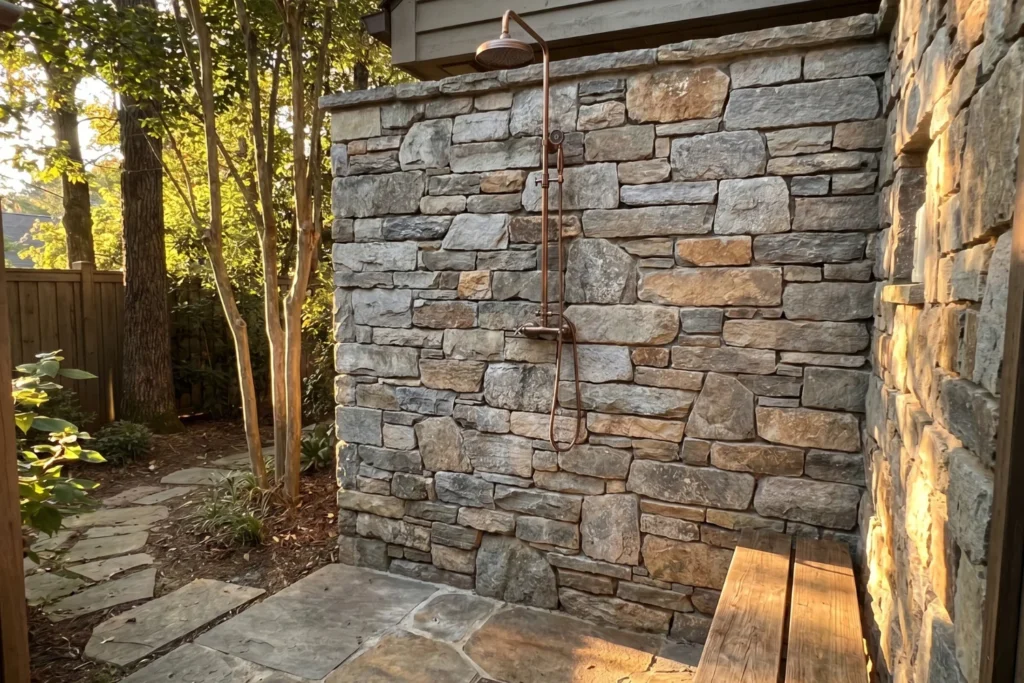
Save this: Stone accents are the cheapest way to make an outdoor bathroom look permanent and expensive. Peel-and-stick stone panels at $5 per square foot deliver the same visual weight as real stacked stone.
Quick Answer: Stacked stone or river rock accents ($5 to $10 per square foot) add texture and thermal mass to outdoor bathroom ideas. Stone absorbs daytime heat and releases it through the evening, extending comfortable use.
13. Use Tropical Plants for Instant Resort Atmosphere
Ferns, hostas, elephant ears, and birds of paradise cost $10 to $50 each and create the lush, private environment that makes an outdoor bathroom feel like a resort rather than a garden shed. Group them in clusters around the shower and tub rather than spacing them evenly. The humidity from the water keeps moisture-loving varieties thriving without extra irrigation.
Plants also perform the same function as walls in terms of blocking sightlines, but they do it with movement, texture, fragrance, and seasonal change that no solid structure can replicate. Clusters of three different heights — ground cover, mid-height shrubs, and tall specimens — create the layered green wall effect seen in high-end tropical resort bathrooms.
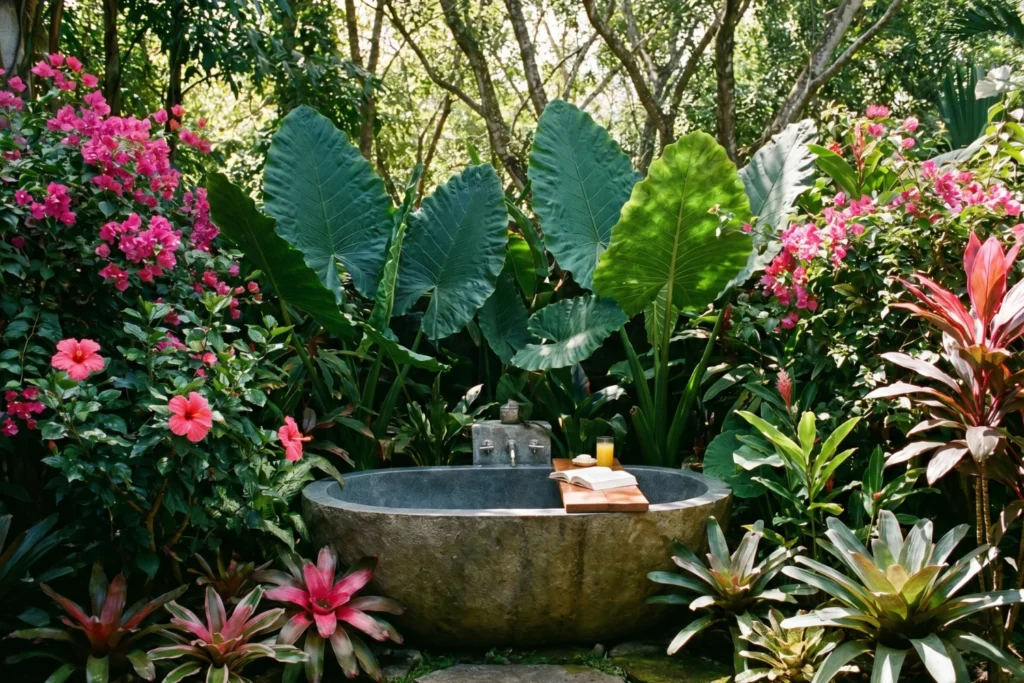
Quick Answer: Clusters of ferns, elephant ears, and birds of paradise ($10 to $50 each) create an instant resort atmosphere in outdoor bathroom ideas. They thrive on shower humidity and block sightlines without solid walls.
Designer Secrets Most People Miss
Colors
The most common mistake in outdoor bathroom design is choosing colors that compete with the landscape rather than extending it. Your outdoor bathroom should feel like it grew there. Stick to earth tones — sage green, warm terracotta, charcoal, and cream — because these absorb light rather than reflecting it, which makes the space feel grounded and intentional. According to NKBA-certified interior designers: “Earth tones make an outdoor bathroom feel like it grew there, not like you built it and dropped it into the yard.” Avoid bright whites on walls or cabinets — they show water stains, age quickly in UV, and fight the natural palette rather than complementing it.
Quick Answer: The best colors for outdoor bathroom ideas are earth tones — sage green, warm terracotta, charcoal, and cream. They absorb light, age gracefully, and extend the garden rather than competing with it.
Lighting
Layered lighting transforms an outdoor bathroom from functional to genuinely spa-like. Use three light sources: ambient lighting via string lights or lanterns, task lighting via motion-sensor LED near the shower, and accent lighting via uplights on plants or stone features. According to the American Lighting Association, layered lighting can increase perceived space by up to 30% compared to a single overhead source. American Lighting Association Always use 2700K warm-tone bulbs outdoors — cool white LEDs make natural materials look cold and clinical. According to NKBA-certified outdoor designers: “Three layers of light turn a basic outdoor shower into a spa at night.”
Quick Answer: Layer outdoor bathroom lighting with three sources — ambient string lights, motion-sensor task lighting near the shower, and accent uplights on plants. Use 2700K warm bulbs exclusively to keep natural materials looking rich.
Storage
Vertical storage is the only storage that works reliably outdoors. Wall-mounted shelves, hanging baskets, and hooks keep everything off the ground where moisture collects after rain. According to a 2024 Houzz Bathroom Trends study, 68% of outdoor renovation complaints involve insufficient storage rather than insufficient space. Houzz Research Brown storage elements — teak shelves, woven baskets, leather hooks — are not just functional. They are design elements. Choose them first and arrange blue or green accents around them. According to NKBA-certified outdoor designers: “Do not hide your outdoor storage. Let it be the design feature that anchors the space.”
Quick Answer: Vertical storage — wall-mounted shelves, hanging baskets, and hooks — keeps everything above the ground moisture level. Brown storage elements like teak and woven rattan are also design features, not just function.
FAQ
What are the best materials for an outdoor bathroom?
The best materials for outdoor bathroom ideas are teak, ipe, porcelain tile, natural stone, and powder-coated aluminum. Teak is naturally oily and resists rot without sealing. Porcelain tile is non-porous and handles freeze-thaw cycles. Powder-coated aluminum resists rust without the weight of stainless steel. Avoid painted wood, chrome fixtures, and standard cabinet materials — all fail within one to two seasons outdoors.
Quick Answer: Teak, porcelain tile, and powder-coated aluminum are the top material choices for outdoor bathroom ideas. They resist moisture, rot, rust, and UV damage without requiring regular sealing or maintenance.
How do you add privacy to an outdoor bathroom?
Use plants like clumping bamboo or giant miscanthus grass, install a stone or concrete half-wall, or hang marine-grade outdoor curtains. Plants are the most effective option because they block sightlines, absorb sound, and create a sense of enclosure that moves naturally with the breeze. Half-walls protect from wind at body level. Curtains provide flexible enclosure that opens completely when not needed.
Quick Answer: Plants, half-walls, and marine-grade outdoor curtains provide outdoor bathroom privacy without the closed-in feel of solid walls. Clumping bamboo is the most effective single option — it blocks sight, absorbs sound, and reaches 10 to 15 feet.
Can you have a full bathroom outdoors?
Yes, but it requires professional plumbing, proper insulation of supply lines, and full weatherproofing of all fixtures and surfaces. A full outdoor bathroom includes a toilet, sink, and shower and costs $10,000 to $25,000 depending on location and materials. Planning permission may be required depending on your municipality. In most climates, supply lines also require winterization before the first hard freeze.
Quick Answer: A full outdoor bathroom is fully achievable but requires professional plumbing, weatherproofing, and $10,000 to $25,000 in budget. Most municipalities require planning permission for plumbed outdoor structures.
What is the cost of building an outdoor bathroom?
Costs range from $25 for a solar bag shower to $25,000 for a fully plumbed outdoor bathroom with toilet, sink, and shower. The most common starting point — a plumbed outdoor shower with hot and cold water — averages $2,500 installed. A freestanding tub with no plumbing (filled from a hose and drained by hand) adds $300 to $4,000 depending on material.
Quick Answer: Outdoor bathroom costs range from $25 for a solar shower to $25,000 for a full plumbed setup. The most popular starting point — a plumbed outdoor shower — averages $2,500 installed.
Your Bathroom Deserves This
You can use this space every single day of the warmer months. Make it worth stepping outside for.
Start this week with three specific actions:
- Pick the one idea from this list that solves your biggest current problem — clutter, privacy, or failing materials — and execute it this weekend.
- Measure your space before buying anything — the most common installation mistake is purchasing a shower pole or teak panel set without accounting for drainage slope.
- Save this article to your outdoor bathroom board so you have the full list when you are ready for the next phase.
The best outdoor bathroom is not the most expensive one. It is the one that makes you want to stay outside a little longer.
Save this article to your outdoor bathroom ideas board so you always have it when you are ready.
For more help choosing materials, fixtures, and layouts that fit your bathroom’s real constraints, see our guide on fitting a tub and separate shower into a small bathroom.