
Does a Bathroom Need a Dehumidifier? The 60% Rule
Most bathrooms do not need a dehumidifier. If your room only turns damp while someone is showering and the mirror clears within about thirty minutes, an exhaust fan is the correct tool and a dehumidifier is money you will not get back.
Buy a bathroom dehumidifier only when the air still feels heavy hours later, which nearly always points to a room with no working vent at all.
That single distinction decides the purchase, and almost nobody makes it before they start shopping. They compare tank sizes and noise ratings for a machine that was never going to fix the problem in front of them.
Both devices pull water out of a bathroom. Neither one does it the same way, at the same moment, or for the same reason. What follows is the test I use before recommending either of them.
It costs roughly ten dollars, takes one week of casual glances at a dial, and tells you exactly which side of this decision your own bathroom sits on.
Some links below are affiliate links. They cost you nothing extra and help keep this site running.
Table of Contents
Start with the number, not the product

Order a hygrometer before you spend anything else. Small dial or digital screen, it reads the relative humidity in a room and turns a vague complaint about dampness into a number you can act on.
Guesswork is how people end up running a machine all day in a room that only ever needed a better fan. Position it on the wall opposite the shower at roughly chest height, well away from both the door and the extractor.
Take three readings every day for a week: first thing in the morning, twenty minutes after someone showers, and last thing at night before bed.
Those three numbers separate a shower problem from a room problem, and the two have completely different answers waiting at the end of this article.
What an exhaust fan actually removes
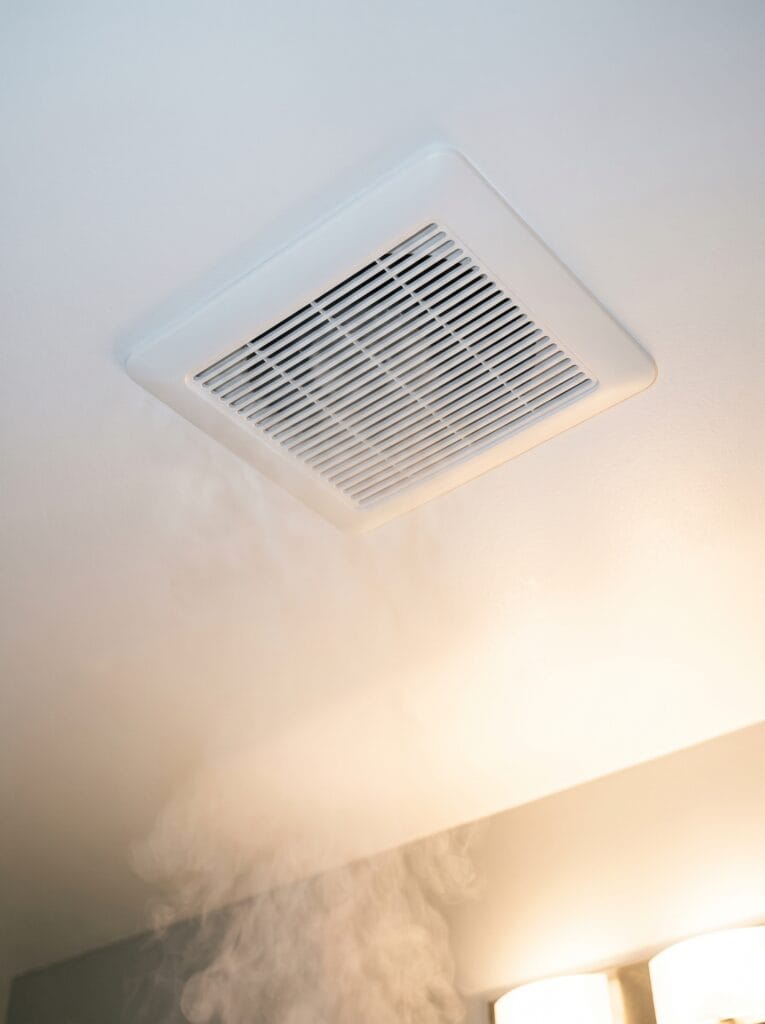
An exhaust fan does not dry your bathroom, it simply evicts the wet air through a duct and sends it outside the building.
During and just after a shower that is precisely what you want, because steam arrives far faster than any other appliance in the house could remove it. Speed is the entire advantage here, and nothing else in a bathroom comes close to matching it.
Steam is a burst event that arrives in minutes, and a fan sized correctly for the room clears most of it within fifteen to twenty minutes of the water being turned off. Its weakness is the exact flip side of that strength, because the moment the fan switches off it stops contributing anything at all.
What a bathroom dehumidifier actually removes

Dehumidifiers trade speed for persistence, which makes them the opposite tool.
Air passes over a chilled coil inside the casing, water condenses out of it and drips into a tank, and the dried air returns to the room to collect more moisture on its next circuit through the machine. Against a wall of shower steam that same machine loses badly, and running it then is mostly wasted electricity.
Barely ten minutes of hot water overwhelms any domestic unit small enough to fit in a bathroom, because moisture arrives far quicker than the coil can pull it back out again. Where it earns its keep is the long quiet stretch afterwards, the hours when nothing else in the room is doing any work at all.
The 60% rule that settles dehumidifier vs exhaust fan
The United States Environmental Protection Agency draws the line at 60% relative humidity.
Below that figure mould spores struggle to germinate on ordinary household surfaces, and above it they begin to, with the 70% to 80% band spreading growth across most surfaces inside a day or two. Read your own week of numbers against that line now, because this is the moment the decision resolves itself.
Spikes above 60% during a shower that fall back within half an hour mean your fan is already doing its job and you should spend nothing further.
Readings still sitting above 60% at dawn, after eight hours without water, are the one pattern that justifies the purchase. One ThermoPro TP49 Digital Hygrometer costs roughly as much as two coffees.
Get it on Amazon : ThermoPro TP49 Digital Hygrometer
Why your wall matters more than your room

Here is the part that nearly every buying guide leaves out entirely.
Mould does not respond to the average humidity of a room, it responds to the moisture sitting on one particular surface, and those two figures can sit very far apart inside the same small bathroom. Cold surfaces are the reason for the gap.
When warm wet air meets a chilled external wall, a north-facing corner or the tile behind a cistern, the air touching that surface cools and its relative humidity climbs sharply. Your dial in the middle of the room can read a comfortable 50% while the corner behind the door sits closer to 80%.
Test the cold spots with your hand after a shower rather than trusting the dial alone. Often the fix is better ventilation in a bathroom with no window, not a machine standing on the floor.
The two cases where you genuinely need both

Some bathrooms genuinely need both devices, and there are only two of them. First is the windowless interior room where the extractor vents into a loft or a short stub of duct instead of outside, so moisture leaves the room and then sits inside the building fabric.
Second is any bathroom sitting inside an already damp house.
Should the whole property run above 60% through the winter months, drying one room alone achieves very little, because moist air simply walks back under the door within an hour of the machine shutting off.
Outside those two situations, owning both amounts to paying twice over to solve a single problem that one of them would have handled.
What each option really costs over a year
Running cost is where this decision quietly changes shape, and it happens to be the one figure most buying guides leave out completely. Purchase price turns out to be the smaller half of what any of these options will actually take from you across a single winter.
| Option | To buy | Typical draw | Honest verdict |
|---|---|---|---|
| Silica gel tub, no power | $15 to $25 | None | Dries a cabinet, not a room. Useful under the sink. |
| Peltier mini unit | $40 to $60 | 60 to 90 watts | Pulls roughly one pint a day. Silent, and too weak for a whole bathroom. |
| Compressor dehumidifier | $150 and up | 200 to 500 watts | The only type that meaningfully dries a bathroom. Audible. |
| New extractor fan | $60 to $150 plus fitting | 15 to 30 watts, minutes a day | Cheapest to run by a wide margin. Fixes most rooms outright. |
Look at that last column before you look at the first.
A compressor unit drawing 300 watts for six hours daily costs real money across a winter, while a fan pulling 20 watts for twenty minutes costs almost nothing, and that gap usually dwarfs any difference in purchase price.
Passive tubs deserve a warning, because they get bought for the wrong job constantly. Something like the Eva-Dry E-333 Wireless Mini Dehumidifier dries a closed vanity cabinet and nothing more.
Your morning reading already told you the answer
Go back to the number you recorded first thing in the morning, before anybody in the house had run the water. Under 60% means the bathroom dries itself overnight and your existing fan is enough, so put that money toward something you will actually notice in the room.
Over 60% at that same hour means the room never clears on its own and a compressor dehumidifier has earned its place.
Check the cold corners by hand either way, because a wall that stays damp while the dial reads normal is pointing at the surface rather than the air. Ten dollars and one week of glancing at a dial will save most people the considerably larger cost of buying the wrong appliance, whether that is a bathroom dehumidifier or a new fan.