Bathroom Hardware Ideas That Match Your Faucet and Fit Your Drawers
The best bathroom hardware ideas start with the faucet: choose one finish and sheen, then match every pull, knob and hook to it. Size each pull to about a third of the drawer width, and buy solid metal wherever steam hits. Mixed metals work only when one finish clearly leads and the second shows up twice.
Hardware is the cheapest upgrade in a bathroom and the one people rush. A knob that is half a shade off the faucet looks like an accident, and a pull that is too short for its drawer looks like a mistake from across the room.
The ideas below sort by the thing you are actually deciding: finish, size, placement or material. Measure your drawers and check your hole spacing first, because most returns come from a pull that will not fit the old screw holes.
Affiliate disclosure: this post contains Amazon affiliate links. If you buy through one, we may earn a small commission at no extra cost to you.
Table of Contents
Match the knob’s patina to the faucet, not just its colour

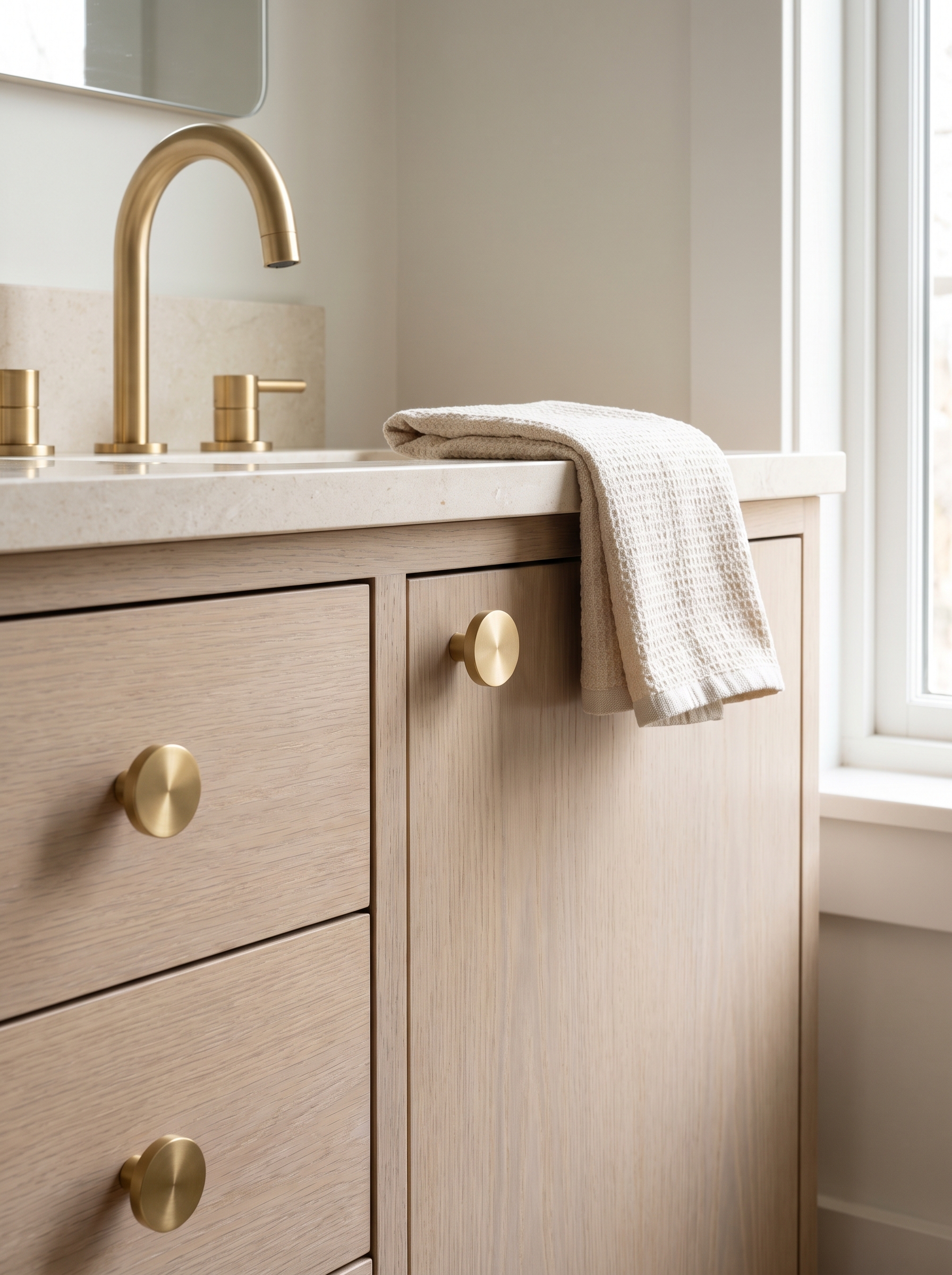
Unlacquered brass and a brass faucet only read as a set if they age together. In one steamy room both darken at about the same pace, so the knob and the spout drift toward the same warm brown.
A lacquered knob beside an unlacquered tap does the opposite, and the gap widens every month. Ask the seller which coating the metal has before you pair anything, and treat the words “living finish” as the trade name for unlacquered.
Expect the shift to show within two or three months of daily use. To slow it, rub a thin coat of microcrystalline wax over the knobs. To speed it up, do nothing and let wet hands do the work.
A 1-1/4 inch round knob suits a standard Shaker drawer front without crowding the frame. It needs a single screw through the drawer, so replacing an old knob takes a screwdriver and about two minutes.
Size a bar pull to a third of the drawer’s width
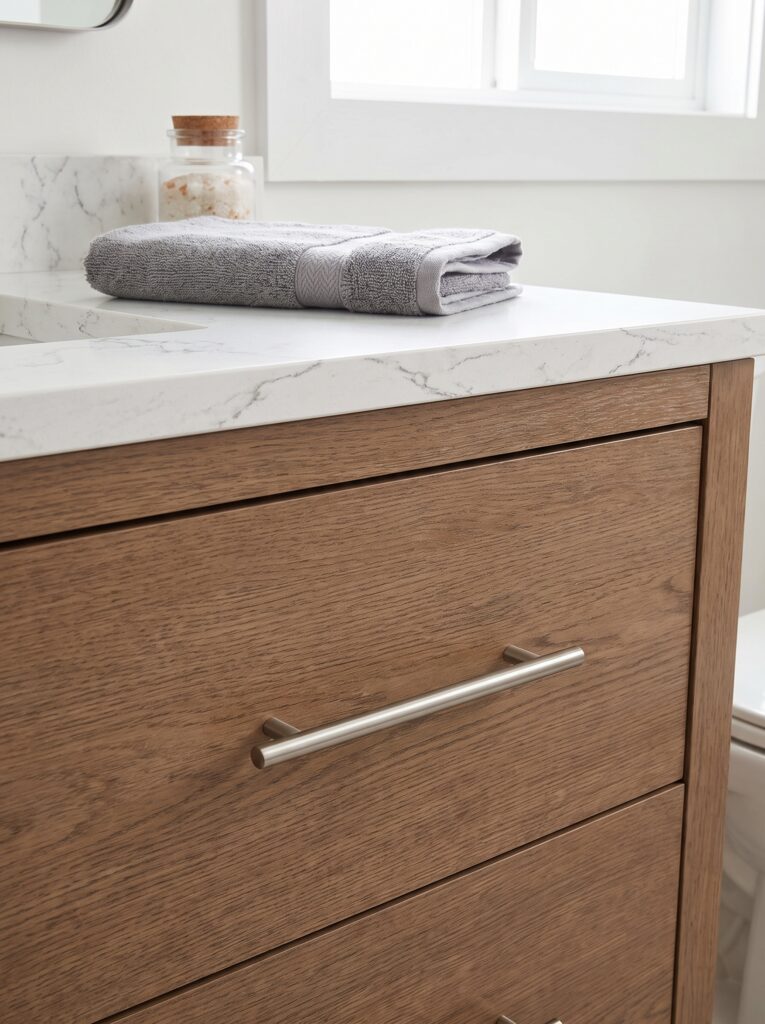
Most people choose a pull by finish and then find it looks tiny on a wide drawer. A bar pull should run about one third of the drawer front, so a 30 inch drawer wants a pull near 10 inches, not the short handle from the kitchen aisle.
Measure the drawer, divide by three, and shop by hole centre, the distance between the two screw holes. Two-hole pulls come in set spacings, so round your result to the nearest size that actually exists.
Brushed nickel is the calm choice on warm oak because it neither fights the grain nor copies it. Polished chrome looks harsh against that much wood, and brass doubles the warmth until the drawer starts to look orange.
On a narrow drawer under 18 inches, drop to a 5 inch pull or a pair of knobs. A long pull on a short drawer looks like a handle bolted to a shoebox.
Choose cup pulls for a wide, shallow drawer
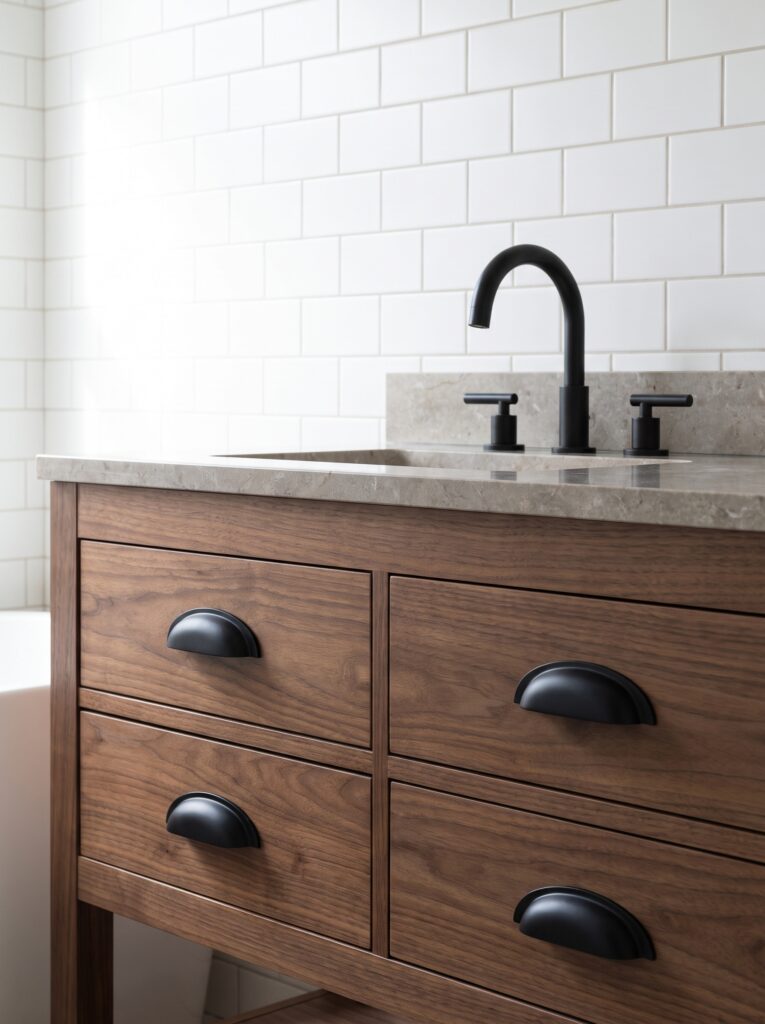
Cup pulls suit the wide, shallow drawers that vanities have and kitchen cabinets rarely do. Your fingers curl under the lip, so you can open a drawer with a wet hand without smearing the front.
On a wide drawer, set one at each end rather than one in the middle, about a quarter of the way in from each side. Two pulls also let two people open the same drawer at once, which matters at a shared double vanity.
Match the black to the faucet by sheen as well as colour, since a satin tap beside a glossy pull looks like two different product lines. Most cup pulls come in 3 inch and 3-3/4 inch spacings, so check your holes first.
Check the screw length before you fit them. A pull needs a screw about 1/4 inch longer than the thickness of the drawer front, and the box screws are often too short for a thick vanity drawer.
Shop it on Amazon: Ilyapa Matte Black Kitchen Cabinet Pulls, 3 Inch Bin Cup Drawer Handles, 10 Pack
Pale blue and grey vanities take chrome better than brass

Pale blue paint goes flat next to warm brass and looks crisp beside chrome, because the cool metal picks up the blue in the colour. If your vanity sits in the blue-grey range, start with chrome or polished nickel and bring warmth in some other way.
A vertical T-bar on a door is easier to grab than a knob and stays clear of the frame. Put it on the opening edge, about 2 to 3 inches down from the top of a base cabinet door.
Warm greys and greige vanities are more forgiving. Brushed nickel and satin brass both sit comfortably there, so choose by the faucet you already own. Hold a sample against the painted door in daylight before you commit, since paint shifts colour across a day.
If you want warmth, bring it in with a wood mirror frame or a linen towel, not with a brass pull the paint will fight. The hardware should be the quiet part of the room.
Use a long pull on drawers and knobs on doors
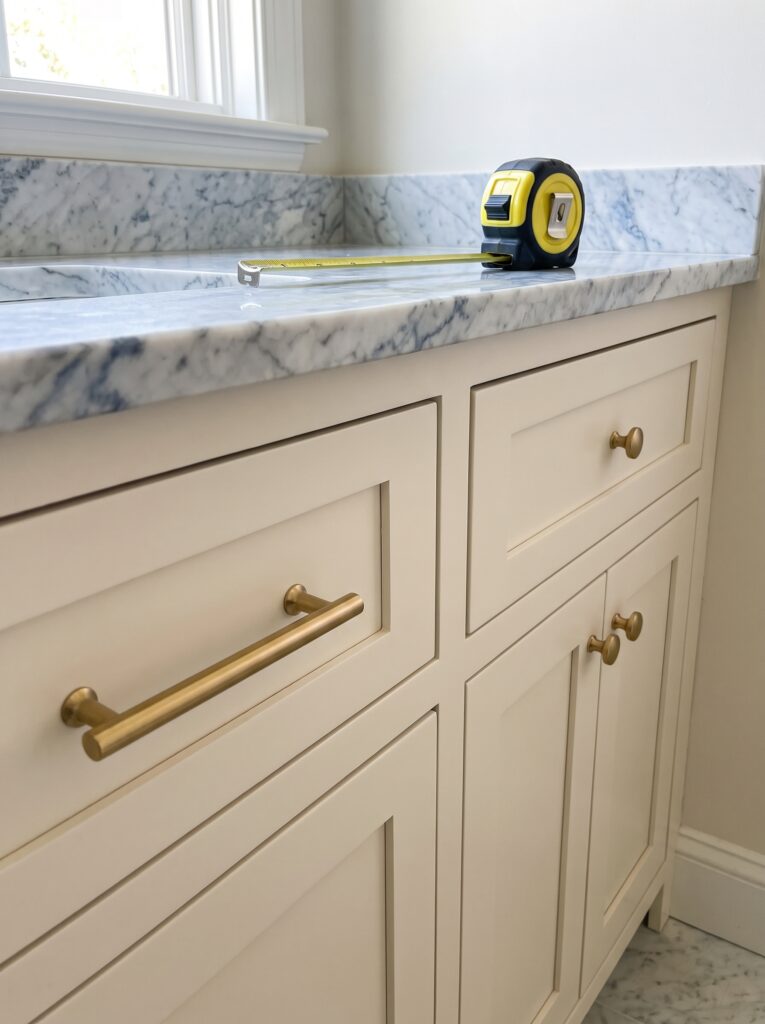
Split the job by what the front does. Drawers slide out, so a pull that spans the front lets a whole hand take hold. Doors swing, so a small knob near the opening edge is enough.
Measure the drawer width and the existing hole spacing before you order. The common centre-to-centre sizes are 3 inches, 3-3/4 inches (96 mm) and 5-1/16 inches (128 mm).
A pull with different spacing will not use your old screw holes, and filling and redrilling a painted drawer is a weekend of sanding. For drawers already drilled at 3-3/4 inches, a brushed brass set is an easy start.
Place knobs on doors 2 to 3 inches in from the corner farthest from the hinge, and keep every knob in the row at the same height. A knob that sits a quarter inch off is the first thing a guest notices.
Shop it on Amazon: ZAUYX 10 Pack 3-3/4 Inch Hole Center Brushed Brass Cabinet Pulls
Try an edge pull when you want a clean drawer face

A narrow bathroom where hips and towels brush past every morning is the place to skip the protruding handle. An edge pull sits in the top lip of the drawer and gives your fingers a place to hook without adding anything to snag on a sleeve or a child’s head.
It works best on flat-front drawers at least 3/4 inch thick, since the pull needs material to fix into. On a sage green or dark oak front, brushed brass reads as a fine line instead of a statement.
Mount it flush with the top edge and use a paper template for the screw holes. A pull that sits even a sixteenth out of line will show against a plain, flat front.
The trade-off is grip. You open the drawer with a curled fingertip instead of a whole hand, so edge pulls suit lighter drawers for towels and spare rolls better than a heavy drawer of hair tools.
Match satin to satin, not satin to polished

Two brass pieces in different sheens will not read as a match, even from the same maker. Satin brass knobs need a satin brass faucet, and polished ones need polished. Hold a sample of each side by side in the room’s daylight, not under the shop lights.
This is also the cheapest fix for a room that feels almost right. Swapping only the knobs to match the tap’s sheen costs a fraction of replacing the faucet.
Look at the metal’s tone as well as its finish. Some brass runs yellow and some runs pink, and a yellow knob beside a pink faucet reads as a mismatch even when both are satin. Order one knob before you order twelve.
If your faucet is already installed and unmarked, take a photo of it in daylight and compare it on your phone with the product photos. Trust your own room’s light over the listing’s studio shot.
Pair chrome faucets with brushed nickel pulls only when the undertone agrees

Chrome and brushed nickel share a cool, silvery undertone, so they coexist where chrome and brass never will. The difference is sheen: polished chrome mirrors the room, brushed nickel absorbs it.
In a small bathroom that contrast reads as depth when the metals sit at different heights. Put the chrome at the tap and the nickel on the drawers.
Keep the handles on the faucet in chrome and let the drawer pulls carry the nickel. If you are planning a bigger swap across the room, the Materials, Fixtures and Layout guides cover finishes room by room.
The pairing fails when the nickel leans warm. A champagne or golden nickel next to bright chrome looks dirty, so check the tone in daylight and avoid mixing brands that name the same finish differently.
Hang brass robe hooks where the shower door opens, not on it
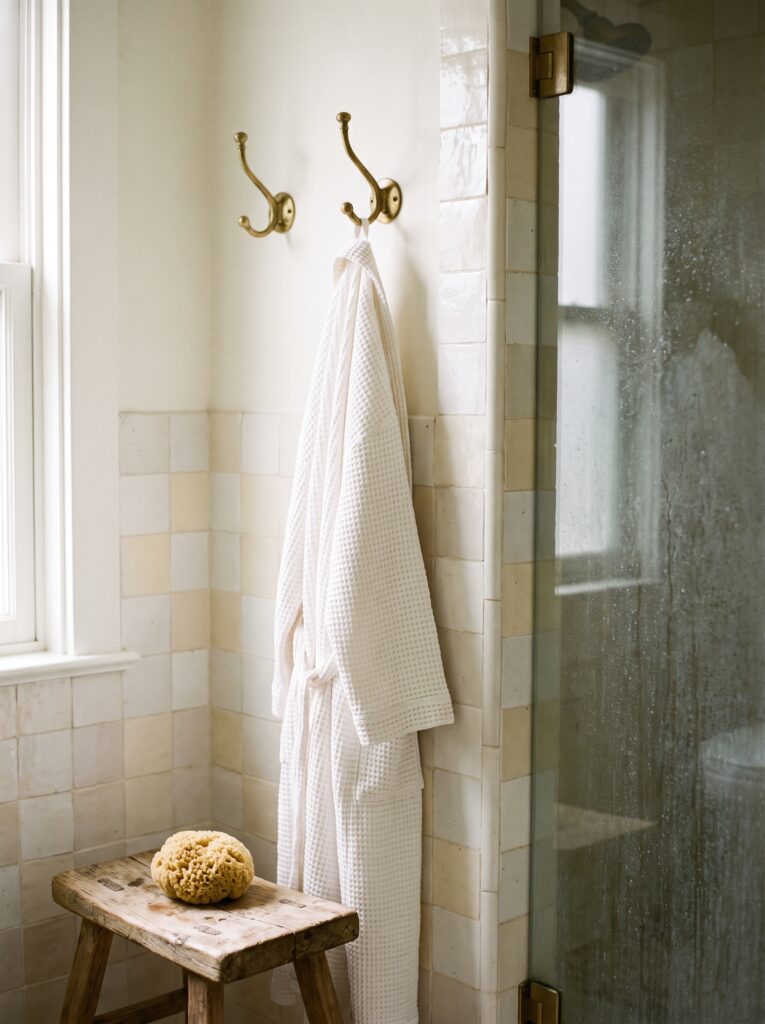
A robe belongs within one arm’s reach of the shower exit, which is usually the wall the glass swings toward. Fix the hook on that side, out of the splash path, and around 68 inches off the floor so a full-length robe clears the tile.
Solid brass tolerates steam for years and darkens instead of peeling, which suits unlacquered fixtures. Choose a hook with a rounded tip so a hanging loop slips on and off without catching.
A double hook holds a robe and a towel on one mount, so you need fewer holes in the tile. Drill through the grout line where you can, since a hole through a tile face risks a crack.
Test the position with a piece of painter’s tape before you drill. Stand where you will step out, reach for the tape, and move it until your hand finds it without looking.
Set the toilet paper holder at 26 inches and 8 to 12 inches forward

Depth is the spot people get wrong. Put the holder’s centre about 26 inches above the floor and 8 to 12 inches ahead of the front of the bowl, so the roll is reachable without leaning. A brushed nickel arm against plaster keeps the metal quiet and matches a nickel faucet across the room.
Choose a single-arm design if you change rolls daily. Fix it into a stud or a rated anchor, since the pull on a roll is sideways and cheap plastic anchors work loose.
Keep the holder on the side wall, within easy reach of a seated adult, and clear of the sink so no splash lands on the roll.
Leave room for the roll to swing. A holder squeezed into a corner drags the paper against the wall, and a roll that rubs will unspool in a sad heap by the end of the week.
Space robe hooks ten inches apart so towels never overlap
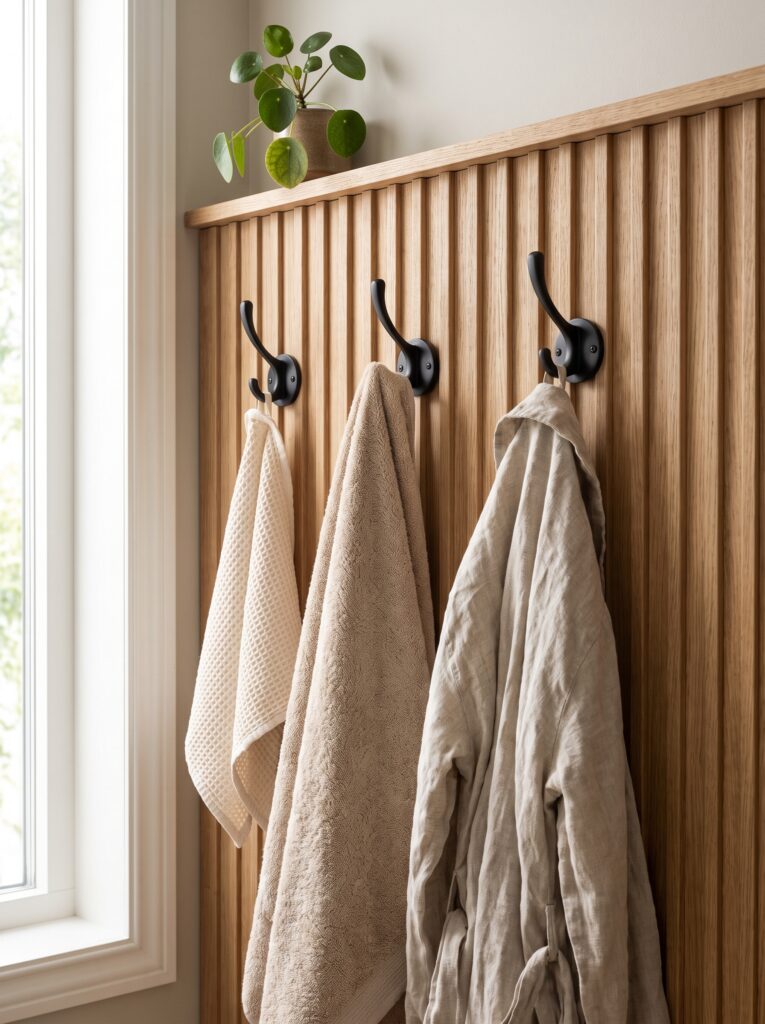
Three hooks solve a family morning better than one long bar, because each towel hangs alone and dries faster. Set them about 10 inches apart so a bath towel never touches its neighbour.
Matte black is the low-maintenance pick against fluted oak or walnut. It hides fingerprints and echoes a black faucet across the room. Screw into studs or panel battens, not just the slats, or the first wet robe will pull the set loose.
A hook is only as good as its fixing. Check the box for the load rating, and if a set of three carries wet bath towels every day, pick a hook rated well above the weight of a soaked towel.
Give each person one hook and stick to it. It sounds bossy, but a hook per person is the reason a shared bathroom stays tidy for longer than a week.
Shop it on Amazon: Angle Simple Double Towel Hook Matte Black, Stainless Steel Bathroom Towel Holder, Coat Robe Hook Wall Mount
Try a floor stand when the wall is tile, glass or a rental
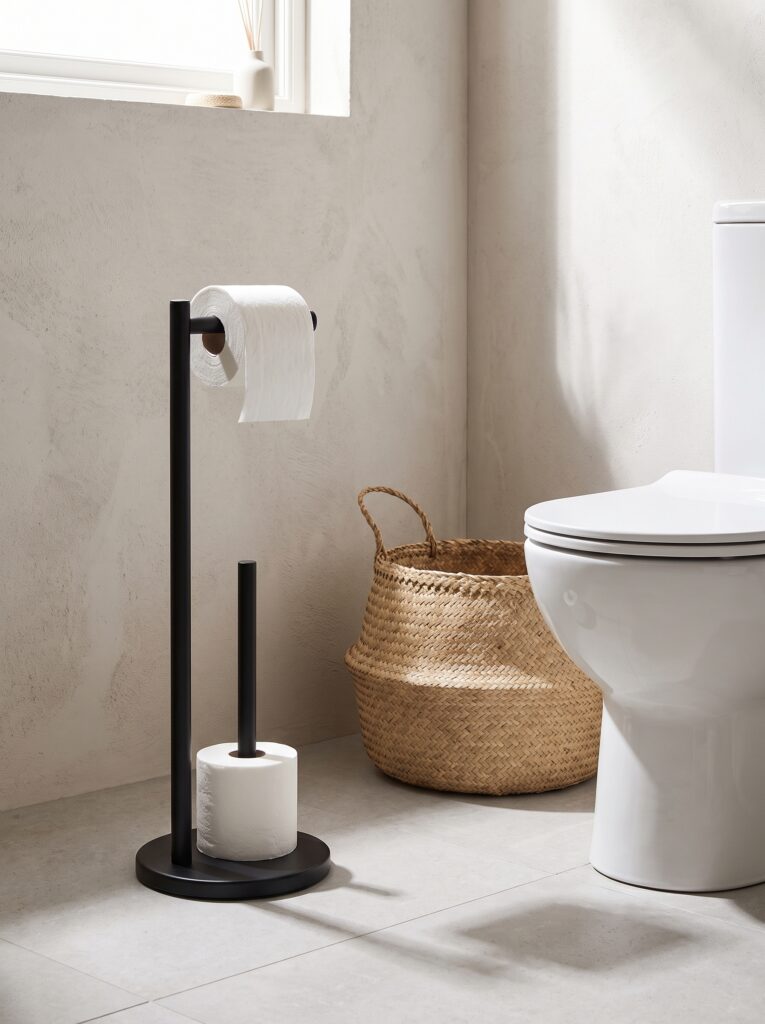
If the wall is off limits, a black floor stand puts the paper roll and two spares within reach without drilling. Tuck it between the toilet and the wall so its base stays out of the walkway.
Pick a base wide enough not to tip when the top roll is pulled hard. Match the black to the faucet, and keep a woven basket beside it for anything else that would end up on the floor.
Test the stand with a full roll on top before you settle on a spot. A top-heavy stand near a door swing gets knocked over within a week.
A stand also takes its finish from the room, so a nickel or brass version in a small powder room can double as a piece of decor. If the floor is uneven, check the base sits flat, or the whole thing will rock every time someone reaches for a roll.
Choose a back-to-back pull for a frameless shower door
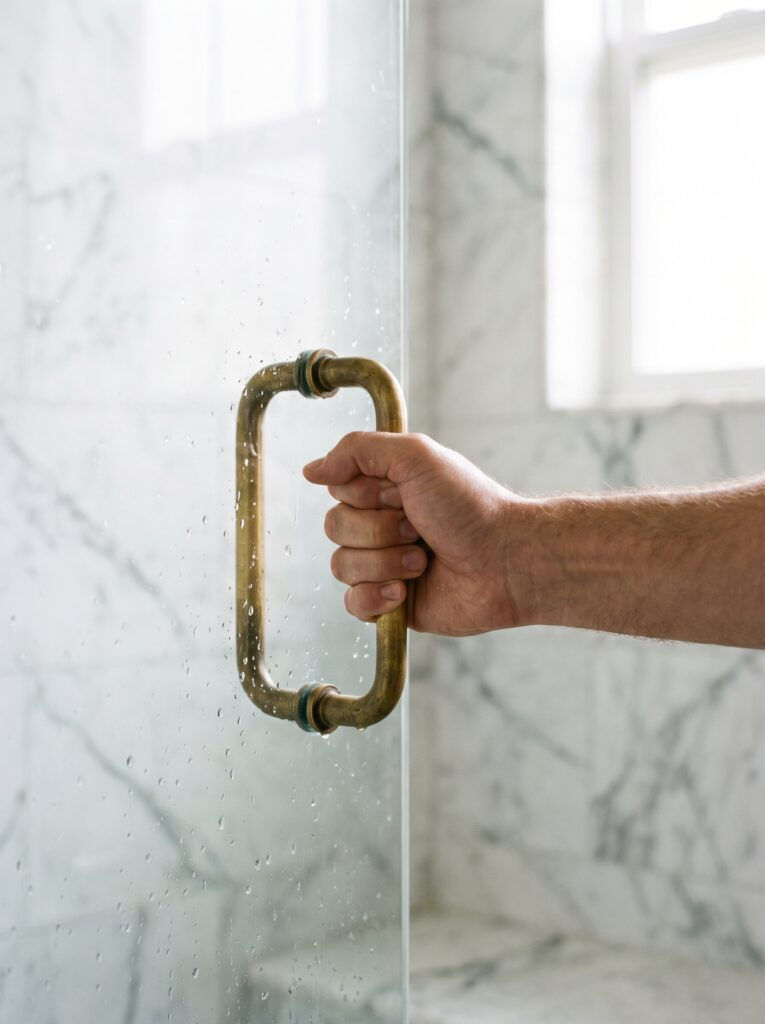
Frameless glass cannot be drilled after it is tempered, so the holes already in your door decide the handle. Measure the hole spacing and the glass thickness first, then buy a back-to-back set that matches, because the two bars bolt together through the glass.
Unlacquered brass develops a mottled patina from wet hands, and against white marble it looks deliberate rather than dirty. If you prefer it bright, wipe it dry after each shower.
Clean it with a soft cloth and mild soap. Abrasive powders strip lacquer and leave bare patches that tarnish at different speeds.
Fit the rubber washers that come with the set, and tighten evenly. Glass never touches bare metal, and a handle tightened hard on one side is the usual reason a door cracks at the hole.
Repeat one black across a framed shower

On a framed sliding door, a long bar handle in matte black should echo the shower head and valve plate, not fight them. Check that the bar is long enough to grab from either side of the frame.
Matte black hides fingerprints but shows hard-water spots, so keep a squeegee in the shower and run it over the bar. If the frame is black and the bar is not, the eye lands on the mismatch first.
Keep the black to three or four pieces in the shower. More than that and the tile disappears behind a grid of dark lines, which is a look you either plan for or avoid.
Check the sheen against the frame as well as the colour. A satin frame and a glossy bar will not match under bathroom lighting. Buy the handle from the same maker as the door if you can, since they finish both to one standard.
Fit a privacy lever, and check the backset before you order
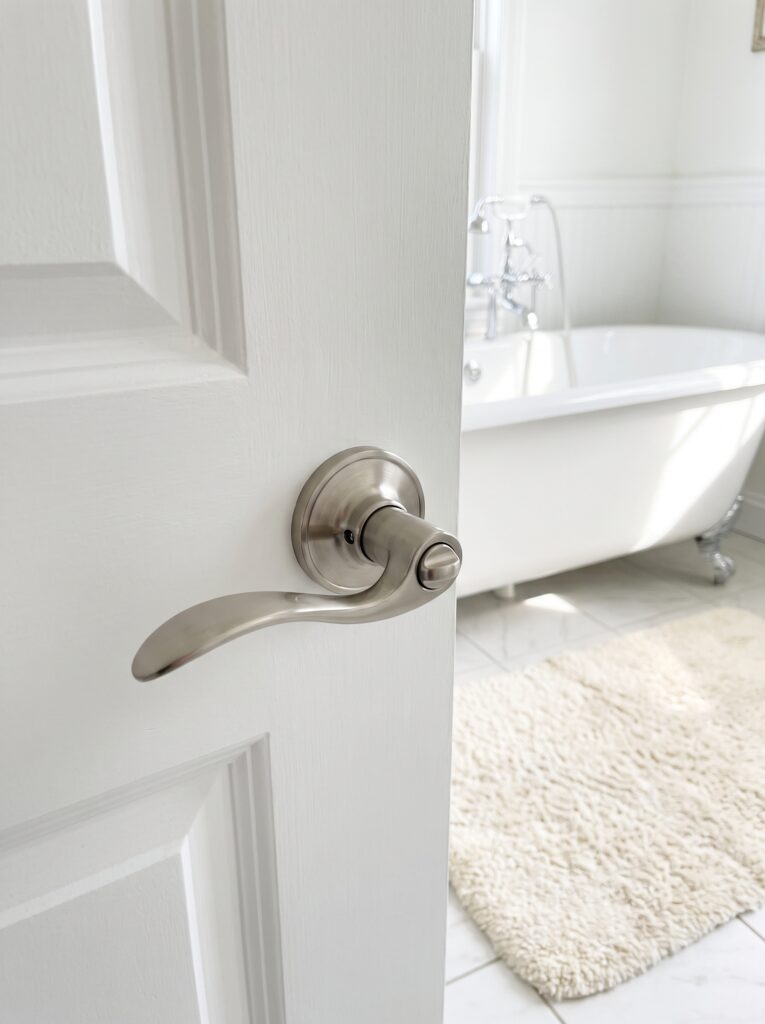
A bathroom door needs a privacy set with a turn or push button, not a passage set that will not lock. A lever also beats a knob for wet hands and full arms.
Before you order, measure the backset, the distance from the door’s edge to the centre of the bore. It is nearly always 2-3/8 or 2-3/4 inches, and a brushed nickel lever will then swap in without redrilling.
Match the lever to the finish of the other hardware you touch in the room, not to the hallway. The bathroom door is the one piece both spaces see, so a neutral brushed nickel rarely clashes with either side.
Choose the handing carefully. A lever with a curved tip is usually made for one side, and a door that opens the other way needs the opposite hand, or the lever will point at the frame instead of at your palm.
Put a small knob on the opening edge of a mirrored cabinet

A mirror cabinet needs only a small knob on the edge that swings open, because the whole door is already the handle. A little oval brass knob keeps the mirror face clear so it reflects the sconces instead of a large fixture.
Centre it about halfway up the opening edge so a hand reaches it without touching the glass. For frame shapes and sizes, see our guide to bathroom mirror ideas.
If the cabinet is recessed into the wall, check the swing before you fit anything. A knob that catches the frame when the door opens will chip paint within a month.
Use a knob small enough that it never fights with the sconces on either side. Two brass sconces and a brass knob are enough, and a third brass element on the mirror frame pushes the whole wall toward one flat yellow.
Use one vintage cross handle on a door as a playful knob
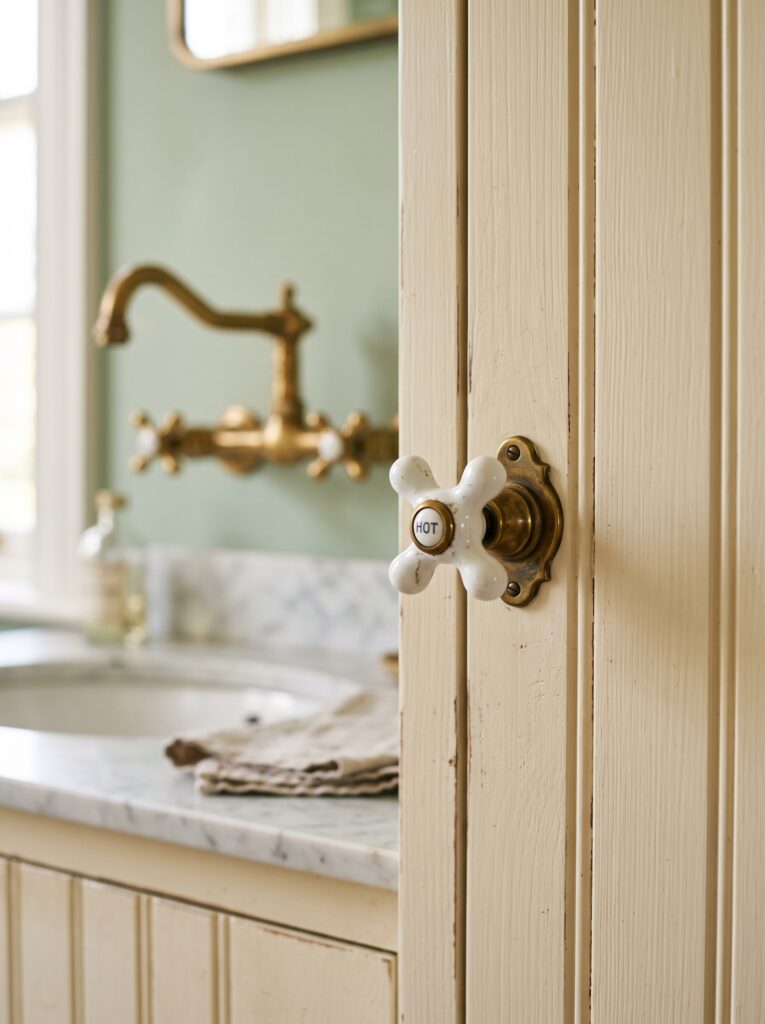
A period porcelain cross handle on a beadboard door turns a plain cabinet into a small joke that still looks intentional. The HOT lettering on the face gives it away, so keep it to one door, or buy blank-faced ones if the joke is not yours.
Repeat the brass and porcelain in the faucet across the room, and keep every other cabinet in plain brass knobs so the vanity does not become a display of taps.
Fix it with the original escutcheon plate behind it. The plate protects the paint from the turning handle and gives the cabinet a finished, period look.
Check the spindle length before you buy a reclaimed handle. Tap handles have long stems for a thick faucet body, and a thin cabinet door needs a shortened spindle or a spacer washer behind it.
Let one finish lead and use the second only twice

A mixed-metal bathroom works when one finish clearly leads. Give black the drawers, the towel ring and the soap pump, then let brass appear only at the faucet and the mirror frame: two places, not five.
The second finish should show up at least twice, or it reads as a mistake instead of a choice. Keep the sheen consistent inside each metal so the two finishes look like a plan.
Test the plan before you buy: photograph the room, then hold each finished piece against the screen, or tape paper swatches of the second finish where it will go. If it looks lost in two places, drop it to one metal.
A useful order is to fix the leader first, live with it for a week, and then add the second finish. Rooms that get both metals in one afternoon tend to end up with three.
Match your bathroom hardware ideas to the faucet finish
Start with the faucet, since it is the one piece you are least likely to swap. This table gives the safe match, the bolder match and the pairing to skip.
| Faucet finish | Safe match for pulls | Bolder match | Skip |
|---|---|---|---|
| Polished chrome | Polished chrome or polished nickel | Matte black | Brushed brass |
| Brushed nickel | Brushed nickel or stainless | Matte black | Polished gold |
| Matte black | Matte black | Brushed brass | Polished chrome |
| Satin or brushed brass | Brass in the same sheen | Matte black | Polished chrome |
| Unlacquered brass | Unlacquered brass | Oil-rubbed bronze | Polished nickel |
Bring a photo of the faucet or a sample piece to the shop, and judge the pair by daylight, since warm showroom bulbs flatter every brass.
Write down these five measurements before you shop
Most hardware returns come from a number nobody wrote down. Take a tape measure and a notepad into the bathroom before you open a single tab.
Start with the hole spacing on every drawer and door you plan to change, measured centre to centre. Then note the width of each drawer front, which sets the pull length, and the thickness of each front, which sets the screw length.
For the shower, measure the glass thickness and the spacing between the existing handle holes. For the door, measure the backset. For the toilet paper holder and robe hooks, mark the finished heights on the wall with painter’s tape and stand back to check them.
Photograph each measurement next to the tape, so you can check it on your phone in the shop aisle.
Four tells that separate solid hardware from plated hardware
Steam and wet hands punish thin plating within a year or two. Run each candidate through these checks before you pay.
Pick it up. Solid brass or zinc feels dense for its size. A hollow piece feels light and rings when you tap it.
Read the screws. Cheap sets ship thin machine screws that strip on the first tightening. Look for full-length threads and the right screw length for your drawer thickness.
Turn it over. The finish should be even on the back and the edges, not only on the front face.
Check the finish type. A stated PVD coating or a lifetime finish warranty wears better in steam than a painted or sprayed finish.
Where to begin if you only change one thing this weekend
Start with the pieces you touch most, the vanity pulls and the shower handle, and let the faucet finish decide the rest. Measure your hole spacing first, order a sample of each finish, and hold them up in daylight.
If you keep one idea from these bathroom hardware ideas, make it this: match by sheen, size by the drawer, and stop at two metals.
Save this pin to your bathroom hardware board so the measurements are handy when you shop.