How to Ventilate a Bathroom With No Window: 8 Easy Fixes
If you are working out how to ventilate a bathroom with no window, the fix is making the exhaust fan you already have do its job: check that it actually pulls air, give the room a gap under the door so replacement air can get in, and run it for 20 minutes after every shower. Renters can do all three without tools. A dehumidifier helps, but it dries air instead of replacing it, so treat it as backup.
Your mirror stays fogged long after you leave. Grout darkens in the corner nearest the shower, paint above the door starts to bubble, and the whole room smells faintly damp by Thursday. You assume the answer is a bigger appliance or a landlord who returns emails.
Almost every guide on bathroom no window ventilation opens with “install a ducted extractor fan,” which is useless if you cannot cut a hole in someone else’s ceiling. Nothing below requires drilling. Everything else costs under $40, and the two changes that matter most are free.
Everything here runs in the order you should try it, starting with a two-minute test that tells you whether your fan is worth keeping. Real numbers are included where they matter: fan sizing, run time, and the humidity reading you are aiming for after a shower.
This post contains affiliate links. If you buy through them, I may earn a small commission at no extra cost to you.
Test whether your existing fan actually moves air
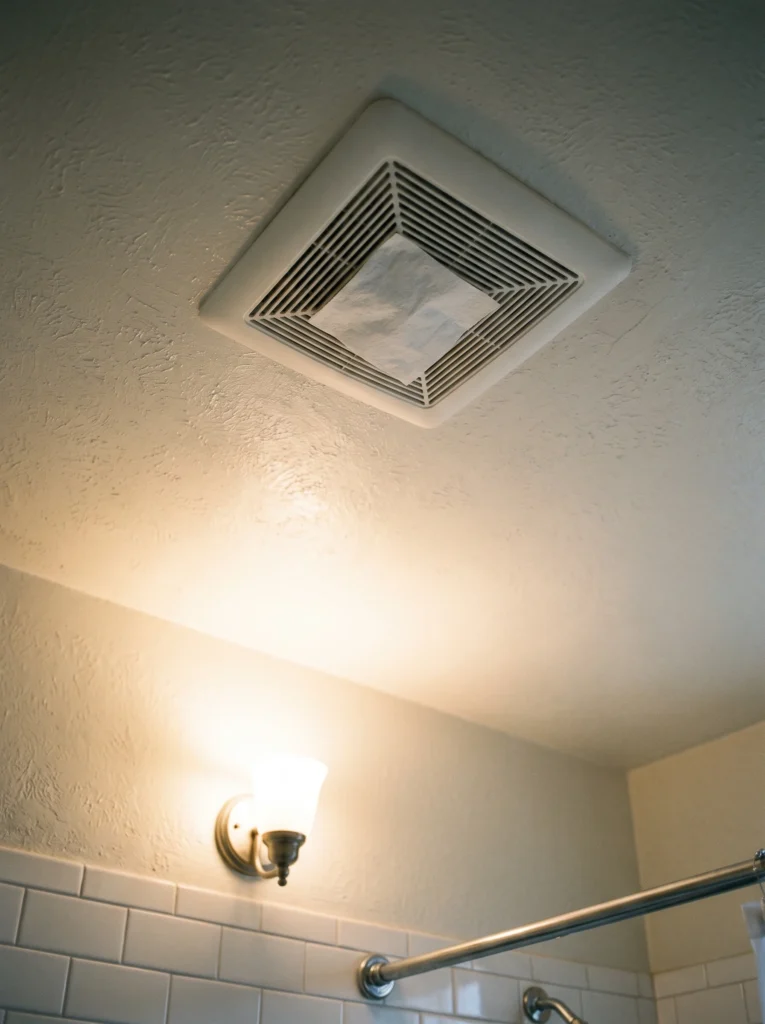
Hold one square of toilet paper flat against the grille with the fan running. It should stick there by itself. Paper that slides off means the fan is barely moving air, and every other fix in this article will underperform until that changes.
Failed tests usually trace to one of three things. Lint packed into the housing is the most common by far, and pulling the cover down to vacuum it takes about five minutes. Ducting causes the rest: plenty of homes have a fan that dumps straight into the attic, which relocates the moisture rather than removing it.
Repeat the test once it is clean. Holding again means the fan is worth building around. Dropping a second time points at a motor or a duct problem, and in a rental that is a message to your landlord rather than a Saturday project.
Give the fan somewhere to pull air from

No fan can empty a sealed box. Air pulled out through the ceiling has to be replaced by air coming in somewhere else, and in a windowless bathroom the only route is usually the gap beneath the door. Seal that gap with a draft stopper or thick new flooring and the fan spins against a vacuum, moving a fraction of what the box promised.
Three quarters of an inch is the gap to aim for. Measure it with pocket change, since a stack of three quarters comes out close enough. Doors that sit flush on a bath mat or a newly tiled floor can be lifted off their hinges and trimmed along the bottom, which costs nothing beyond a borrowed saw and an afternoon.
Louvered doors solve this permanently and look deliberate rather than makeshift. Tenants who cannot swap a door get the same result by leaving it open four inches through the shower and for a while after. Nobody talks about this step, and it is the reason a perfectly good fan underperforms in so many small bathrooms.
Size the fan to the room, not to the hole in the ceiling
Sizing starts with one CFM per square foot of floor, the Home Ventilating Institute’s rule, with 50 CFM as the minimum for any bathroom under 100 square feet. Five by eight needs 50. Ten by ten needs 100. Past 100 square feet you stop measuring floor and start counting fixtures instead, at roughly 50 CFM each for the toilet, the shower and the tub.
Builder-grade fans are almost always 50 CFM, because that is the cheapest unit that satisfies code. That single fact explains a lot of frustration: the fan can be working exactly as designed and still lose to a long hot shower in a room that needed 80.
Sones measure how loud it will be. Anything rated 1.0 or below is quiet enough that you will actually leave it running, which matters more day to day than the last 20 CFM on the box. Fan choice sits alongside every other materials, fixtures and layout decision in a small bathroom, and it is the one people research least.
Run it 20 minutes after you get out, not just during the shower
Steam does not leave when you do. Nearly all the water is still hanging in the air at the moment people flip the fan off, and over the next hour it settles onto whatever is coolest: the mirror, the ceiling, the grout line behind the shower head.
Twenty minutes is the run time fan manufacturers print in their own manuals. Free to do, and it is the highest-value change on this page. Set a phone alarm for a week until it becomes automatic.
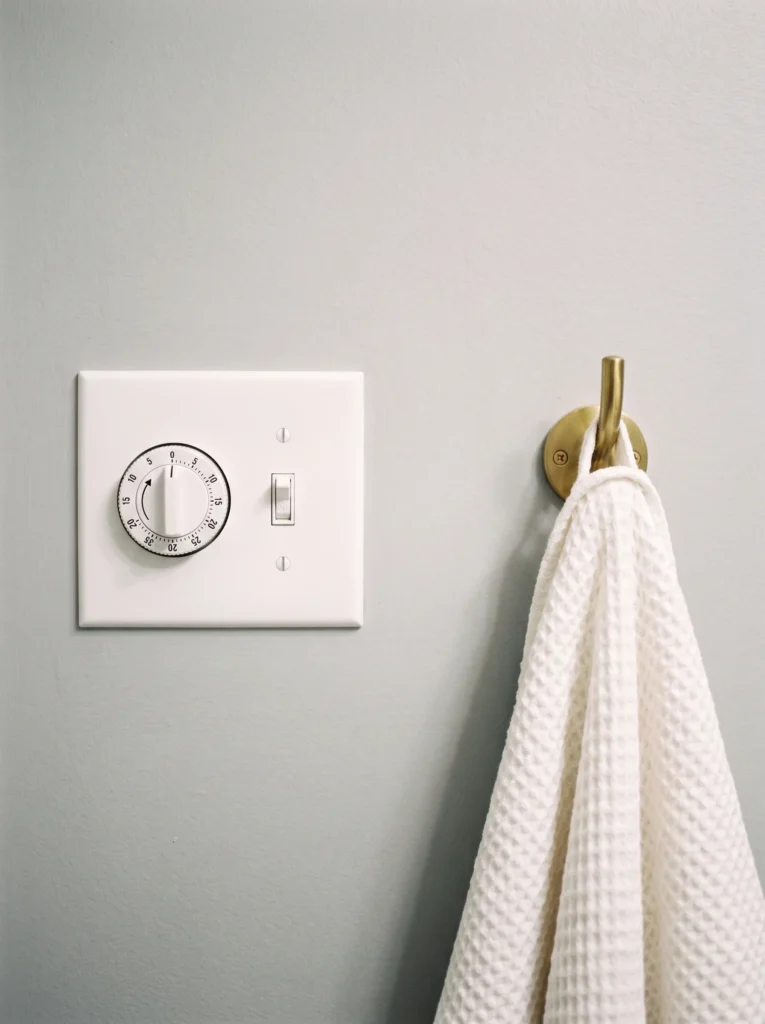
Dial timer switches take the discipline out of it completely. It swaps into the existing switch box, runs anywhere from 5 to 60 minutes, then cuts power on its own. Wiring puts it in homeowner territory rather than tenant territory, though an electrician will usually fit one in under half an hour.
Add a dehumidifier when you cannot touch the fan
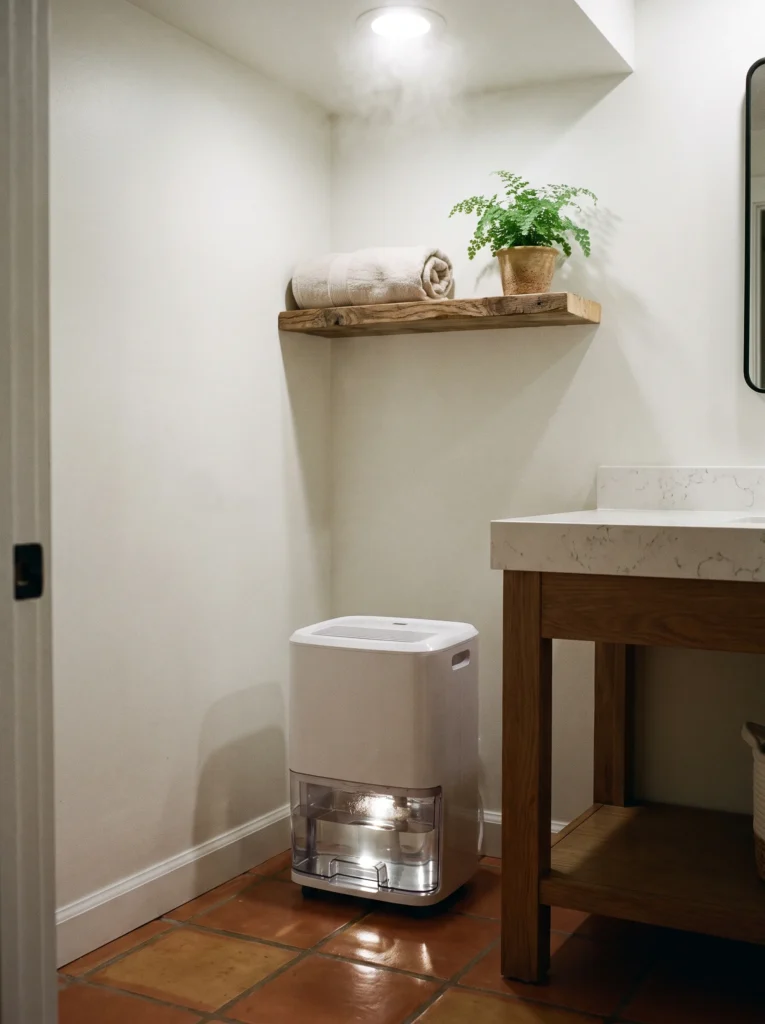
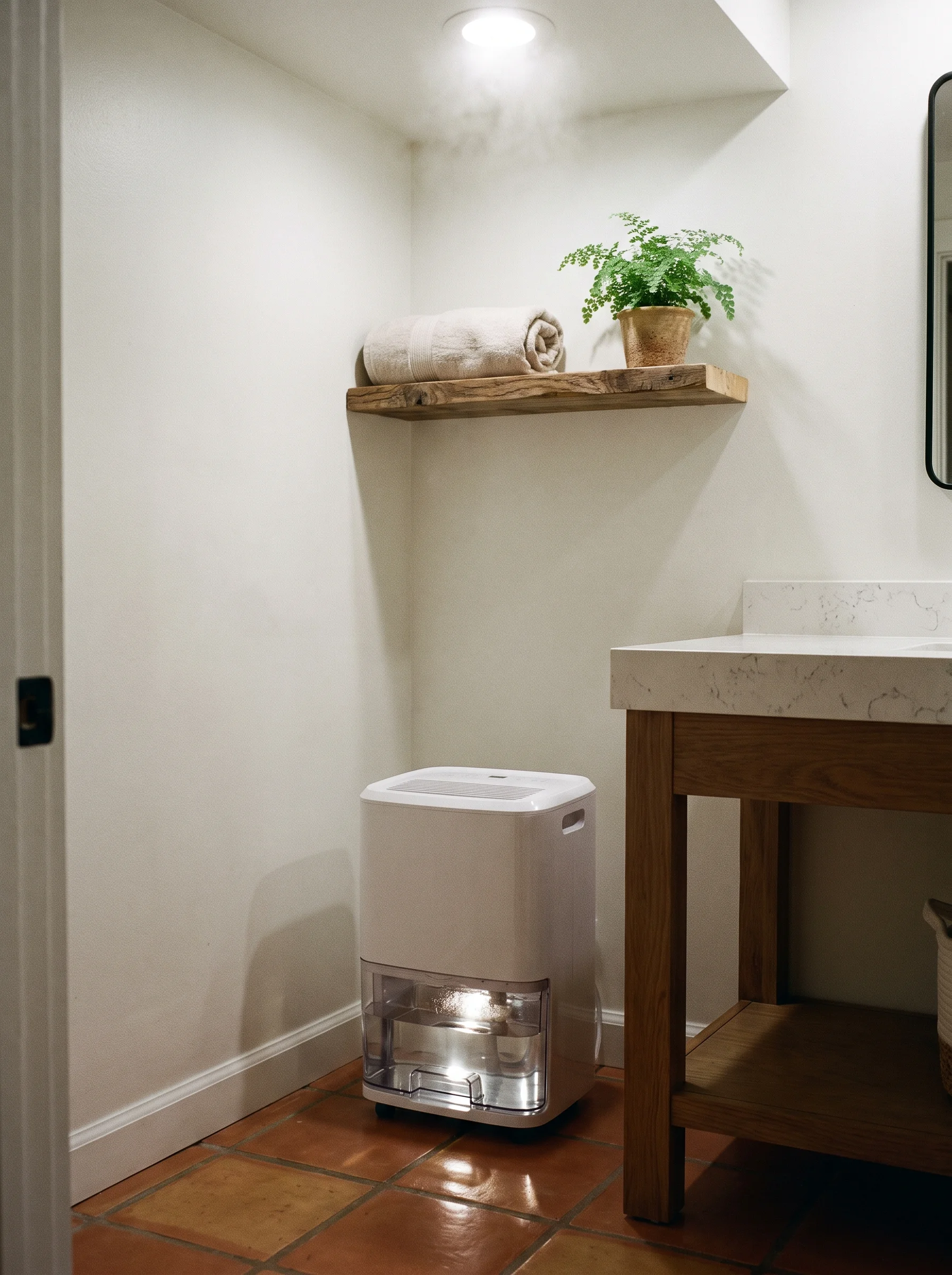
Dehumidifiers are not ventilation, and the distinction saves you money. They pull water out of air that stays in the room. Fans remove the air itself, and everything riding in it. For a windowless bathroom stuck with a weak fan, a compact dehumidifier is a supplement rather than the whole answer.
Small 35-ounce units cover bathrooms up to roughly 280 square feet and run quietly enough to leave on overnight. Empty the tank daily. Units shut off by themselves when the tank fills, so a forgotten one simply stops working rather than overflowing onto your floor.
Put it in the corner furthest from the shower, out of the splash zone and out of the walking path. Running it for an hour after you shower does more than leaving it on all day, because that is the window when the moisture is actually in the air.

Move the air with a fan you already own
Point a box fan out the doorway, not into the room. Facing outward it pushes damp air into the hallway, where a much larger volume of dry air dilutes it, and pulls replacement air in around the door frame at the same time.
Roughly ten minutes of that does real work in a small room. Clip fans on a towel bar manage the same trick where floor space is tight, and a $15 one runs on almost no power.
Think of this as the fallback when nothing else is possible, though it genuinely beats an unducted ceiling fan that moves your moisture into the attic. Half baths and tiny powder rooms rarely need anything more, since nobody is producing steam in a room with no shower in it.
Cut the steam before it reaches the ceiling
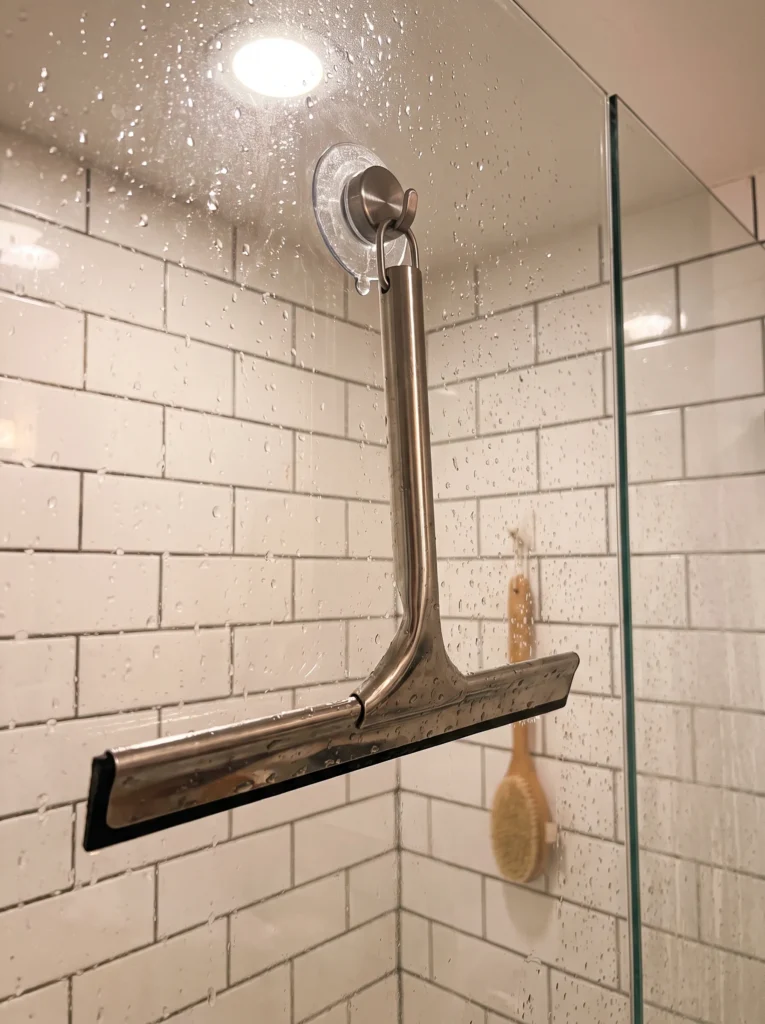
Producing less steam beats extracting more of it. Cooler water puts less moisture into the air, and dropping the temperature for the final two minutes of a shower makes a difference you can watch on the mirror.
Wipe the glass and tile down before you step out. Sixty seconds with a squeegee clears water that would otherwise evaporate straight back into the room and end up on your ceiling. Keep it on a suction hook inside the shower, because a tool stored in the cabinet gets used twice and then forgotten.
Spread the curtain out afterward, or leave the glass door propped open. Water trapped in the folds of a bunched curtain evaporates slowly for hours, which is exactly why mildew shows up along the bottom hem first.

Watch the humidity instead of guessing
Buy the number rather than guessing at it. A $10 hygrometer tells you whether anything you changed is working, and it stops the cycle of buying appliances to fix a problem nobody has measured.
EPA guidance puts healthy indoor humidity between 30 and 50 percent, and mold gets comfortable once a room sits above 60. What matters in a windowless bathroom is not the peak but the recovery: time how long the reading takes to fall back under 60 after a shower. Thirty minutes means your setup works. Two hours means it does not.
Mount it at eye level on the wall opposite the shower. Readings taken right beside the tub spike hard and will worry you for no reason.

Four mistakes that keep a windowless bathroom damp
Wet towels left on the rail undo a lot of good ventilation work. Each one holds close to half a pound of water and releases it slowly back into the same small room over the following hours. Hang them somewhere with airflow, or at minimum spread them wide rather than folded in thirds.
Plug-in air fresheners treat the symptom. Damp smell is water in the drywall and the grout, so masking it changes nothing about bathroom ventilation and buys maybe two hours. Odor that returns within a day is telling you the moisture never left.
Bleaching ceiling mold without fixing airflow is the third one. Spores come back in a few weeks because the conditions that grew them are unchanged, and repeated bleaching gradually wrecks the paint you were trying to save.
Loud fans get trusted more than they deserve. Noise comes from the motor and the housing, not from the duct, so a rattling unit can be pushing warm wet air into your attic while sounding like it is doing its job properly. Volume proves nothing here. Only the paper test does.
How to ventilate a bathroom with no window: which fix to use
Rank these by what you are allowed to change, not by what performs best in a lab. Tenants and owners reading the same list should walk away doing different things, and the tenant’s version still works.
The ducted fan you already have
Best for anyone whose fan genuinely vents outside. Cleaning it costs nothing and a timer switch runs about $20. Nothing else here performs better. Verification is the catch: you have to confirm the duct actually reaches an exterior vent, which usually means a look in the attic or a walk around the outside of the house.
A replacement fan sized to the room
Best for owners with an undersized or dead unit. Budget $80 to $200 fitted, more if new duct has to be run. Results are high and permanent. Ownership is the catch: this is not a tenant’s call, and cutting a larger ceiling opening is real work rather than a weekend flourish.
A plug-in dehumidifier
Best for renters and anyone whose fan cannot be repaired. Around $40 to $70, no installation, no permission needed. Performance lands in the middle, since it dries air without exchanging it. Emptying is the catch, every single day, and it does nothing at all for odor.
Door gap plus habits
Best for everyone, alongside whichever option above applies. Cost is zero. Results surprise people, because a fan with proper makeup air and a 20-minute run outperforms a bigger fan choking in a sealed room. Memory is the catch, which is the entire reason timer switches sell.
What to do first this week
Start with the toilet paper test tonight, since it decides everything that follows. Two minutes, no money. Whatever it tells you narrows the rest of this list down to two or three things worth your attention.
Check your door gap next, then commit to the full 20 minutes of run time for one week straight. Plenty of windowless bathrooms improve enough on those three changes alone that the mirror clears before you have finished brushing your teeth.
Leave the hygrometer until you have sorted out how to ventilate a bathroom with no window. Measuring a room you have already fixed tells you something useful, while measuring one you have not just confirms what the fogged mirror was telling you for free.