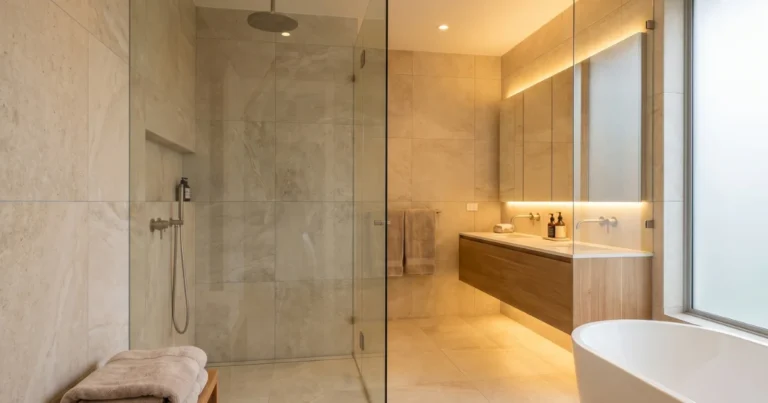
Bathroom Niche Ideas for the Shower, Vanity and Toilet Wall
The best bathroom niche ideas start with the wall, not the tile. In a shower, set the niche at shoulder height on a side wall that the spray misses. Beside a mirror or a toilet, set it where your hand already goes. Size every one to a stud bay, about 14.5 inches clear, and slope any wet shelf so water runs out.
Most roundups stop at the shower. Yet a niche is only a recess between two studs, so the same box works beside a mirror, above a toilet, at the end of a tub or under a sloped attic ceiling. Each wall brings its own height, depth and catch.
The 18 ideas below follow the wall: six in the shower, four around the vanity, three by the toilet, two at the tub and three in odd spots. Each gives a size, a height or a rule you can check with a tape measure before anyone cuts a hole.
One note on terms. Built into the wall between the studs, a niche adds no depth to the room. A shelf screwed to the wall is a different job with different fixings.
Affiliate disclosure: this post contains Amazon affiliate links. If you buy through one, we may earn a small commission at no extra cost to you.
Table of Contents
Set a wide horizontal niche on a side wall, away from the shower head
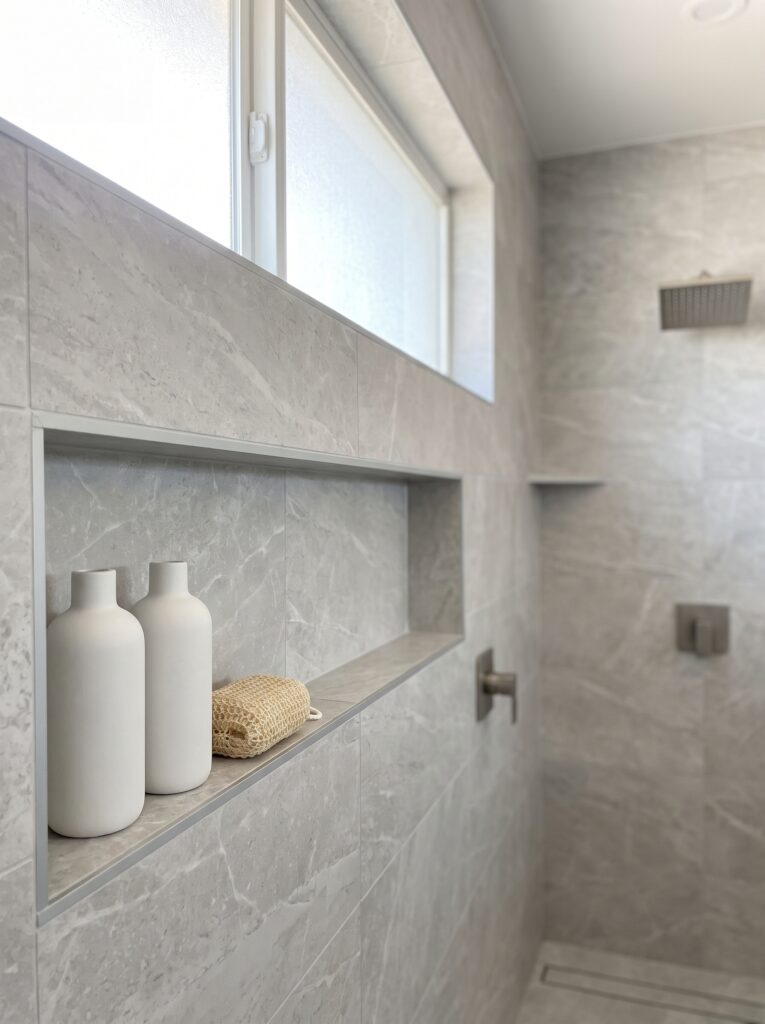
Put a long, low niche on a side wall of a walk-in shower if the main wall carries the valve and shower head. Spray hits that main wall first, so a recess to one side stays mostly dry and the bottles last longer between cleans.
Aim the shelf at shoulder height. For many adults that lands near 48 inches off the floor, but stand in your own shower and mark your line before anyone cuts. Large-format porcelain tile on the back lets one horizontal grout line run straight through.
Width is the catch. Anything wider than one stud bay means cutting a stud and framing a header, which is carpenter work and not a tiler’s job. Measure your tallest bottle first and add an inch of headroom.
Fit one tall niche into a single stud bay on a tub and shower wall
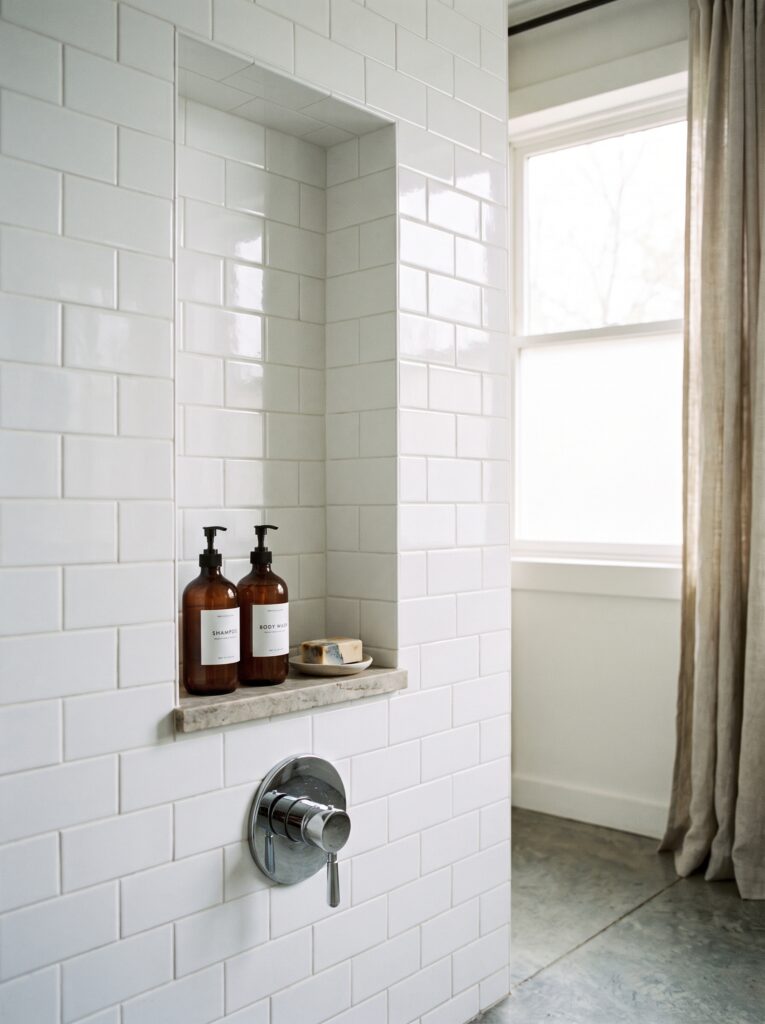
Studs usually sit 16 inches apart, which leaves about 14.5 inches clear, so a niche 12 inches wide drops into one bay without cutting anything. That makes a single vertical box the tidiest of the shower niche ideas for a tub and shower combination.
Go for a 12 by 28 inch box, a common size. The bottom shelf takes a big shampoo while small items sit above it, and the base lands just over elbow height so nothing needs fishing out.
Look inside the wall before you mark anything. Supply pipes often run through the same bay as the valve, and a cut through one becomes a plumbing bill. One small inspection hole, or a cheap inspection camera, settles it.
Depth is the last number. Since a 2×4 wall is 3.5 inches deep, expect a niche about 3 inches deep once the back panel goes in.
Stack two niches at different heights when two people share the shower
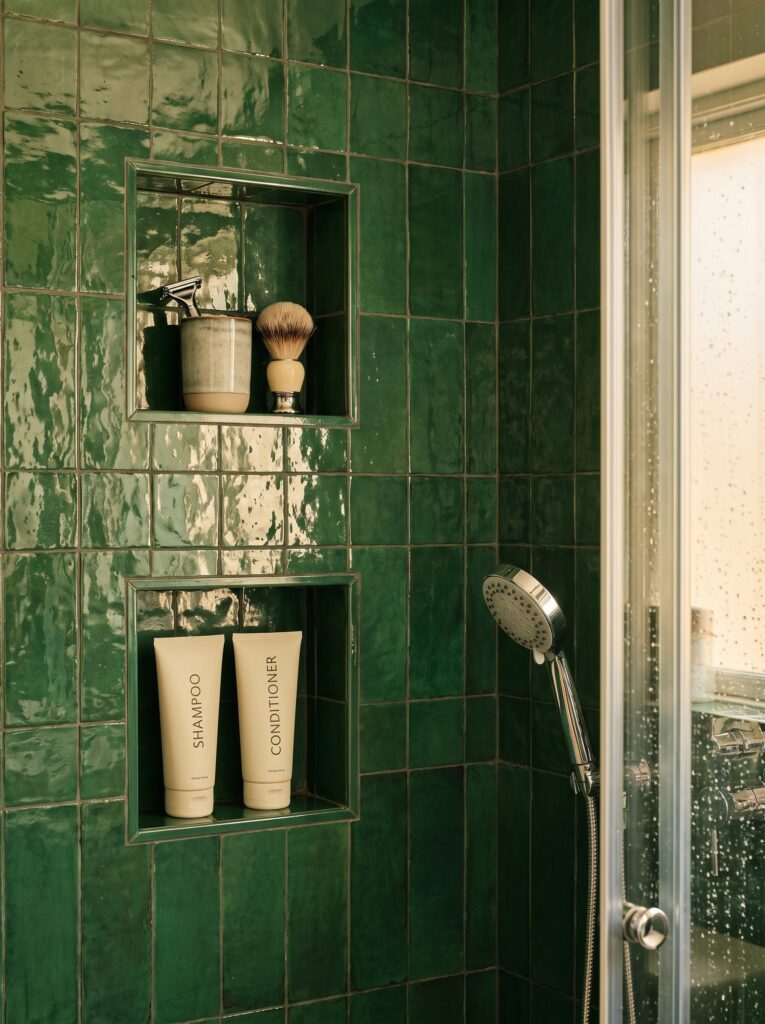
Two small boxes cost a little more to build than one big one, yet they suit two people of different heights. Place one at the taller person’s shoulder and one lower for the shorter, with about 12 inches of solid wall between them so the tile cuts stay clean.
Neither box belongs on the wall with the shower head, where spray would soak it.
Each box fits a single stud bay, so the pair lines up on the same studs. Prefab niches, such as a 12 by 12 inch one, arrive waterproof with sealed inside corners, which saves the fiddly part and ties into the wall membrane.
Shop it on Amazon: Schluter KERDI-BOARD-SN Shower Niche, 12 x 12 inch (KB12SN305305AF)
Run large-format tile straight through a frameless niche

Most people frame a niche with contrasting trim. Frameless does the opposite and lets the wall tile run straight in, so the recess reads as a shadow instead of a box. For shower niche tile, large-format or stone-look porcelain works best.
The work happens on paper. Plan the tile layout before setting any tile so the niche edges land on grout lines, and use the same grout color inside and out. Half a tile off, a niche looks like a mistake from across the room.
Mitre the outside corners or use a thin bullnose, because raw tile edges chip and show a pale core. Layout calls like this repeat across the whole room, and our materials, fixtures and layout guides cover the tile and fixtures around the niche.
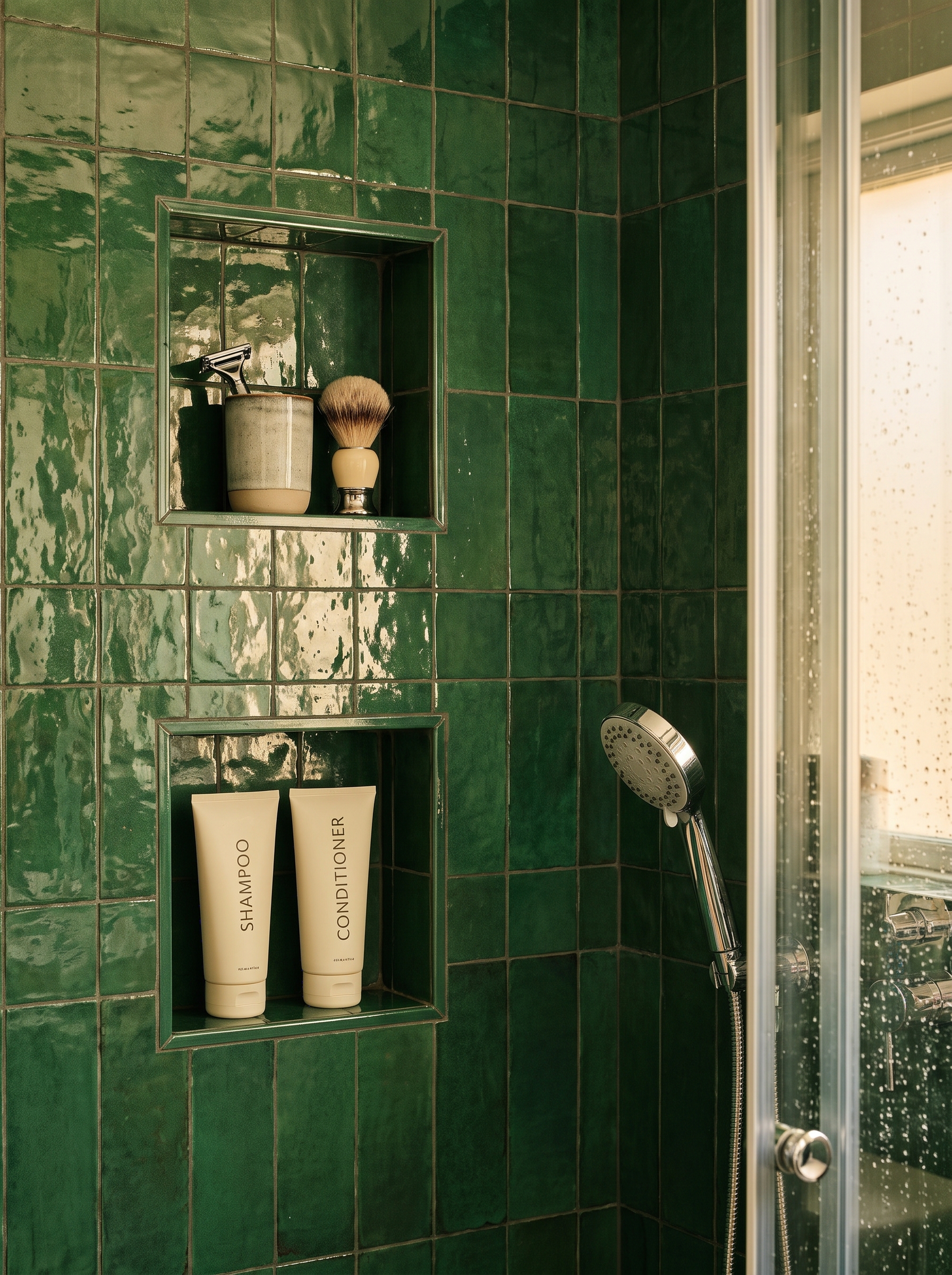
Edge a niche in metal when the tile is dark
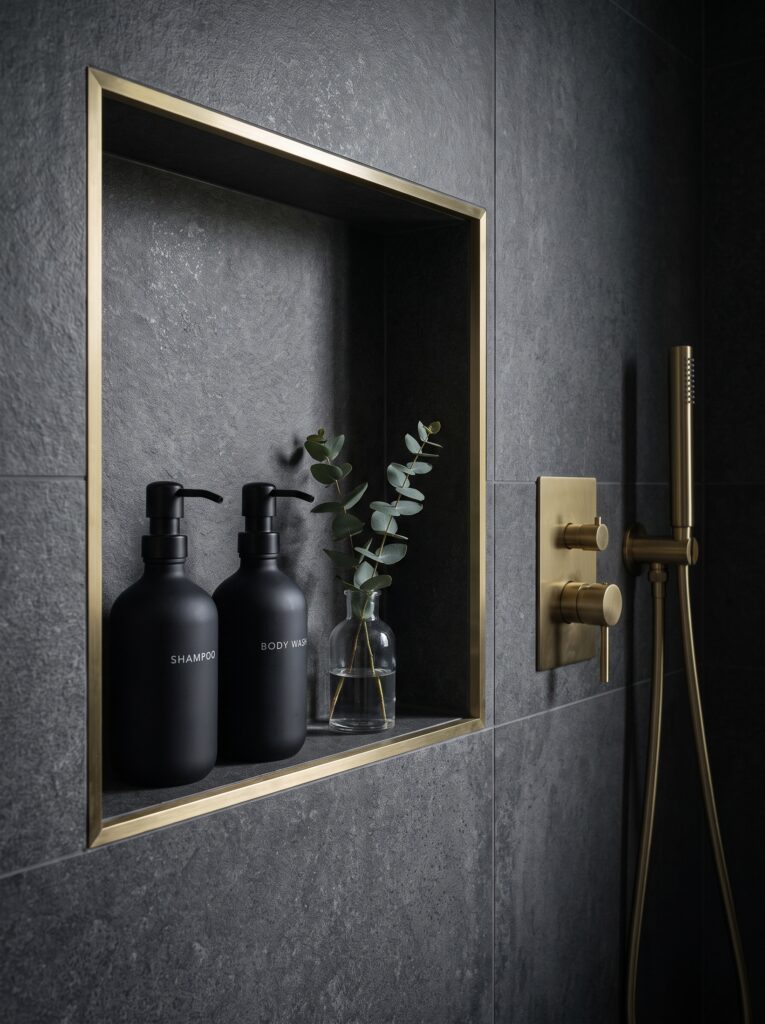
Dark tile swallows the edge of a niche. Thin metal edging fixes that: brushed brass or stainless steel around the opening frames the shelf and guards the corners from chips.
Bed the trim in thinset as the tile goes up, because it cannot be added later without cutting tile. Choose the same finish as the valve and shower arm, and pick brushed over polished, since brushed hides water spots.
Look at the finish on the metal. Unlacquered brass tarnishes in a humid shower, which some people like and others do not, while a lacquered or coated finish keeps its color. Leave a gap about the width of a grout line between metal and tile, and fill it with silicone matched to the grout.
Light a niche from inside when the shower is deep or dark
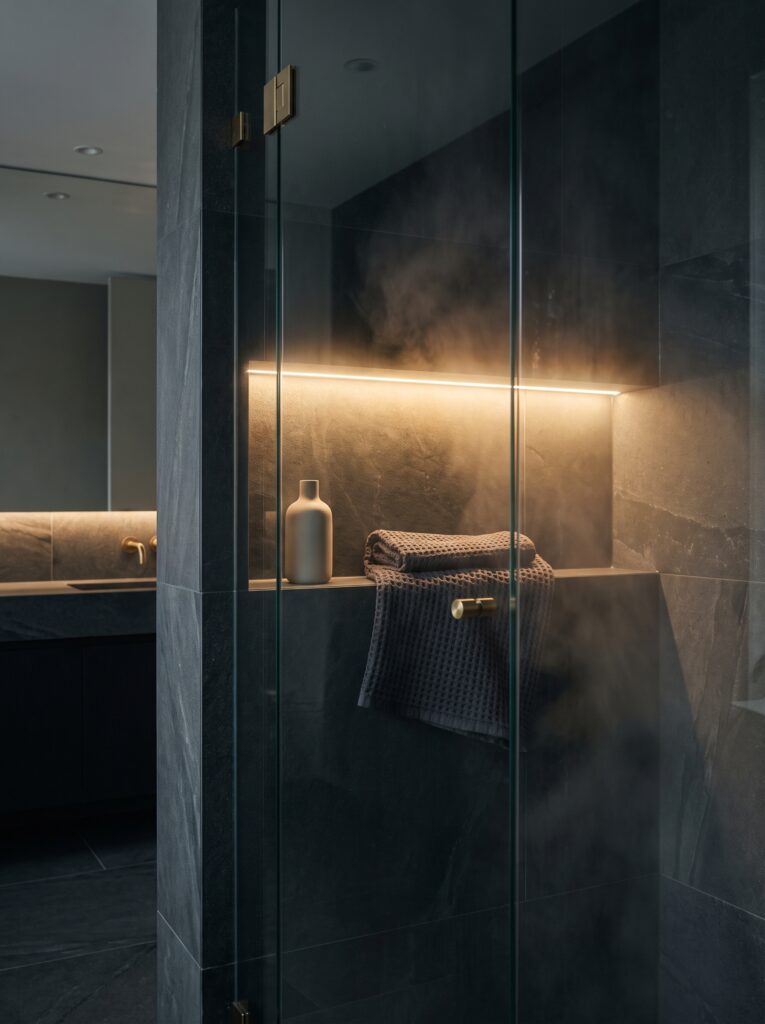
Anyone with a deep shower and no window needs light somewhere other than the ceiling. That job suits a niche: a thin strip along the top edge washes the shelf with warm light and doubles as a night-light.
Choose a strip rated IP65 or higher in warm white, around 3000 kelvin, and tuck it behind a small lip so the diodes never show. Low voltage still needs a driver, and the driver must live outside the wet zone, in a dry cabinet or the ceiling.
Plan the cable run before the tile goes up, since the wire has to reach a switch through the wall. Many strips ship without a power supply, so check what is in the box, and have an electrician check the circuit and its GFCI protection.
Shop it on Amazon: PAUTIX COB LED Strip Light 12V Warm White 3000K Waterproof IP65 18Ft CRI90+
Cut a tall niche beside the mirror for what you reach for twice a day
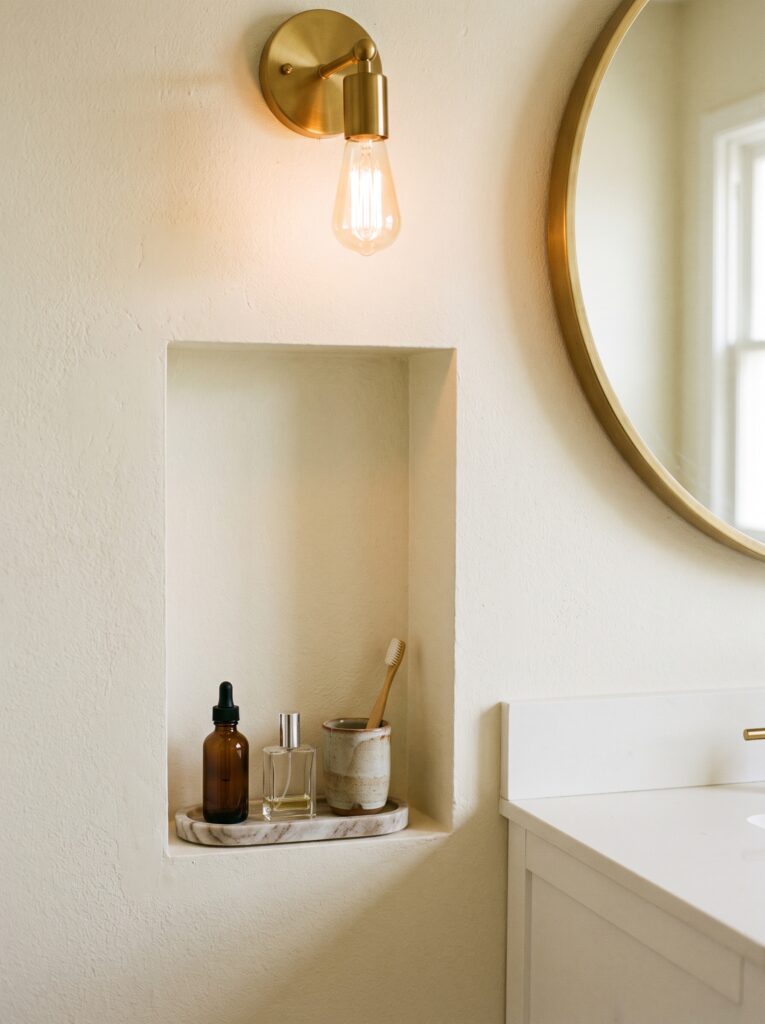
Cut a narrow niche beside the mirror if the counter fills up with the five things you touch every morning. Around 12 inches wide and 24 inches tall works, set at hand height. This kind of bathroom wall niche keeps the counter clear without a cabinet.
Place the shelf just above the faucet’s splash zone and below the top of the mirror, so the box looks tied to the mirror and not stuck on the wall. Put a marble tray on the shelf to catch drips and make tidy a habit.
Look for pipes first. Sink supply lines, vents and wiring tend to run in the walls around a vanity. Plaster or painted drywall suits a dry niche, so skip tile unless the wall is already tiled. With no door, this niche shows everything, so keep the contents to a tray and a cup.
Store rolled towels in an oak-lined niche beside a double vanity
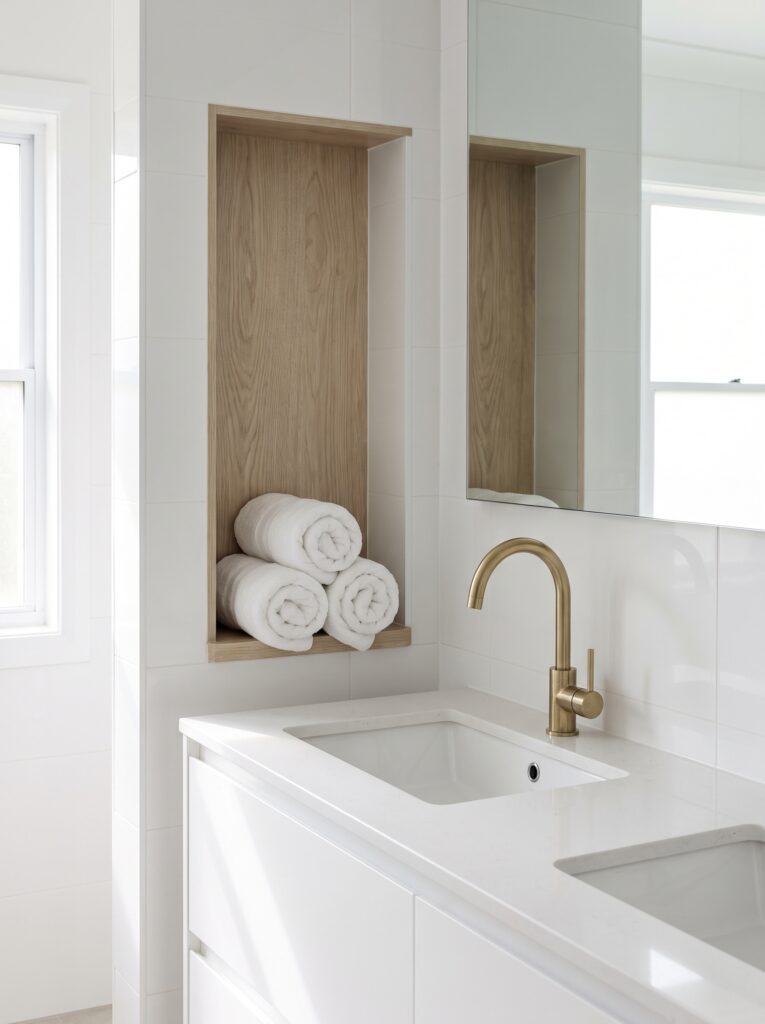
Hand towels belong in a niche when the vanity has no rail and no spare wall. Rolled loosely and stacked in a pyramid, three fit in a bay about 14 inches wide. Of the bathroom niche ideas for a dry wall, this is the easiest to start with.
Depth sets the limit. Most 2×4 walls give about 3 inches, so a hand towel works and a bath towel does not.
Wood on the back panel warms a white room and costs little, as long as it stays out of the spray. Seal oak or veneer on every edge with a water-based clear coat, and put the niche at the end of the vanity nearest the door, where a guest finds it without asking.
Run a long, shallow niche along the wall behind the vanity

Floating shelves are the usual answer behind a vanity. A long, shallow niche does the same job with nothing sticking out and nothing to knock off. Between 6 and 8 inches of height holds a few jars and a vase and leaves room for the mirror below.
Line it in glazed handmade tile, such as zellige, so splashes wipe off and the uneven surface catches light. Treat it as a wet zone anyway: waterproof the back and give the sill a slight tilt toward the room.
Past one stud bay you need a header, so price a carpenter before you fall in love with the length. Leave a few inches of plain wall between the niche and the mirror so the two read as separate pieces.
Squeeze a compact niche above a small wall-hung sink in a powder room
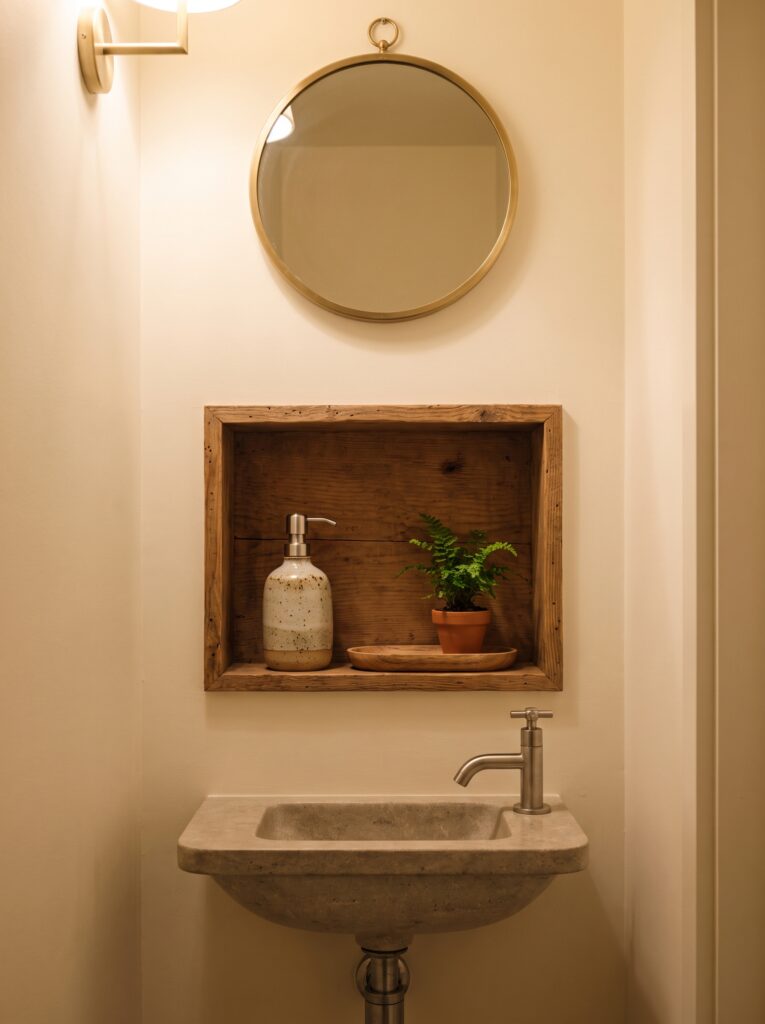
Powder rooms have no space for a medicine cabinet, so a compact niche above the sink takes its place. Roughly 12 by 14 inches is enough for a soap pump, a tray and a small plant.
Hang it a hand’s width above the tap, with a slim round mirror just above it. Water lines for a wall-hung sink run in the same wall, so find them before cutting. Usually a stud finder and a look inside the wall settle it.
Wood framing suits a warm, rustic room and gives a shallow recess a finished edge. Framed like this, it reads more as a box on the wall than a true recess, which works on a plaster or painted finish. Warm light from a nearby sconce makes the shelf glow at night.
Recess a shelf above the toilet to keep the walkway clear

A recessed shelf adds no depth, so the walkway stays clear and the wall keeps a clean line, while a hung shelf over the toilet invites a bumped head. Of the bathroom niche ideas here, this one frees the most room in a tiny WC.
Hang the bottom edge of the recessed shelf 8 to 12 inches above the tank so the lid still lifts for repairs, and center the niche on the bowl. Thin oak holds two rolled towels, a candle and a trailing plant.
Find out what hides behind the wall. The toilet wall often holds the vent or soil stack, and an exterior wall may be full of insulation. If either sits in the bay, move over a bay or surface-mount a shelf instead. Leaves and candles do not mix, so trim the plant back.
Set a toilet paper niche at seated reach, about 26 inches off the floor

Set a toilet paper niche about 26 inches off the floor and 8 to 12 inches in front of the bowl if you want an arm to reach it without twisting. Seated reach decides everything here.
Standard rolls are roughly 4.5 inches wide and 4 inches across, so an opening about 10 inches wide and 5 inches high holds one roll and a small dish for a spare. Recesses this small fit between two studs with room to spare.
Paint the inside a shade darker than the wall and the niche looks deliberate. Mind the door swing and the flush plate. Skip it on an outside wall, where the cold surface sweats and the paper goes limp.
Turn a spare bay beside the toilet into a floor-to-ceiling storage column
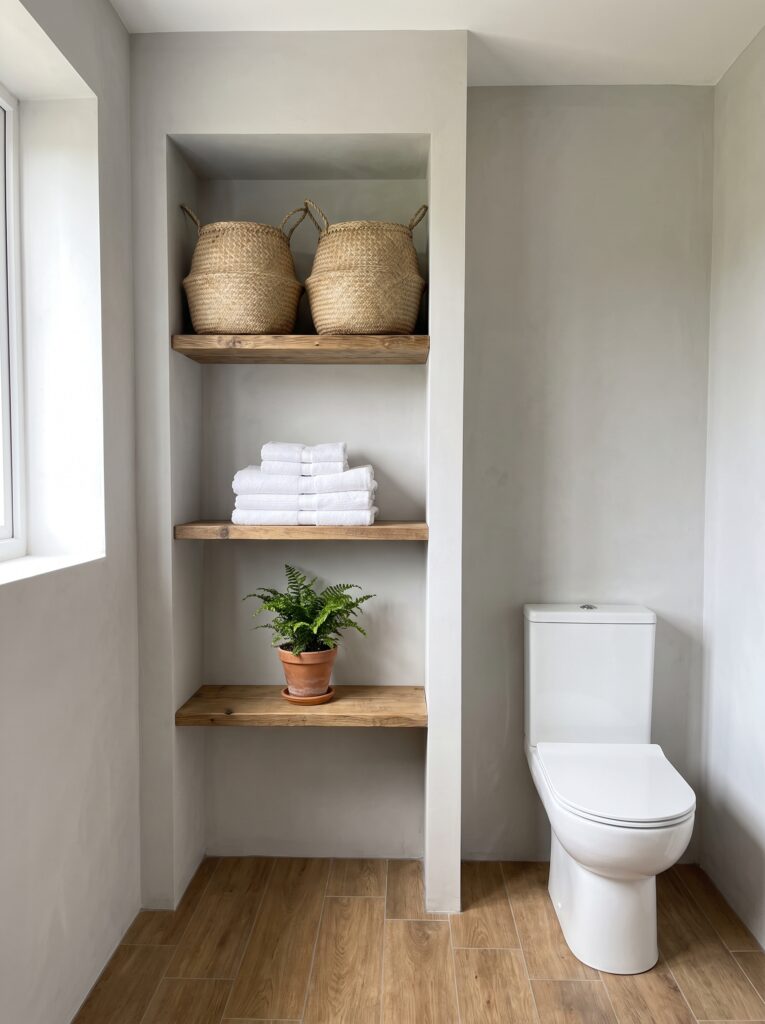
Narrow WCs often have a dead wall beside the bowl. There, a recessed column can replace a cabinet: three timber shelves hold baskets, towels and a plant, and the floor stays free.
This idea needs depth. Towels fit in 3.5 inches, but a basket wants 8 to 10. Look for a boxed-in chimney breast, a thick partition or a closet-depth alcove, or build a return wall to create the pocket.
Space the shelves about 12 inches apart and lift the lowest one a few inches off the floor so a mop can pass. Pale, matte plaster keeps the column calm. Combine it with the other bathroom niche ideas for the toilet wall and the whole corner becomes storage.
Give a freestanding tub a deep ledge at the end

Anyone with a freestanding tub has a bare wall behind its end, and a deep niche there holds candles and a glass of water. Rough stone handles drips and heat better than painted wood.
Place the ledge about 10 to 12 inches above the rim, near where an elbow rests when you sit back. Lower and a bottle meets your head, higher and you stand up to reach it.
Tile the recess in the same tile as the wall and let the ledge stand a little proud of the surface, so it catches water and gives the eye a place to land. Use a heavy holder on a wet ledge, and keep flames away from towels and curtains.
Run a long niche along the back wall of an alcove tub
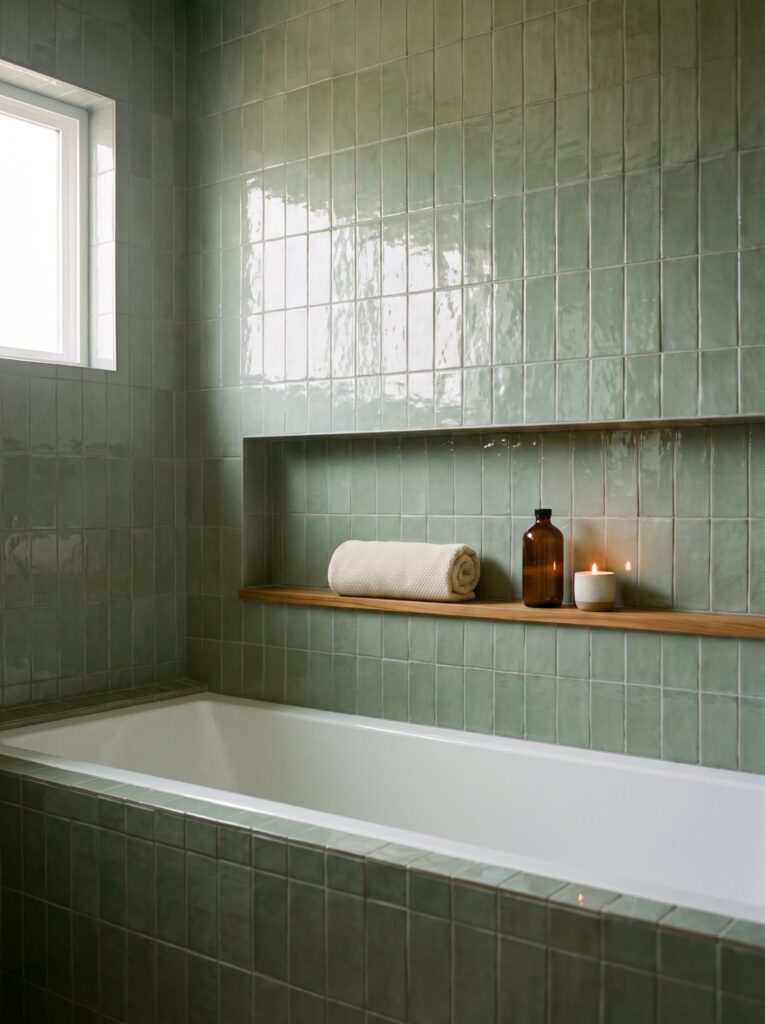
A long niche costs more to frame than a short one, yet it is the best use of an alcove tub’s back wall. At 6 to 8 inches tall and 12 to 16 inches above the rim, the strip holds a towel roll, a bottle and a candle without crowding the bather.
Thin teak warms green tile and handles damp well when sealed. Slope the shelf slightly toward the tub and oil it twice a year so it does not turn gray.
Run across more than one stud bay and you need a header and a waterproofed back wall. For ways to fit a tub and a separate shower in a tight room, see our small bathroom tub and shower ideas.
Follow the slope in an attic bathroom with a niche between the rafters
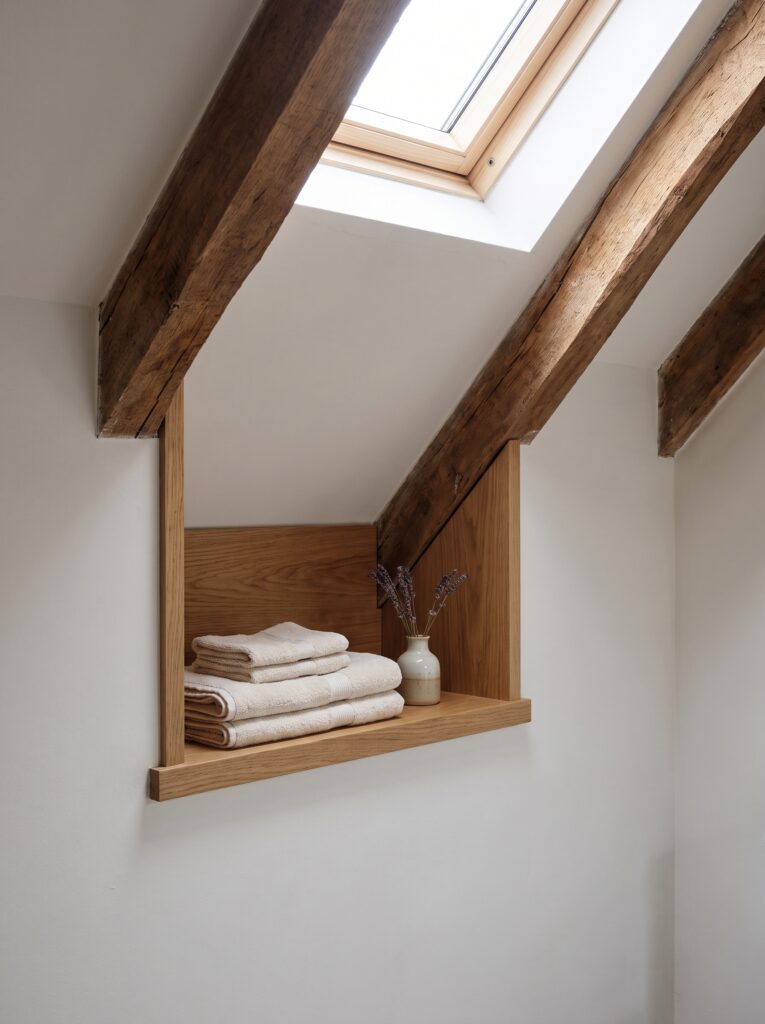
The sloped wall in an attic bathroom looks like dead space, yet a niche between the rafters turns it into storage. Rafters are often deeper than wall studs, so the recess has room for a real towel stack.
Rafter bays are full of insulation, so cutting into one can leave a cold spot. Ask the installer how to keep the insulation and vapor barrier unbroken, for example with a rigid board behind the back panel.
Put the shelf where you can stand upright to reach it, not under the lowest part of the slope. Cut a cardboard template first, tape it to the wall and check head height before the saw comes out. In a room this awkward, bathroom niche ideas like this one earn their keep.
Use the wall above the washing machine in a bathroom-laundry nook

Bathrooms that double as laundries have plenty of wall above the machine and nowhere to keep detergent. Right there, a tiled niche keeps the pods and a cloth within reach.
Measure the machine’s full height with the lid up, then start the niche at least 6 inches above that. Machines vibrate and run warm, so tile the recess and keep wood out of it.
Store pods in a closed jar with a lid, and place it high. Brightly colored pods look like candy to small children, and a recess at counter height is not out of their reach. Add a fern to soften the tile.
Treat an arched niche as a display spot in a dry powder room
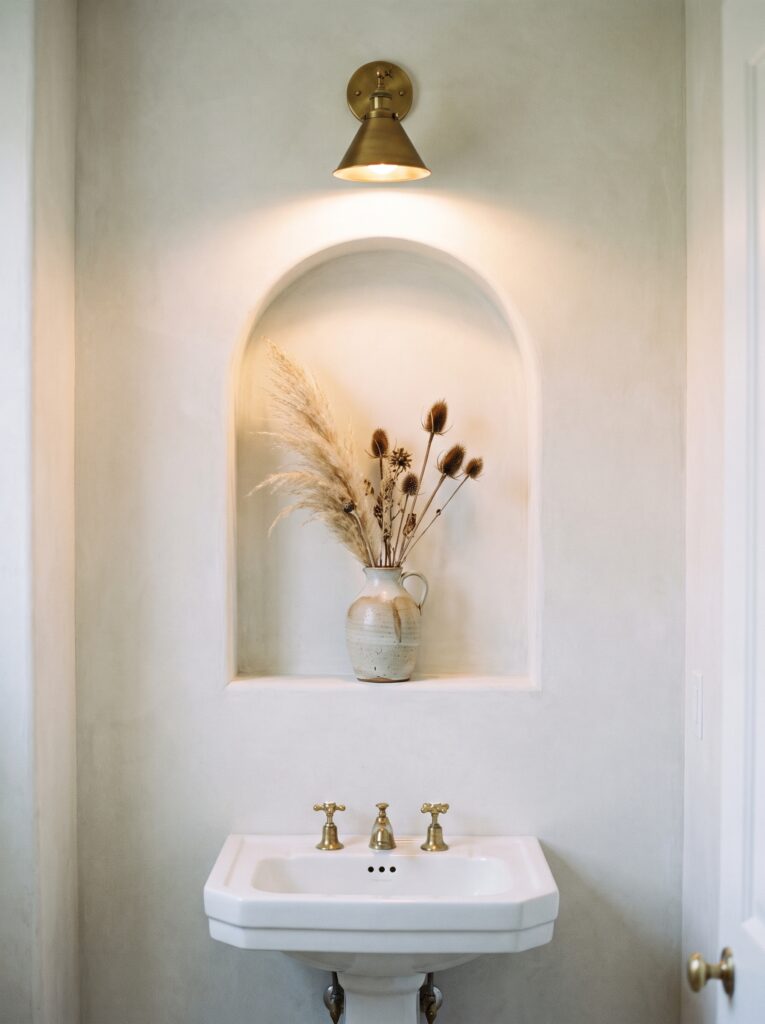
Arched niches are decoration more than storage, so put one in a dry powder room where nothing gets wet. Plaster or limewash wraps the curve smoothly, while tile does not, since every cut along an arch shows.
Frame the arch with a curved drywall former or a plaster mould, and set the base about at eye level. One tall vase of dried stems looks better than a crowd of small items.
Just above the arch, a small brass wall sconce throws a soft glow into the recess, and a pedestal sink below keeps the wall symmetrical. Measure the stud bay first: an arch usually grows from a standard rectangular bay, so its width stays under 14.5 inches.
Know what fails first in a wet niche
A dry niche almost never fails. Whichever of the shower niche ideas above you choose, a wet one fails in a predictable order, and the damage starts where nobody looks. Use this table when you plan the build or inspect an old shower.
| Weak spot | What goes wrong | How to prevent it |
|---|---|---|
| Inside corners | Tile and grout move a little, the grout cracks and water slips behind the tile. | Use flexible silicone in the inside corners, not grout. |
| Flat shelf | Water pools, leaves scale and grows mold. | Slope the shelf slightly toward the shower so water drains. |
| Waterproofing behind the tile | A screw or a cut that pierces the membrane lets water into the wall. | Use a prefab waterproof niche, or a membrane over cement board, and seal every fastener. |
| Exterior wall | A cold wall sweats and the back of the niche stays damp. | Pick an interior wall, or insulate behind the back panel. |
| Unsealed stone or wood | It stains, swells or turns gray. | Seal natural stone, use sealed teak or oak, and keep wood out of direct spray. |
| Light driver | Power supplies and moisture do not mix. | Keep the driver in a dry space and protect the circuit with a GFCI. |
Silicone is the one product on this list worth buying before you start, because the inside corners get sealed on day one and again every few years. Choose 100 percent silicone made for kitchens and baths.
Shop it on Amazon: Gorilla 100% Silicone Caulk, Kitchen & Bath Sealant, White, 10 oz Cartridge
Match bathroom niche ideas to the wall you actually have
Start with the wall, then the height, then the finish. Find the studs, check for pipes and mark the shelf where your hand lands. Tile, trim and light come last, because any finish looks good on a niche that fits and none does on one that sits in the spray.
One free wall is enough to begin. A single bay between the studs gives you 14.5 inches clear and about 3 inches of depth, plus a sloped shelf if it gets wet. Pick the wall you use most, and the right bathroom niche ideas will follow from there.
Save this pin to your bathroom storage board so the sizes stay close when you plan your niche.